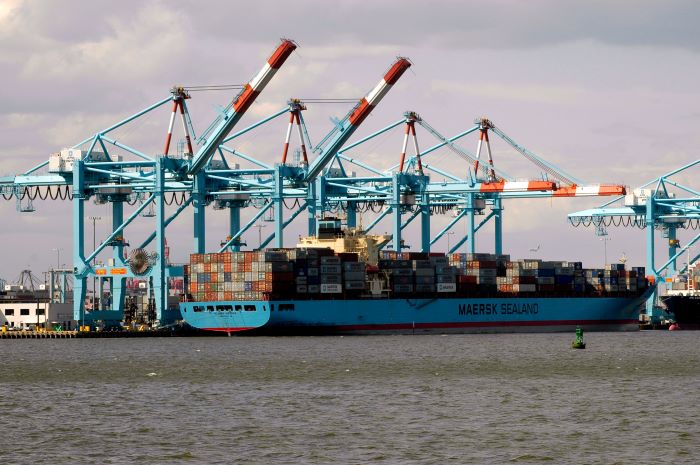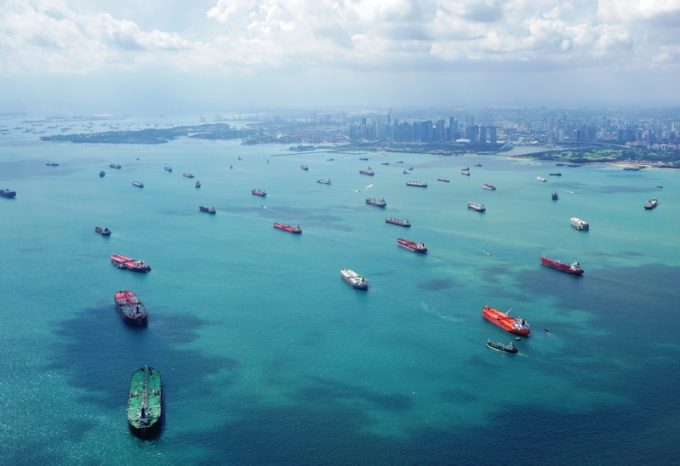
2M split may be on the horizon as tonnage-rich MSC prepares to go it alone

Since August 2020, MSC’s brokers have completed the acquisition of nearly 250 second-hand containerships to usurp 2M partner Maersk as the biggest ocean carrier in capacity terms, suggesting the alliance deal may not be renewed when it expires in April 2024.

According to Alphaliner data, the Geneva-headquartered carrier currently operates 709 vessels, for a capacity of 4.6m teu, compared with Maersk’s 711 ships and 4.3m teu.

However, MSC has a massive orderbook, of 1.75m teu (equivalent to the fleet of fifth-ranked carrier Hapag-Lloyd), while Maersk has just 374,000 teu of capacity on order.

S&P brokers told The Loadstar MSC was by far the “most aggressive” carrier during the peak of the second-hand tonnage boom, with only CMA CGM’s 85 or so acquisitions threatening its monopoly of the buyer’s market.

MSC said its aim was to be less dependent on the charter market for its growth aspirations and, following the vessel acquisitions, its owned tonnage was up to 45% of its fleet – albeit not as high as Maersk’s 60%, or Hapag-Lloyd’s 62%.

Moreover, the range of purchases by the carrier – from ULCVs down to feeder vessels of 2,500 teu and below – supports its strategy of taking control of more of its vessel operations rather than using slot-charter swaps or using commercial feeder operators for hub-and-spoke relays.

Many of MSC’s vessel purchases were made when daily charter hire rates were skyrocketing and owners were trying to lock-in deals at highly elevated rates for minimum two-year periods.

Consequently, the asset values of the ships soared and, although MSC secured second-hand tonnage at the start of its buying spree at bargain rates (before their values caught up with their earnings potential on the charter market), during the peak of the market they were obliged to pay top dollar to secure purchases.

For example, in September last year, MSC paid $68m for the 2005-built 5,042 teu CSL Santa Maria which, according to Vesselsvalue, is now worth just $30m.

And in November 2021, the carrier acquired one of Sea Consortium’s largest ships, the 2014-built 4,896 teu X-Press Jersey for an eyewatering $105m. The feeder specialist had acquired it two years earlier for $27m – and, according to Vesselsvalue, it is now worth $48m.

Nevertheless, the declines all represent paper losses, as MSC is unlikely to sell the ships it acquired during the S&P raids and, furthermore, does not have to answer to public shareholders. But the vast tonnage it acquired during the demand peak will now challenge its vessel management staff as they seek to redeploy surplus tonnage.

Furthermore, the delivery of the vast 1.75m teu of newbuild tonnage over the next few years will surely mean MSC will need to operate on a standalone basis after its 2M agreement with Maersk ends.

Indeed, a carrier contact from another alliance The Loadstar spoke to recently was convinced there would be, as he put it, “another game of musical chairs” among the lines, as the industry returns to a pre-pandemic, unit cost-driven ‘new normal’.

“You are only as good as your last month’s voyage results,” he said, “and VSA partners will all be looking to work with the lines that have less exposure to the downturn,” he added.

Source: Theloadstar
CMA CGM shores up finances ahead of downturn

Carrier has paid down its debt and invested in sectors adjacent to its shipping concerns. Warns that inflationary environment is clouding outlook for economic growth

CMA CGM expects to see a faster return to more normal freight rates in the fourth quarter and lower margins as geopolitical tensions reduce demand and increase its costs.

To mitigate this, the company has made significant inroads into its debt repayments while strengthening its shipping, ports, logistics and air freight capabilities.

The third quarter had already been shaped by “persistent geopolitical tensions” that had spurred higher inflation and dragged down consumer spending, which was already moving returning to higher services spending following the pandemic, the company said in its third-quarter results.

“The group was also impacted by the unstable geopolitical situation, specifically by the increase in unit bunker costs driven by higher energy prices,” CMA CGM said.

“On a like-for-like fuel consumption basis, these higher energy prices led to a year-over-year increase of $822m in bunker costs in the third quarter of 2022. The slowdown in shipping demand pushed down spot freight rates, particularly on main east-west routes.”

Group revenues were up 30% year on year to $19.9bn in the third quarter, but higher costs meant that operating earnings were down 4.6% from the previous quarter at $9.2bn. Net profit of $7.04bn fell by $563m when compared with the corresponding quarter of 2021.

But the group continued to strengthen its balance sheet. Net debt fell $5.3bn during the quarter to just $78m.

“The CMA CGM group once again recorded strong results in the third quarter,” said chief executive Rodolphe Saadé. “Over the past two years, we have significantly strengthened our financial structure and developed our business through the entire supply chain.”

Declining demand had prompted a return to “more normal” international trade flows and a significant reduction in freight rates, he added.

“In this new environment, we will continue to invest to strengthen our positioning in maritime shipping and logistics, accelerate our energy transition and provide our clients with even more efficient solutions.”

CMA CGM said that a number of acquisitions since the start of the year, including that of Gefco, which was approved by competition authorities during the third quarter, had helped strengthen its Ceva Logistics subsidiary.

Revenues in its logistics division were up by over 50% to $4.4bn from the corresponding quarter of 2021.

It had also boosted its terminals portfolio during the quarter, with the joint-venture tender win for the privatisation of the Nhava Sheva terminal in India, while its CMA CGM Air Cargo business had launched its Paris-Hong Kong service following the delivery of its first two new Boeing 777 freighters.

CMA CGM’s full-year results will likely set another record for the company, but the outlook for the following years is definitely less optimistic now.

“The health crisis and the shifting consumer spending patterns that drove strong demand during lockdowns have placed unprecedented strain on the world’s supply chains,” it said.

“These strains are tending to subside in the wake of recent developments in world trade, reflecting a much more uncertain economic environment, which is being deeply affected by geopolitical tensions.”

Source: The Lloyd’s List

2M suspends USEC service as rates, volumes drop near year’s end

Mediterranean Shipping Co. (MSC) and Maersk are halting a trans-Pacific US East Coast service after freight rates have been cut by more than half from the summer peak.

MSC and Maersk, partners in the 2M Alliance, said in separate statements this week that they will temporarily suspend their jointly run Liberty/TP23 service until further notice, adding that the suspension “will help alleviate port congestion.” The last sailing will be Nov. 23 from Indonesia. Liberty/TP23, which was introduced in March 2021, offers service from Indonesia, Vietnam and China to the US ports of Charleston, Savannah, and New York-New Jersey with a string of ships in the 8,000 TEU range.

The service suspension comes as rates into the US East Coast see further weakening as the end of 2022 nears. After dropping about 25 percent from October, average US East Coast freight rates now sit at $4,500 per FEU, with bookings done as low as $3,700, according to a trans-Pacific forwarder who asked not to be identified. That is down 55 percent from levels seen in June, the forwarder added.

“Ocean carriers are cutting rates and voiding sailings left, right, and center,” the source said.

With rates returning to pre-pandemic levels, ship supply to the US East Coast appears too high to offset rate declines. Sea-Intelligence Maritime Analysis said in its most recent Sunday Spotlight newsletter that November vessel capacity into the USEC is 19.5 percent above the level seen in November 2019, with December capacity running even higher at 37.7 percent above the same month in 2019.

Meanwhile, more service changes could be coming. MSC’s standalone Santana service, which was shifted from a West Coast to an East Coast service last year, is reportedly moving to every three weeks instead of a weekly service, according to a maritime shipping source who did not want to be identified. The service change could not be independently verified.

Some of the slowdown in container activity is showing up in the most recently available cargo figures for New York-New Jersey. Although New York-New Jersey has been the busiest US port for three consecutive months, the October volume of 792,548 TEU was essentially flat with the year-ago month. In a statement to JOC.com, the Port Authority of New York and New Jersey said it forecasts full-year 2022 volume to be about 9 million TEU, which would be up only nominally from 2021.

Source: JOC news

Carriers consider laying-up box ships as blanking fails to prop up rates

The idled containership fleet has breached the 1m teu capacity milestone – and is set to jump significantly higher as carriers prepare to temporarily suspend services rather than blank sailings

According to Alphaliner, as of 24 October, the number of inactive containerships either in drydock or seeking employment had reached 284, for a capacity of 1.2m teu, representing 4.6% of the global cellular fleet.

At the peak of demand in February, as carriers squeezed the charter market dry in pursuit of every serviceable vessel, the consultant recorded 154 ships, for a capacity of 442,000 teu, as inactive, many in drydock, representing just 1.8% of the global fleet, .

“Weakening cargo demand and declining freight rates have prompted carriers to cull some sailings and even temporarily suspend a number of services on major east-west tradelanes,” said Alphaliner.

The Loadstar has seen a big uptick in the number of blank sailing advisories from Asia-Europe and transpacific carriers in the past two weeks, with, for instance, some Asia-North Europe loops being voided in consecutive weeks.

However, Alphaliner does not count a ship as inactive unless it has been idle for more than 14 days – hence the proliferation of blank sailings does not figure in the capacity surplus analysis.

During Maersk’s Q3 earnings call yesterday, CEO Soren Skou reiterated the carrier’s strategy to “take out capacity to meet demand”, as the group recorded a year-on-year 7.6% decline in liftings against a downgraded market contraction for 2022 of 2%-4%.

The speed of the decline in exports from China has made the reactive blanking strategies of carriers ineffective at halting the erosion of spot and short-term rates, and more radical capacity reduction plans will be necessary to avoid a collapse in contract rates.

The Loadstar understands that some of the partners in the three east-west alliances are calling for their networks to adopt ‘winter programmes’ until mid-January, ahead of the Chinese New Year holiday.

“Nobody wants to be the first to cut out a loop and potentially lose market share,” one carrier contact told The Loadstar.

“There are hawks that want radical action and doves that want to carry on blanking, but everybody is suffering, that’s for sure, and getting concerned about next year,” he said.

Meanwhile, on the containership charter market, the increase in surplus open tonnage is putting more downward pressure on daily hire rates and materially reducing durations.

“Charter rates have continued to weaken for classic panamaxes of 4,000-5,300 teu in the past two weeks, with fixtures now typically concluded for periods of six months at a low-mid $20,000 a day,” said Alphaliner.

In fact, a broker source said this week, owners were now prepared to entertain much lower time-charter periods.

“We are talking with owners and charterers on some ships about extensions of 30 to 45 days, and for new fixtures three to four months,” he said.

Alphaliner noted that a daily hire rate of $20,000 for a panamax was “still decent by historical standards”, but was “ten times lower than what owners could achieve in early 2022”.

Source: THE LOADSTAR

Ocean carriers cut trans-Pac services as blank sailings fail to stem rate slide

Mediterranean Shipping Co. Maersk, and CMA CGM are cutting three trans-Pacific services in response to a sharp drop in import demand and spot ocean freight rates.

The service changes, which amount to one post-Panamax service and two Panamax services, are not major capacity cuts and are likely to do little to prop up freight rates. But the moves demonstrate how fast carriers are pulling capacity as rates approach or fall below break-even levels.

2M Alliance members MSC and Maersk said last week in separate statements that their jointly run Sequoia/TP3 post-Panamax service will be suspended because of “significantly reduced demand” in the trans-Pacific. The Sequoia/TP3 service offers about 14,000 TEU in weekly capacity from Ningbo and Shanghai to Los Angeles.

The service will be merged into 2M’s 13,600-TEU Jaguar/TP2 service that calls Long Beach, Maersk said. Sea-Intelligence Maritime Analysis said the last sailing on the Sequoia/TP3 service, which was introduced in 2016, will be on the MSC Savona, which is scheduled to arrive in Los Angeles on Oct. 5.

Maersk also said two standalone services into the US East and Gulf coasts would be merged into one. The TP28 service, which the carrier debuted in 2022, would be merged into the TP20 service, which debuted in 2021, as of the final sailing of the Merkur Archipelago from Vietnam’s Vung Tau port on Oct. 13.

Calls at the ports of Norfolk, Charleston, and Houston on both services will be dropped, with the TP20 only calling New York-New Jersey and Mobile, Maersk said. Origin ports on the TP20 will include Jakarta, Vung Tau, Shanghai, and Ningbo. Both services use Panamax-size vessels of about 5,000 TEU.

Maersk said that consolidating services would offer better transit times for shippers and increase berth availability. It added that “as soon as cargo demand recovers, we will bring capacity back through relaunching TP3, TP28, upgrading of other services, and/or sailing extra-loaders.”

Separately, CMA CGM ended its Golden Gate Bridge service, which called the ports of Oakland and Seattle, according to Sea-Intelligence. The last sailing of the service, which offered about 8,500 TEU in weekly capacity, was on the CMA CGM Medea, which is currently berthed at Seattle.

Outside of the major ocean carriers, smaller lines have also been pulling ships from the trans-Pacific. Independent carrier CULines has ended a trans-Pacific express service that it jointly ran with Shanghai Jin Jiang Shipping since July 2021, after closing its TPN service in August, maritime consultancy Alphaliner said in a report. CULines has a second trans-Pacific express service that it still operates, Alphaliner said.

October capacity unchanged from a year ago

The service changes follow a series of blank sailings that carriers have laid out for October in a bid to cut capacity, but that have failed to halt a slide in spot freight rates. Sea-Intelligence said that ocean carriers as of last Friday planned to blank 48 planned voyages during the month. In comparison, carriers had only planned to blank 12 October voyages six weeks earlier, Sea-Intelligence said.

Those blank sailings are doing little to prop up spot ocean freight rates, which have slid 10 percent weekly since mid-August, according to a research report from investment bank Jeffries. Spot rates into the US West Coast are now hovering at $2,400 per FEU, close to the level where ships are only seeing break-even results.

Sea-Intelligence said the service cuts have mostly affected the surge capacity that was brought into the trans-Pacific amid high spot rates. Even with the service cuts, carriers will still have 1.56 million TEU of vessel space deployed in the trans-Pacific during October, essentially flat with totals from last year.

“With the blank sailings announced thus far, the carriers have merely reduced capacity down to the same level as we saw last year,” Sea-Intelligence said. “The relevant issue is the magnitude of capacity operated in the trade, and blank sailings might well be counteracted by larger vessels, new services, and possibly extra-loaders.”

Source: JOC news