TPM23: Ocean Alliance could be next domino to fall after 2M: analyst

The Ocean Alliance could be the next major ship-sharing agreement to sink, possibly sometime this year, as its members chart different strategies and look to gain market share during the current “rate war” among ocean carriers, industry analyst Lars Jensen said Wednesday.

Speaking at the Journal of Commerce’s TPM23 conference in Long Beach, Jensen said ocean carriers face a market similar to the one seen during the 2008-09 financial crisis when a massive buildup of ship capacity came up against weakening demand.

While demand could recover should inventory destocking occur through the spring and US consumers keep spending, Jensen said the industry faces other headwinds, such as political scrutiny over the alliances’ anti-trust exemptions and higher costs from stringent carbon emissions rules. The result, he added, is that carriers are thinking more about “who do I want to spend the next few years with” as has happened with the pending dissolution of the 2M Alliance.

“It’s a normal downcycle we are going through, then there are some elements that are slightly different,” Jensen, CEO and partner of Vespucci Maritime and a Journal of Commerce analyst, said. “Rates are coming down faster than they went up. It is a rate war.”

“2M is the just the first domino to fall,” he added. “When it was formed, you had two parties with the same strategic interest. Now you have two parties whose interests are no longer aligned.”

Cosco has second-largest orderbook

Jensen, one of the first to predict the breakup of 2M, said at the time that Mediterranean Shipping Co.’s  large orderbook of new vessels allowed it to operate on a standalone basis across many trade lanes, without having to share space on Maersk vessels. A similar dynamic could play out with Ocean Alliance member Cosco Shipping, which has the second-largest orderbook of new ships behind MSC, Jensen said.

Cosco faces renewed urgency to fill those new vessels due to a loss of market share over the last two years that Jensen attributed to China’s COVID-19 lockdowns and the resulting shipping delays out of the country.

“I’m going to expect Cosco to be very aggressively going after market share,” Jensen said. “Who’s the easiest prey to go after? That would be customers already on your ships through your alliance partners.”

“That’s not going to sit well with [Ocean Alliance members] CMA CGM and Evergreen Marine,” Jensen said, adding that Taiwan’s Evergreen faces the additional tension of working with a China-based carrier.

Indeed, Cosco recently upsized capacity on an Asia to US Gulf service it operates on a standalone basis, but that is also offered through the Ocean Alliance. The new capacity on that Cosco service now evenly matches one that CMA CGM also offers on a standalone basis to the US Gulf.

Likewise, CMA CGM is pursuing a strategy not similar to Maersk’s, “but somewhere in the same direction,” Jensen said.

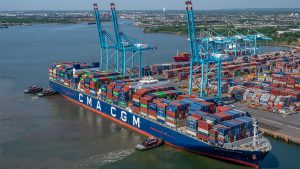
As does Maersk, CMA CGM looks to own US terminal assets after striking acquisition deals on the US East and West coasts. CMA CGM’s North American President Peter Levesque said during his appearance at TPM23 Tuesday that owning terminals allows the carrier to “determine our own destiny.”

The Ocean Alliance’s agreement is set to expire in 2027, Jensen said, but he noted the current market uncertainty and the pending breakup of 2M could hasten a decision not to renew the Ocean Alliance in 2023.

Regarding THE Alliance, Jensen said “it’s slightly stable” due to similar operating strategies and less aggressive ship ordering. However, he said the changing carrier landscape may make THE Alliance’s two biggest members, Hapag-Lloyd and Ocean Network Express (ONE), reconsider their partnerships. Jensen even posited that the two could decide to merge as a way to take on ever-larger ocean carriers.

“This is not the first time we’ve seen alliances break up and get re-formed,” he said. “The challenge is once everyone’s dance card is open, Hapag and ONE will have some thinking to do about who do we actually want to be lined up with now that everything is shifting.”

Source:

Angell, M. (2023, March 1). TPM23: Ocean Alliance could be next domino to fall after 2M: Analyst. Retrieved March 9, 2023, from https://www.joc.com/article/tpm23-ocean-alliance-could-be-next-domino-fall-after-2m-analyst_20230301.html
Hong Kong liner rapidly builds up links with Russia

Yesterday, Splash detailed the main container names operating in and out of Russia, with a slew of new capacity entering the region as many global carriers have exited in the wake of war with Ukraine.

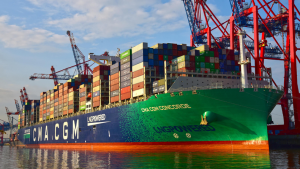
One of the most ambitious new players is Hong Kong-registered OVP Shipping, formed in late 2020. OVP launched a first liner service linking China with Vladivostok in the middle of last year. It has seen launched a China – Novorossiysk service in mid-November, while, according to Alphaliner, its first China to St Petersburg service is underway now, and will become a fortnightly offering from next month when more chartered-in tonnage joins the OVP fleet. Alphaliner lists the Hong Kong carrier in 61st spot in its top 100 liner rankings.

While much has been written about the importance of Dubai to Russian-linked shipping operations in the wake of sanctions following the invasion of Ukraine, another important shipping enabler for Moscow has been the maritime hub of Hong Kong.

Box rates in and out of Russia remain “highly elevated” according to Linerlytica.

“New capacity continues to flow into the Russian trade with the latest newcomers Safetrans, Torgmoll/New New, Reel Shipping and OVP Shipping adding ships to the trade as congestion at the Russian Far East gateways of Vladivostok and Vostochny have generated demand for new services from Asia to the Black Sea and Baltic gateways of Novorossiysk and St Petersburg,” analysts at Linerlyica noted in its most recent weekly report describing the Russian freight scene as “thriving”.

Source:

Chambers, S. (2023, March 1). Hong Kong liner rapidly builds up links with Russia. Splash247. Retrieved March 2, 2023, from https://splash247.com/hong-kong-liner-rapidly-builds-up-links-with-russia/

MSC Services Expansion

MSC expanding standalone services to grow its network outside 2M

THE Mediterranean Shipping Company (MSC) is focused on expanding its standalone services outside the 2M Alliance, reports London’s Loadstar.

The carrier has tapped into the Indian export market to the US with an expansion of its Sentosa loop, which offers a connection of Indian ports of Mundra and Nhava Sheva to Long Beach and Oakland.

MSC stated the enhanced service will deploy twelve 11,500 to 16,650 TEU vessels, instead of the current seven.

MSC also announced it was relaunching its Dragon service, from Asia to the Mediterranean. It said the Dragon service would connect Asia to Israel, Italy, and the south of France, and “offer the fastest transit times into the Mediterranean”.

The carrier has not nominated vessels that will operate the revised loop, which is to start from Shanghai on March 15 and will include direct calls at Ashdod and Naples.

Vespucci Maritime consultant CEO Lars Jensen stated it appeared to be “the first divergence” between the 2M carriers since the announcement last month of the parting in January 2025.

“I expect to see continued divergence and potentially an earlier formal breakup, but for now the timing is 2025,” said Mr Jensen.

Source: Hong Kong Shipping Gazette

MSC TransPacific services update Amberjack & Emerald

Starting in May, the MSC Amberjack service will operate on the following rotation, connecting south and central China and South Korea to the U.S. east coast:

Qingdao – Ningbo – Shanghai – Busan – Panama Canal – Kingston – Charleston – Savannah – Norfolk – Kingston – Panama Canal – Busan – Qingdao

Calls at Jacksonville and Wilmington will be removed and switched to the Emerald service (see below), starting with the vessel MOUNT EVEREST, ETA Qingdao on 6 May.

Also from May, the Emerald service will follow a new rotation, removing Norfolk, but adding Jacksonville and Wilmington to compensate for the removal of these ports on the Amberjack service: Xiamen – Yantian – Shanghai – Busan – Panama – Canal – Cristobal – Savannah – Jacksonville – Wilmington – New York – Suez Canal

Source: AJOT.com

TS Lines closes Vancouver service and repurposes fleet for intra-Asia

Taiwanese intra-Asia carrier TS Lines has sold three containerships as it refocuses resources on its core intra-Asia services.

Last week, Greek broker Intermodal reported that TS Lines had sold 2019-built 1,096 teu TS Shanghai and TS Yokohama and the 2006-built 962 teu TS Moji to a European buyer for $40m.

A source at TS Lines confirmed the sale and that it would not be chartering the ships back.

The buyer has been identified as German tonnage provider HR Schiffahrt, and brokers said there was talk that TS Lines had also put the 2007-built 2,553 teu TS Manila up for sale.

The Loadstar has reported that TS Lines would be axing its Asia-Europe and Asia-US east coast services, jointly operated with China United Lines and SeaLead Shipping, respectively.

Today, the TS Lines source revealed it had also permanently called time on its North West 1 service that connected China with Vancouver, Canada, which began in October 2021 and ceased in November last year.

The source said: “As we’re taking delivery of a dozen newbuildings this year and considering that asset values have been falling, we decided to sell a few ships to adjust our fleet size.”

The source however, declined to confirm the sale of TS Manila, bought for $6m in August 2020 and valued at around $14m.

Like many other regional carriers, TS Lines entered long-haul tradelanes when freight rates hit historical highs, only to depart these routes after market conditions normalised. Chairman Chen Te-sheng recently said the next two years were expected to be challenging, although TS Lines still hoped to complete its Hong Kong Stock Exchange listing this year.

TS Lines has 1,100, 2,900 and 7,000 teu ships being delivered from Fujian Mawei Shipbuilding and Shanghai Waigaoqiao Shipbuilding this year. The 1,100 teu vessels are designed for China-Japan routes; the 2,900s are intended for East Asia-Australia/New Zealand services, while the 7,000 teu ships are expected to be assigned to services connecting East Asia with India and the Persian Gulf.

A broker suggested TS Lines might be “cashing out of older ships” as asset values plummeted in tandem with weaker market conditions. TS Moji had a valuation of $9m when TS Lines bought the ship in May 2021, but was reportedly sold to HR Schiffahrt for $7m.

TS Shanghai and TS Yokohama were ordered from Kyokuyo for $17m each in 2018, their value peaked at around $51m each in October 2021, but had plummeted to $16.5m at the time of the recent sale.

Source: theloadstar

Taiwan, M. L. in. (2023, February 13). TS lines closes Vancouver Service and repurposes fleet for intra-asia. The Loadstar. Retrieved February 14, 2023, from https://theloadstar.com/ts-lines-closes-vancouver-service-and-repurposes-fleet-for-intra-asia/

Doomsday clock’ ticking down as shipping lines lose control of the market

Ocean carrier voyage results could soon start appearing in red ink as freight rates flirt with breakeven levels on major east-west tradelanes.

Although the container spot rate crash appears to have bottomed-out in the past few weeks, annual contract rates are also now in sharp decline.

According to Drewry’s latest Container Insight report, carriers have “lost control of the container market” by failing to manage capacity and will “act on capacity only when they are forced to do so by heavy losses”.

The maritime research consultant claimed “a deep-seated instinct to preserve volumes has kicked in”, with carriers discounting rates heavily to secure short-term bookings.

It said that, until a few months ago it was fairly confident the lines would take “the necessary steps” to reduce capacity before the market got out of control, but now admits it was wrong and that it gave carriers “too much credit by thinking they would proactively manage capacity”.

Drewry said that, after talking to various stakeholders, it had been convinced a structural change had occurred in the liner industry and that “consolidation and more efficient carrier alliances would help change old habits”.

“That was wrong too,” said Drewry.

“The price paid for reverting to type is that contract quotations are now being set at a fraction of the levels of a year ago,” it said, adding it had “vastly downgraded freight rates and profitability forecasts” showing that, from Asia to North Europe and Asia to the US west coast, revenues were running at close to round-voyage slot costs.

Drewry described the scenario on the key tradelanes as “akin to a doomsday clock, counting down the time before carriers incur losses”.

Meanwhile, anecdotal reports to The Loadstar suggest carriers are “waiting for more visibility” after the Chinese New Year on 22 January before taking more radical action, such as suspending more network loops, but that they remain optimistic there will be an inventory restocking rebound in demand post CNY.

Indeed, an investor note from HSBC Global Research say post-CNY it expects “capacity discipline to keep contract and spot rates above breakeven”.

It adds: “China’s removal of Covid-19 restrictions and potential restocking demand could drive a recovery in shipments post-CNY and lift rates in the near term.”

Nevertheless, it believes there are downside risks, from inflation, on consumer spending that could dampen demand and “likely trigger another round of price competition”.

Drewry said it still thought there would be a “major capacity reconstruction” in the liner industry, “but it will be carried out to prevent freight rates from falling below breakeven, not to gently ease profit margins above historical averages”.

It concluded: “While cargo demand has contracted at a faster pace than many anticipated, and some action has been taken to address overcapacity, it has been largely too little, too late. Instead, carriers have lost control of capacity and reverted to price competition to retain volumes.”

Source:

Wackett, M. (2023, January 5). ‘Doomsday clock’ ticking down as shipping lines lose control of the market. The Loadstar. Retrieved January 10, 2023, from https://theloadstar.com/doomsday-clock-ticking-down-as-shipping-lines-lose-control-of-the-market/

Carriers are facing the ‘quiet before the storm’ for contract rates

A year ago, shippers were desperate to agree annual contract deals with ocean carriers  to secure their supply chains, and were prepared to do, and pay, ‘whatever it took’.

And carriers were holding ‘beauty contests’ to determine the most attractive large-volume BCOs to be included in their exclusive customer portfolios.

But 12 months on, the container liner shipping market has seen an 180-degree turn – world economies are being racked by huge hikes in energy costs, high inflation and spiralling interest rates, causing a pause in discretionary spending by consumers and a sharp downturn in demand.

Since the ‘non-event’ peak season in July and August this year – traditionally when carriers garner the most revenue from pre-holiday season orders – container spot rates from Asia have collapsed, along with demand, as carriers have been obliged to heavily discount their short-term rates.

Moreover, the margin between the weekly decreasing spot rates and the elevated annual contract rates became so great that one by one carriers buckled and granted their core contract customers dispensation to book cargo via their spot platforms.

Meanwhile, despite an aggressive blanking strategy by the shipping lines, including ‘slidings’ and sending vessels on the backhaul from North Europe back to Asia via the longer Cape of Good Hope route, carriers were unable to turn the fall in spot rates back to pre-pandemic levels, or below on some tradelanes.

Nevertheless, there is evidence over the past couple of weeks that the spot rate bottom may have been reached on the key Asia-North Europe and Asia to US west coast routes.

For instance, this week’s Asia-North Europe component of Drewry’s WCI index actually recorded a slight uptick, to $1,706 per 40ft.

And there was another sign this week that the rot had stopped on the route, with The Loadstar’s inbox receiving very few ‘spam’ e-mail quotes from China-based forwarding agents offering “prompt space with all carriers at $1,000 a box”.

And on the transpacific Asia to US west coast route, spot rates also seem to have plateaued, with the week’s Xeneta XSI reading ticking up 1.3%, to $1,529 per 40ft.

By Christmas on the Asia to Europe tradelane, the contract season is normally well under way, but judging by the feedback from some of The Loadstar’s forwarding and NVOCC contacts, there is an understandable reluctance by both shippers and carriers to start negotiations until they see how the market plays out after the Chinese New Year, which commences on 22 January.

Xeneta’s long-term contract market report for December saw its index of crowd-sourced contract rates flat on the month, albeit that few deals were completed.

But Xeneta’s CEO Patrik Berglund believes we are really just seeing “the quiet before the storm”, in terms of contract rate reductions. He said: “The narrative for the beginning of 2023 looks to be very different.

“All indicators point towards considerable rate drops from today’s levels, with several of the major Far East trades pointing towards new long-term contracts that are much closer to the current far lower spot rate benchmarks.”

Source:

Wackett, M. (2022, December 23). Carriers are facing the ‘quiet before the storm’ for contract rates. The Loadstar. Retrieved December 28, 2022, from https://theloadstar.com/carriers-are-facing-the-quiet-before-the-storm-for-contract-rates/

Ocean Network Express acquires terminals in US West Coast

OCEAN NETWORK Express has agreed to acquire a 51% stake in two terminal companies held by its Japanese parents.

Both TraPac LLC and Yusen Terminals LLC—owned by Mitsui OSK Lines and Nippon Yusen Kabushiki Kaisha, respectively—provide container terminal services in Los Angeles, with the YTL also operating in Oakland in the US west coast.

A definite agreement has been signed between the parties, while the deal remains pending regulator’s approval.

The acquisitions are part of the continued efforts by MOL and NYK to integrate their container shipping businesses into ONE.

“The recent disruptions to the supply chain due to the [coronavirus pandemic] have highlighted the importance container terminals play in keeping global trade flowing,” ONE said in a statement.

“The newly acquired container terminals will safeguard ONE’s access to terminal capacity in key and strategic gateways, support its growth ambitions and enhance its service offerings to customers.”

Source: The Lloyds’ List

CMA CGM expands onshore power use in Shanghai

CMA CGM has signed a long-term agreement with Shanghai International Port Group to expand the use of onshore power supply to cut emissions.

The approach, dubbed as “cold ironing”, allows ships to shut down auxiliary engines while at berth, hence eliminating emissions — including carbon dioxide, sulphur oxide, particulate matter and nitrogen oxide — and reducing noise pollution.

“From today, all fully-fitted CMA CGM containerships calling at the port of Shanghai will systematically use the onshore power connection,” said the French carrier in a statement on Thursday.

Earlier, the two companies completed a technical trial of the facilities at the Yangshan Deepwater port in Shanghai in late November, which involved a large containership, the 13,982 teu APL Fullerton (IMO: 9632026), among several other vessels.

CMA CGM said its newbuildings and the most recent vessels to enter its fleet were equipped with the technology to use cold ironing. Meanwhile, “an extensive retrofitting programme” is being conducted to extend the facilities to other ships.

The company expects 13 of its vessels to connect to onshore power when calling at the port of Shanghai by the end of this year and a further 50 by mid-2023.

“CMA CGM is steadfastly committed to installing more environmentally responsible solutions on board our vessels, the group supports cold ironing and we will continue to equip our fleet accordingly,” said CMA CGM’s China chief executive Ludovic Renou.

CMA CGM and SIPG have also collaborated on liquefied natural gas bunkering at the port.

In March this year, Hai Gang Wei Lai (IMO: 9886756), a 20,000 cu m LNG bunker barge deployed by the Chinese port operator, fuelled 15,000 teu CMA CGM Symi (IMO: 9867839) via a ship-to-ship transfer.

“We firmly believe that enhanced co-operation between ports and shipping companies will accelerate the journey of decarbonisation,” said SIPG general manager of engineering Wenbin Luo.

Source: The Lloyd’s List

CMA CGM to acquire two terminals in the growing port of New York and New Jersey

CMA CGM has agreed to buy two “flagship” terminals at the port of New York and New Jersey from Global Container Terminals.

The French liner giant will take control of GCT Bayonne and GCT New York, which have a combined capacity of 2m teu per year.

“While Bayonne terminal has the highest level of automation, the fastest truck turn time in the harbor, the closest ocean access, and an ability to service vessels of up to 18,000 teu, New York Terminal benefits from a highly productive labor force in the Port of New York and New Jersey and connects the dense New York hinterland with direct trucking and intermodal access,” the company said.

The group said it had significant development plans for the terminals, including expanding its combined capacity by up to 80%. The increase will serve the company as it seeks to further grow its shipping line calls in the New York area.

The move is part of CMA CGM’s strategy to develop its terminal business and increase its presence in the US, having also bought back Fenix Marine Services’ terminal in the port of Los Angeles in January.

Overall, the group has investments in 52 port terminals in 28 countries through CMA Terminals and its Terminal Link joint venture, including five terminals in the US.

“The acquisition of GCT Bayonne and GCT New York terminals is a strategic investment for the CMA CGM Group. It reinforces the services we provide to U.S. customers and their supply chain efficiency. It further consolidates our positions in the United States, a major market among the fastest-growing worldwide, and will help us continue our development,” said chairman and chief executive Rodolphe Saadé.

The announcement comes as the port of New York and New Jersey is on track for its strongest year on record, having grown 18.5% in 2021 from the previous year, and 9.4% in the year to date. It has taken the lead as the busiest port in the US in the past three months, overcoming both of its west coast competitors at Los Angeles and Long Beach.

A significant chunk of the port’s growth this year is due to cargo diversions from the west coast, where port congestion and a protracted labour dispute have led disruption-wary shippers to send their freight eastwards. It remains to be seen how much of the diverted cargo will remain in the port of New York and New Jersey and other east and gulf coast ports after the labour situation on the west coast is resolved.

After handling record levels of cargo for 26 straight months, the port of New York and New Jersey showed the first signs of slowing down in October amid a broader trend of declining imports to the US. Throughput declined by 0.5% year-on-year, while imports were down 4%, and the vessel backlog at its anchor has shrunk to average between two and three ships. Still, October’s throughput was 18.9% higher than in 2019, and while spot rates on the Shanghai-New York route were down 65% this year, they were up 12% on the New York-Rotterdam route and 17% on the Rotterdam-New York route, according to Drewry.

The acquisitions, announced late Tuesday, are subject to regulatory approvals.

Source: The Lloyd’s List

Port of Savannah to increase containership handling capacity

THE board of Georgia Ports Authority has approved a plan to renovate and realign the docks in the port of Savannah’s ocean terminal to better accommodate the port’s growing box volumes.

The terminal handles breakbulk and containers, and the transformation is part of a broader effort to turn it into a container-only operation.

The depot will continue containership and breakbulk operations during construction, said GPA chief operating officer Ed McCarthy.

The docks will be rebuilt to provide an additional 2,800 linear feet of berth space that could handle two 16,000 teu containerships simultaneously, which will be served by new ship-to-shore cranes.

The GPA plans to shift most breakbulk operations to the port of Brunswick, where construction has started on 360,00 sq ft of dockside warehousing, according to executive director Griff Lynch.

“Completion of this project will improve our flexibility and allow Georgia Ports to optimise cargo movement, supporting our customers in delivering goods to market efficiently,” he added.

Overall, the project “will bring expanded gate facilities and paving to allow for 1.5m twenty-foot equivalent units of annual capacity,” according to the statement.

The port of Savannah has grown tremendously over the past two years during the pandemic-induced import boom. It handled almost 20% more cargo in 2021 than in 2020, and has grown an additional 7.2% so far this year compared with the year earlier period. Volumes were further buoyed this year by the labour dispute on the west coast that led many disruption-wary shippers to divert their cargo eastwards.

The port logged its busiest month on record in August, handling 575,513 teu, while October (552,800 teu) and July (530,800 teu) were its second and third busiest months, respectively.

The increase in volumes has created a vessel backlog that hovered over 35 boxships during summer, and while it has come down significantly from those highs, Lloyd’s List Intelligence data shows that there were still 23 ships at anchor as of Monday afternoon, the most of any US port.

Port officials expect that volumes will ease as the year ends, and Mr Lynch said that the opening of a new container berth at the port’s Garden City terminal next summer coupled with the declining volumes will help expedite vessel service.

“While we are beginning to see an anticipated market correction, it is important that GPA move forward with projects like the ocean terminal enhancements to accommodate business growth,” said GPA board chairman Joel Wooten. “Through continued infrastructure improvement, we will ensure the free flow of commerce, and our ability to meet expanding customer demand.”

The GPA board has approved $1.17bn in infrastructure investments over the past year, according to the statement.

Source: The Lloyd’s List