Blank sailing
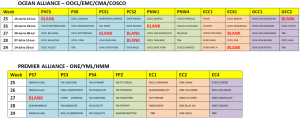
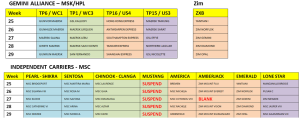

Blank sailing
One month after a four-day strike by customs workers at Mexico’s Port of Manzanillo, cargo operations at the country’s busiest container gateway have yet to show any noticeable improvement, stakeholders say.
Despite ongoing efforts to clear out logjams triggered by the brief strike, berth waiting times for arriving vessels at Manzanillo have risen to their highest this year — 1.8 days, according to data from maritime visibility provider Vizion and data and analytics company Dun & Bradstreet.
Terminal operators had previously said they expected the congestion to clear by early June, but extended weekend hours at the port and an increase in customs personnel have not yet had an impact on the delays.
Carlos Tamayo, director of logistics in Mexico for logistics provider C.H. Robinson, told the Journal of Commerce that customers have seen delays of up to two weeks due to the congestion.
“Container throughput [at Manzanillo] has decreased by approximately 50% as a result of extended wait times for entering and exiting the port,” Tamayo said. “For freight that hasn’t shipped yet, we’re advising customers to move up bookings by at least three to four weeks and consider alternate ports like Lázaro Cárdenas.”
Shippers who use Manzanillo might face additional costs if they don’t meet their scheduled gate-out window due to congestion.
Details please refer to the JOC news.
Source: JOC
Fragmented union bargaining and government backstops during contract talks are factors behind the longshore strikes and other labor unrest that have gripped Canada’s West Coast ports during the last two years, a report commissioned by the Labor Ministry report has found.
The report, released Thursday, suggests British Columbia’s longshore unions need to bargain with employers on a province-wide basis, rather than a port- or employer-specific basis, to avoid further unrest that jeopardizes Canada’s supply chains. It also urged early government intervention to head off strikes.
The 156-page report, which was commissioned by the Labor Ministry and developed by Canadian labor relations experts Vincent Ready and Amanda Rogers, looks into the labor disputes that have hit British Columbia’s ports. It was commissioned in July 2023 by Labor Minister Steve MacKinnon after longshore workers rejected a contract proposal that led to a 13-day strike at Vancouver and other Canadian West Coast ports.
The inquiry found that while “there exists a mature bargaining relationship among the parties, it is far from healthy, and is marred by ongoing conflicts, misaligned priorities and a fiercely protectionist stance by the union.”
Mike Leonard, president of the British Columbia Maritime Employers Association (BCMEA), said in a statement that if the report’s findings are put in place, it “will advance long-term stability at Canada’s West Coast ports to the benefit of all parties.”
ILWU Canada could not immediately be reached to comment on the report.
Details please refer to the JOC news.
Source: JOC
Ocean shipping rates from Asia to Europe shot up ahead of this week’s June 1 freight-all-kinds (FAK) increases by carriers, with the substantial price hikes supported by mounting delays at severely congested port hubs at both ends of the trade lane.
While port bottlenecks absorb capacity on Asia-Europe, surging demand on the trans-Pacific is prompting carriers to shift vessels to the booming China-US trade lane, putting further upward pressure on Asia-Europe rates.
“Carriers are redeploying ships from Asia-Europe and other routes to the trans-Pacific routes, with the capacity in Asia-Europe dropping 17% in the week starting June 16 vs. the end of May,” HSBC noted in its weekly transportation update.
“However, we think these are insufficient to address the cargo rush [on the trans-Pacific], while capacity reallocation could cause shortages in other corridors,” according to the bank’s analysts.
Drewry highlighted in a recent market update that since late March, labor shortages and low Rhine River water levels have pushed up berth waiting times by 37% in Antwerp, 49% in Hamburg and 77% in Bremerhaven.
In Asia, Shanghai and Singapore, the world’s busiest and second-busiest ports, respectively, are battling congestion driven by a rush of exports to the US during a 90-day tariff cooldown.
Rate hikes, surcharges
As capacity tightens, carriers are rolling out significant rate increases from Asia to both North Europe and the Mediterranean, as well as implementing “peak season surcharges” on some Mediterranean routes.
Source: JOC
Singapore has joined Shanghai, the world’s second-busiest and busiest ports, respectively, in facing congestion driven by a rush of exports to the US during a 90-day tariff cooldown, according to forwarder and carrier sources.
Operations in Singapore have been “heavily disrupted,” with transshipment cargo delayed by up to two weeks, forwarder Kuehne + Nagel said in an update Wednesday on its SeaExplorer visibility platform. According to a Monday update from container carrier Hapag-Lloyd, ships are waiting up to three days to berth at Singapore’s primary terminals due to vessel bunching and congestion.
That Singapore is the world’s largest transshipment hub makes it convenient for carriers to transship cargo as they redeploy vessels from European and other long-haul trades to US-focused services. Congestion at other Asian ports is also contributing to a backlog of ships in Singapore.
Shanghai congestion worsens
The situation has also deteriorated in Shanghai, with carriers reporting wait times of up to five days, compared with about three days last week, according to K+N.
The largest global forwarder said shippers are diverting cargo away from Shanghai to Ningbo to avoid delays, slowing operations in Ningbo. Similarly, congestion has worsened at Port Klang, Malaysia’s gateway terminal complex, with “heavily disrupted operations” and vessel wait times of up to three days, K+N said in its SeaExplorer update.
And in South Asia, the ports of Colombo, Sri Lanka; Mundra, India; and Chittagong, Bangladesh, “are also seeing increased waiting times at the moment,” Hua Joo said.
Vessel schedules from Ocean Network Express (ONE) this week provide an example of how the additional pressures in Singapore and Port Klang are impacting network fluidity. ONE’s 3,000-TEU Wan Hai 331, deployed on its Japan-Straits-Malaysia service, was four days late departing Hong Kong last Friday, but berthing delays in Singapore and Port Klang have increased these delays to eight days, with the ship scheduled to arrive in Singapore on June 3.
Schedules for June and July indicate ONE has lengthened the estimated time of arrival from four days to up to seven days from Hong Kong to Singapore for a raft of vessels operating on intra-Asia and Europe-Mediterranean services to account for berthing delays in Singapore.
Other ports in Asia, including Tianjin, Qingdao, Shenzhen, Nansha and Hong Kong in China; Busan, South Korea; Yokohama, Japan; Ho Chi Minh, Vietnam; and Manila, Philippines, are also dealing with declining port performance, K+N said.
The number of vessels waiting at key ports in Asia has been trending upward again in the last two weeks after plunging from a high at the start of May, according to Portcast’s ship tracking index. There were 62 ships waiting to berth at Shanghai on Wednesday, approximately double the number in mid-May. The vessel backlog outside Singapore hit 55 on May 14, before plunging as low as 23 on May 21, Portcast data shows.
Attention turns to US West Coast
During Evergreen Marine’s annual general meeting Thursday, chairman Chang Yen-yi said port congestion would spread to US West Coast ports next month as vessels from Asia, including extra capacity that carriers are deploying during the current tariff pause, start arriving at Los Angeles and Long Beach.
Similar to during the pandemic, the sharpest limits to capacity during an import surge will be outside the truck gates, not at the marine terminals. As containers exit the ports, the influx of international intermodal shipments will test rail car supply, and importers and consignees could face less availability of warehousing and chassis.
Source: JOC
US importers ended Thursday with little clarity on the permanence of sweeping tariffs after an appeals court allowed President Donald Trump’s tax to go forward for a least a week-and-a-half.
The US Court of Appeals for the Federal Circuit’s decision Thursday to pause the International Trade Court’s rejection of the tariffs Wednesday, citing a lack of constitutionality, comes in the early days of peak season and with inbound capacity from Asia generally booked through next month.
The appeals court laid out a briefing schedule through June 9 but did not detail its reasoning for the pause.
The Trump administration has said it is also looking at other ways to maintain tariffs, suggesting importers won’t have clarity on the permanence of tariffs in the foreseeable future. The rulings don’t apply to US tariffs of aluminum and steel, which put downward pressure on US breakbulk demand.
Amid a flurry of mixed signals, smaller shippers may be gauging whether to rush or slow shipments, logistic consultant Kevin Parkerson told the Journal of Commerce. But, he said, the largest retailers are keeping their strategies consistent with how they’ve operated since tariffs were announced in April: maintain imports to keep goods on shelves, whatever the tariff rate.
US importers had little time to change their booking plans given that the two rulings occurred within roughly 24 hours of each other. Before this week, container lines warned that container space from Asia to the US would be tight through June as they worked to restore capacity removed following the plunge in bookings out of China.
The peak season ahead of the winter holidays generally begins in June and runs through August, though it has moved to other windows in recent years due to various external dynamics.
US retail imports are forecast to end this month with the first decline in more than a year and a half, according to Global Port Tracker (GPT) published in early May by Hackett Associates on behalf of the National Retail Federation. US imports will end May down 13% May 2024, and will mark the first year-over-year decline in 19 months.
Source: JOC
HMM has teamed up with Singapore’s Pacific International Lines and X-Press Feeders to launch a weekly North China-Singapore-Indonesia service beginning next month as part of a wider plan by HMM to expand its network beyond its core long-haul services.
The new China-Singapore-Indonesia service will be inaugurated from Tianjin on June 19, Seoul-based HMM said in a statement Monday, adding the loop would enhance its “competitiveness in the Indonesian market and strengthen feeder connectivity to … long-haul trades.”
Surendran Mathilagath, general manager for Pacific International Lines’ intra-Asia services, said the service is “designed to support our customers in meeting the growing demand in Asia for both dry and reefer trades.”
The three carriers will deploy a total of five vessels ranging between 4,000 TEUs and 5,000 TEUs, with the full rotation for the 35-day roundtrip voyage being Tianjin, Qingdao, Xiamen, Singapore, Jakarta, Surabaya, Singapore and Tianjin.
Surge in intra-Asia connectivity over past year
The new service comes amid a year-over-year surge in intra-Asia connectivity, with double-digit increases in the number of services between China and key markets including Thailand, Vietnam and Singapore. According to figures from transport consultancy MDS Transmodal, that includes an 18% gain, from 131 to 154, in the number of services between China and Vietnam from the second quarter of last year to the current quarter.
The new service also continues a trend of mainline carriers teaming up with regional players on intra-Asia services. This year alone that includes Taiwan’s Yang Ming Marine Transport linking with Taiwanese feeder operator Interasia Lines and Hong Kong-listed TS Lines to launch a Japan-Taiwan-China-Vietnam service; Ocean Network Express partnering with Indonesian carrier Samudera Shipping Line on an extended Thailand-India-Gulf (TIG) service; and Evergreen Marine teaming with Wan Hai Lines, Thailand’s Regional Container Lines and Singapore-based Bengal Tiger Line on a Vietnam-Thailand-East Coast India service.
Details please refer to the JOC news.
Source: JOC
CMA CGM appears to be the first carrier among mainline heavyweights making a firm bid to return to the traditional — and significantly shorter — Suez Canal route that remains a tricky proposition for the industry despite recent reports of a de-escalation of hostilities in the Red Sea.
The Marseille-based carrier has finalized operational plans to shift vessels deployed on its India-Middle East-Mediterranean service, named the MEDEX, back to the normal sailing journey through the Suez beginning next month, new schedule data obtained by the Journal of Commerce from industry sources reveals.
The first vessel marking the routing change will be the CMA CGM Palleas, departing India’s Nhava Sheva Port on June 7 and transiting the Suez June 28. That sailing will be followed by the CMA CGM Nabucco and CMA CGM Titus, due to transit the Suez on July 5 and July 12, respectively, sources say.
The weekly MEDEX deploys a fleet of 10 CMA CGM ships, with Cosco Shipping co-loading on the service through slot charter rights that sources put at approximately 1,000 TEUs per week out of the Indian region, including Sri Lanka’s Colombo Port.
Sources at CMA CGM and Cosco in India who spoke with the Journal of Commerce confirmed the resumption of the Suez rotation for the MEDEX service.
Despite CMA CGM’s apparent return to the Suez, the route is still viewed as a risk by other major liners. Maersk has ruled out a return to Red Sea transits this year, saying Trump’s announcement about the Houthis standing down was still “pretty far” from the threshold that would make the carrier comfortable in resuming Suez transits.
Details please refer to the JOC news.
Source: JOC
Zim Integrated Shipping Services is relaunching a suspended service from China to Los Angeles due to the demand revival amid the 90-day pause in the tariff spat between Washington and Beijing but has nonetheless downgraded its volume expectations for the trans-Pacific trade.
The Zim Central China Xpress, connecting Los Angeles with Ningo and Shanghai, will restart next week, the carrier said Monday, little more than a month after Zim announced its suspension on April 22 as part of the carrier’s broader 30% to 35% trim in its trans-Pacific network.
Zim’s volumes from China halved after President Donald Trump on April 9 announced 145% tariffs on Beijing, although an influx of imports from Vietnam and Thailand helped mitigate the plunge.
The sudden decline in US import booking has spurred Zim to downgrade its 2025 outlook for growth on the trans-Pacific to low single digits compared with its original forecast of high-single-digit growth. The market is at the highest level of uncertainty in recent memory, and the health of volumes for the rest of the year hinges on the extent of US tariffs on Chinese imports, Zim CEO Xavier Destriau told the Journal of Commerce.
While there is a threat that a rebound in imports from China could overwhelm US West Coast ports, Destriau said the US marine terminals Zim is calling are fluid.
“But at some point, there is a risk of port congestion, if indeed, there is a surge in volume and a surge of capacity potentially also being redeployed due to newly recovered attractiveness of the trade,” he said.
Details please refer to the JOC news.
Source: The JOC news
US ports face almost $7 billion in tariff costs under the Trump administration’s proposed levy on Chinese container cranes, according to the American Association of Port Authorities (AAPA), which has joined other stakeholders in calling for a delay to allow a domestic crane industry to develop before cutting China out of the market.
AAPA delivered the estimate in prepared comments ahead of a hearing on Monday on the new tariffs at the United States Trade Representative (USTR). The USTR in April unveiled the proposed tariffs on Chinese-made cranes, containers, chassis and similar equipment as part of its one-year-old investigation into China’s dominant market share of the maritime, logistics and shipbuilding industries.
The investigation, begun under the Biden administration at the request of several US trade and manufacturing unions, has already resulted in a new tariff to be assessed on Chinese ships and ocean carriers calling the US beginning in October.
AAPA said 44 of the 55 cranes currently on order by US ports are being made in China. Over the next 10 years, US ports need to purchase another 151 container cranes, with 121 of those due to come from China, AAPA said.
Those current and future orders total about $2.5 billion, AAPA said. If the tariffs on container equipment — up to 100% — are added to existing tariffs on Chinese imports, US ports will pay $6.7 billion in tariffs, according to the group.
As an example, AAPA said the Port of Houston is scheduled to receive eight cranes from Shanghai Zhenhua Heavy Industries (ZPMC), China’s leading manufacturer, in the spring of 2026.
Houston would be forced to pay $304 million in tariffs on that order if the fees are imposed, AAPA said, adding “that means over $300 million not invested in infrastructure projects at one of the nation’s largest ports.”
AAPA asked that any cranes ordered before April be exempt from the tariffs.
“American ports need these cranes now, but they simply cannot afford [the] unexpected costs,” AAPA said. “They cannot back out of these purchases.”
Details please refer to the JOC news.
Source: the JOC news