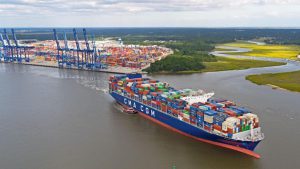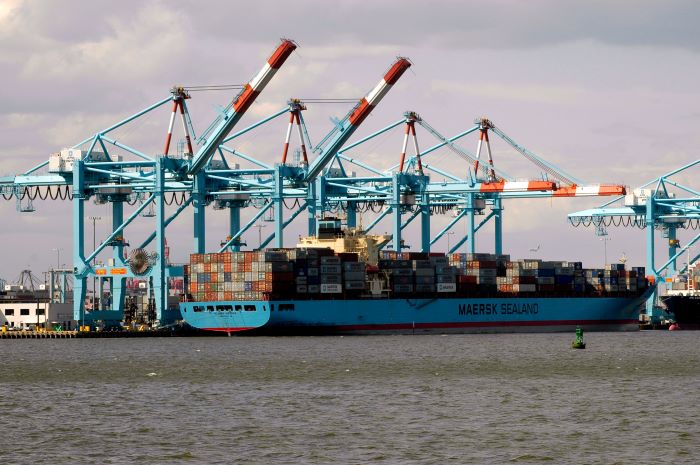
Port of New York and New Jersey ends record-breaking run

A STREAK of year-on-year record cargo volumes at Port of New York and New Jersey has ended after 26 months.

The port handled 792,548 teu in October, a slight drop of 0.5% from the year-earlier period, and 5.9% lower than September.

But it remained the busiest in the US, overtaking the ports of Los Angeles and Long Beach for a third consecutive month.

New York and New Jersey’s overall throughput is up 10.6% year to date, while imports are up 10.4% through September (the port has not yet published a breakdown of October figures). However, a shrinking vessel backlog suggests that volumes in the port might be cooling.

Other ports on the east coast have also reported strong figures. After Hurricane Ian reduced the port of Savannah’s throughput in September, it rebounded with its second strongest month on record in October.

The ports of Houston and South Carolina had their best Octobers on record, and Virginia’s throughput was just 30 teu off its October 2021 record. Moreover, in contrast to the port of New York and New Jersey, October throughput at Savannah, Houston, Virginia, and South Carolina rose from September.

Combined, New York and New Jersey and Savannah — the two largest east coast ports — handled slightly more cargo than the San Pedro Bay ports, which traditionally dominate US cargo throughput.

The recent milestone illustrates the headwinds from the protracted west coast labour negotiations that led shippers to increasingly divert cargo eastwards. Imports from China to Los Angeles and Long Beach in October were down 48.0% and 31.6% year on year, respectively, according to supply chain and logistics software provider Descartes.

Despite the strong throughput figures, the broader trend of declining import volumes in the US could be catching up with the east and Gulf coast ports. Imports across the ports have grown by an average of 10.3% so far this year, but presented a mixed picture in October.

While Houston and Charleston recorded double-digit year on year growth, Savannah’s imports rose by a modest 1.2% despite the rebound from September, and Virginia’s imports declined for a second consecutive month.

In addition, the vessel congestion that has impacted the east and US Gulf coasts ports for months is easing, as the National Retail Federation and Hackett Associates project that November imports in the US’ top 10 biggest ports will be down 9% year on year, dropping below 2m teu for the first time since February 2021.

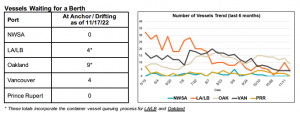
The average number of vessels anchored in the port of New York and New Jersey is down to three after settling in double digits throughout September.

In Houston, the backlog this week was down to single digits after nearing 30 ships in mid-September, Lloyd’s List Intelligence data shows. Port executive director Roger Guenther said there has not been “any slowing in Houston in recent months”. The port plans to implement a container dwell fee early next year to improve cargo fluidity.

Savannah remains the US’ most congested port. Its executive director, Geoff Lynch, said the number of ships anchored is trending downward.

Lloyd’s List Intelligence data showed the backlog consists of about 25 boxships on November 28 after lingering above 30 for much of the past few months.

Source: The Lloyd’s List
Canadian and US Terminal update (Week 48)

Rupert

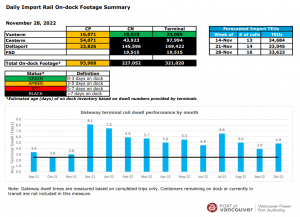
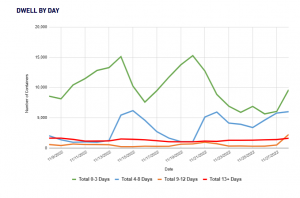
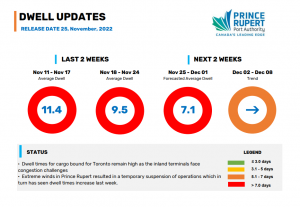
  • Dwell times for cargo bound for Toronto remain high as the inland terminals face congestion challenges
  • Extreme winds in Prince Rupert resulted in a temporary suspension of operations which in turn has seen dwell times increase last week.

Vancouver

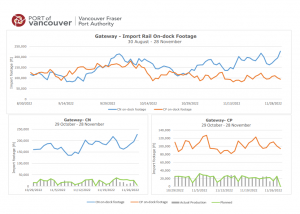
  • The dwell is still high for all the terminals. Centerm and Delta have the worst performance, with dwell time more than 7 days

Halifax 

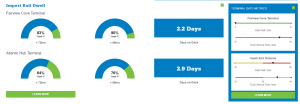
  • Both Fairview Cove Terminal (at 2.2 days average dwell last week) and Atlantic Hub Terminal (2.9 days dwell time) are working normal.

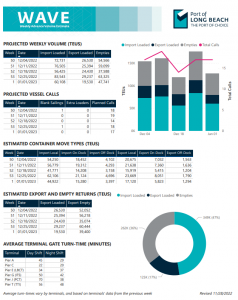
USA Long Beach

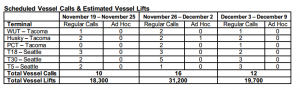
Seattle + Tacoma (The Northwest Seaport Alliance)

Highlights & Updates

Please note there will not be a Gateway Performance & Outlook report sent this week due to the

Thanksgiving holiday. The next report will be sent on Friday, 12/2. Happy Thanksgiving!

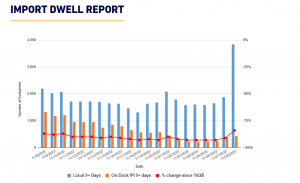
  • PCT will have a limited gate Friday, 11/18. Contact ETS for more details.
  • All terminals will be closed Thursday, 11/24 for the Thanksgiving holiday.
  • T5 will be closed Friday, 11/25. For a complete list of next week’s gate schedules visit our website here.
  • There is ample warehouse & transload capacity available across the gateway. Our monthly Warehouse &
  • Transload Availability report, which shows many providers with space, is found on page 3 and on the website here.
  • The USDA’s Commodity Container Assistance Program (CCAP) is still available to exporters who use T46 and
  • West Hylebos Yard to stage export loads. More info on reimbursement and eligible commodities found here.
  • At PCT Everport now requires all trucking companies to secure valid empty out appointments.
  • Husky and PCT currently are not accepting TRAC or DCLI bare chassis drops until further notice.

CMA CGM shores up finances ahead of downturn

Carrier has paid down its debt and invested in sectors adjacent to its shipping concerns. Warns that inflationary environment is clouding outlook for economic growth

CMA CGM expects to see a faster return to more normal freight rates in the fourth quarter and lower margins as geopolitical tensions reduce demand and increase its costs.

To mitigate this, the company has made significant inroads into its debt repayments while strengthening its shipping, ports, logistics and air freight capabilities.

The third quarter had already been shaped by “persistent geopolitical tensions” that had spurred higher inflation and dragged down consumer spending, which was already moving returning to higher services spending following the pandemic, the company said in its third-quarter results.

“The group was also impacted by the unstable geopolitical situation, specifically by the increase in unit bunker costs driven by higher energy prices,” CMA CGM said.

“On a like-for-like fuel consumption basis, these higher energy prices led to a year-over-year increase of $822m in bunker costs in the third quarter of 2022. The slowdown in shipping demand pushed down spot freight rates, particularly on main east-west routes.”

Group revenues were up 30% year on year to $19.9bn in the third quarter, but higher costs meant that operating earnings were down 4.6% from the previous quarter at $9.2bn. Net profit of $7.04bn fell by $563m when compared with the corresponding quarter of 2021.

But the group continued to strengthen its balance sheet. Net debt fell $5.3bn during the quarter to just $78m.

“The CMA CGM group once again recorded strong results in the third quarter,” said chief executive Rodolphe Saadé. “Over the past two years, we have significantly strengthened our financial structure and developed our business through the entire supply chain.”

Declining demand had prompted a return to “more normal” international trade flows and a significant reduction in freight rates, he added.

“In this new environment, we will continue to invest to strengthen our positioning in maritime shipping and logistics, accelerate our energy transition and provide our clients with even more efficient solutions.”

CMA CGM said that a number of acquisitions since the start of the year, including that of Gefco, which was approved by competition authorities during the third quarter, had helped strengthen its Ceva Logistics subsidiary.

Revenues in its logistics division were up by over 50% to $4.4bn from the corresponding quarter of 2021.

It had also boosted its terminals portfolio during the quarter, with the joint-venture tender win for the privatisation of the Nhava Sheva terminal in India, while its CMA CGM Air Cargo business had launched its Paris-Hong Kong service following the delivery of its first two new Boeing 777 freighters.

CMA CGM’s full-year results will likely set another record for the company, but the outlook for the following years is definitely less optimistic now.

“The health crisis and the shifting consumer spending patterns that drove strong demand during lockdowns have placed unprecedented strain on the world’s supply chains,” it said.

“These strains are tending to subside in the wake of recent developments in world trade, reflecting a much more uncertain economic environment, which is being deeply affected by geopolitical tensions.”

Source: The Lloyd’s List

Top unions split on tentative agreement with US rails

The two largest rail unions, which announced vote totals on Monday, represent nearly half the 110,000 workers that could go on strike in December.

The labor peace negotiated in September between US railroads and their unions got shakier Monday after a split vote among the country’s two largest rail unions- one’s membership ratifying the tentative deal and the other’s rejecting it.  The split votes raise fresh concerns that a crippling strike could occur in early December.

The Brotherhood of Locomotive Engineers and Trainmen (BLET) ratified the agreement brokered in September with the help of the Biden administration, but it was rejected by members of the International Association of Sheet Metal Workers Air, Rail, and Transportation (SMART-TD).  Four rail unions have now turned down the deal, while eight have approved it.

If any union walks off the job, however, others are unlikely to cross the picket lines.

“Today, the BLET joined the majority of our unions in approving the largest wage increases in nearly five decades and also paved a path toward greater scheduling predictability for its members,” Association of American Railroads CEO lan Jefferies said in a statement Monday. “Let’s be clear, if the remaining unions do not accept an agreement, Congress should be prepared to act.”

A “cooling off” period when no strikes or lockouts can occur will run through Dec. 8 for SMART-TD, leaving less than two weeks for a deal to be ratified. It is not known whether the Brotherhood of Maintenance of Way Employees Division (BMWED) and Brotherhood of Signalmen (BRS), which also rejected the tentative agreement and can walk off the job as soon as Dec. 5, will grant an extension to negotiate in unison with SMART-TD and the International Brotherhood of Boilermakers (IBB).  The IBB also rejected the deal.

The BLET and SMART-TD are the two most important unions because they represent nearly half the 110,000 US rail employees covered under the tentative agreement, including brakemen, conductors, engineers, trainmen, yardmen, and yard masters.

Jeremy Ferguson, president of SMART-TD, struck a conciliatory tone despite the rejection.

“SMART-TD members with their votes have spoken; it’s now back to the bargaining table for our operating craft members,” Ferguson said in a statement Monday. “This can all be settled through negotiations and without a strike. A settlement would be in the best interests of the workers, the railroads, shippers, and the American people.”

Potential strike ahead of holidays

Lawmakers in Washington will face pressure to bridge the divide between labor and management because any job action could snarl supply chains in the weeks leading up to Christmas and end-of-year holidays. The timing would be particularly bad for parcel shippers because FedEx and UPS are major intermodal shippers using the US rail network to haul ground packages cross country, and business will pick up in December amid holiday shopping.

“American businesses and families are already facing increased prices due to persistent inflation, and a rail strike will create greater inflationary pressures and will threaten business resiliency,” National Retail Federation CEO Matthew Shay said in a statement Monday. “Congress must intervene immediately to avoid a rail strike and a catastrophic shutdown of the freight rail system.”

While Congress has the authority to force an agreement on both sides, those involved with the negotiations to date have indicated they prefer any disputes are settled at the bargaining table. That is also the position of the White House.

The major disagreement between management and labor is over sick pay, not salaries.

The unions pushed for 15 paid sick days per year, but the Presidential Emergency Board created by President Joe Biden recommended negotiating the issue on a local level, not nationally. After negotiations with Secretary of Labor Marty Walsh, the two sides agreed to a tentative deal that called for one additional paid sick day annually.

But many rank-and-file members do not think that is enough, especially after the work they did during the COVID-19 pandemic when they were viewed as essential workers needed to keep supply chains moving. The BMWED has written to lawmakers to support a compromise of seven days. Workers are worried that getting sick could result in losing their jobs with strict railroad-imposed attendance policies.

Previous collective bargaining agreements did not include paid sick time for short-term absences. Rail management has countered that it provides generous long-term sick benefits and says the average salary for a union employee is in the top 10 percent of all US workers, which management considers compensation for unpaid short-term leave.

Source: JOC news

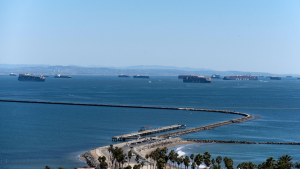
Boxship backlog cleared at Los Angeles and Long Beach ports

THE containership backlog at the ports of Los Angeles and Long Beach has petered out after more than two years, bringing an end to one of the most recognisable features of the pandemic-era supply chain crises.

No vessels were backed up at the San Pedro Bay ports on November 21 for the first day since October 2020, according to Kip Louttit, executive director of the Southern California Marine Exchange.

The backlog reached 42 ships in February 2021 before dropping to nine in June 2021 and then peaking in January this year.

“After 25 months, and with concurrence of the Ports of Los Angeles and Long Beach, the Pacific Maritime Association, and the Pacific Merchant Shipping Association, the container ship backup for the ports of Los Angeles and Long Beach has ended,” said Mr Louttit.

The ports have enough labour to handle current volumes and ocean carriers are sometimes delaying vessel arrivals to optimise their operations. It is therefore “time to move into a different phase of operations and declare that the backup has ended,” he said.

The boxship backlog reached a high of 109 vessels this January, removing fleet capacity and sending freight rates skyrocketing in the process, while also causing long delays in deliveries of goods to consumers.

The mounting congestion and protracted labour negotiations between west coast dockworkers and their employers led many shippers to divert their cargo to east and gulf coast ports, shifting much of the backlogs to their anchorages and terminals instead.

As US import volumes slow, those backlogs are also easing, but are still far from resolved.

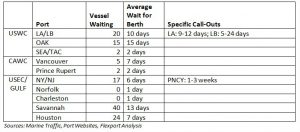
The ports of Virginia, Savannah, and Houston had a combined total of 40 containerships at anchor on Tuesday night, Lloyd’s List Intelligence data show, of which 27 were in Savannah.

Source: Lloyd’s List

2M suspends USEC service as rates, volumes drop near year’s end

Mediterranean Shipping Co. (MSC) and Maersk are halting a trans-Pacific US East Coast service after freight rates have been cut by more than half from the summer peak.

MSC and Maersk, partners in the 2M Alliance, said in separate statements this week that they will temporarily suspend their jointly run Liberty/TP23 service until further notice, adding that the suspension “will help alleviate port congestion.” The last sailing will be Nov. 23 from Indonesia. Liberty/TP23, which was introduced in March 2021, offers service from Indonesia, Vietnam and China to the US ports of Charleston, Savannah, and New York-New Jersey with a string of ships in the 8,000 TEU range.

The service suspension comes as rates into the US East Coast see further weakening as the end of 2022 nears. After dropping about 25 percent from October, average US East Coast freight rates now sit at $4,500 per FEU, with bookings done as low as $3,700, according to a trans-Pacific forwarder who asked not to be identified. That is down 55 percent from levels seen in June, the forwarder added.

“Ocean carriers are cutting rates and voiding sailings left, right, and center,” the source said.

With rates returning to pre-pandemic levels, ship supply to the US East Coast appears too high to offset rate declines. Sea-Intelligence Maritime Analysis said in its most recent Sunday Spotlight newsletter that November vessel capacity into the USEC is 19.5 percent above the level seen in November 2019, with December capacity running even higher at 37.7 percent above the same month in 2019.

Meanwhile, more service changes could be coming. MSC’s standalone Santana service, which was shifted from a West Coast to an East Coast service last year, is reportedly moving to every three weeks instead of a weekly service, according to a maritime shipping source who did not want to be identified. The service change could not be independently verified.

Some of the slowdown in container activity is showing up in the most recently available cargo figures for New York-New Jersey. Although New York-New Jersey has been the busiest US port for three consecutive months, the October volume of 792,548 TEU was essentially flat with the year-ago month. In a statement to JOC.com, the Port Authority of New York and New Jersey said it forecasts full-year 2022 volume to be about 9 million TEU, which would be up only nominally from 2021.

Source: JOC news

ILWU halts vessel operations at Oakland’s largest terminal

Members of the International Longshore and Warehouse Union (ILWU) shut down vessel operations at the Oakland International Container Terminal (OICT) Monday in the latest West Coast port disruption to occur amid longshore contract talks that have now dragged on for more than six months.

A source with knowledge of Oakland’s operations who asked not to be identified said ILWU workers “red-tagged” equipment inside OICT early Monday, meaning none of the equipment could be used until inspected by a mechanic. The source called the move a “gimmick” that forced the loading and unloading of all vessels at the terminal to come to a halt. As of 2:30 pm West Coast time Monday, operations had not resumed, and it was unclear how long the disruption would last.

OICT is the busiest marine terminal at the Port of Oakland, handling about 70 percent of its container volume.

The latest disruption at Oakland comes just two weeks after three of the port’s four terminals were shut down for a morning shift after ILWU marine clerks picketed over a travel pay issue.

The first source and a second source also with knowledge of Oakland’s operations called Monday’s action by the ILWU an obvious attempt to exert pressure on contract negotiations with the Pacific Maritime Association (PMA) that show no sign of reaching a resolution anytime soon. Talks began in May but have been stalled for months and all but suspended since October

The prior contract between the ILWU and PMA, which represents marine terminal operators and ocean carriers, expired on July 1.

OICT is operated by SSA Containers, the same operator that runs Terminal 5 at the Port of Seattle, which has been the site of a work jurisdictional dispute that has forced the broader West Coast contract talks to be put on hold.

While negotiations on a new deal drag, wary shippers seeking to avoid the type of disruption that halted vessel operations at OICT Monday are diverting an increasing amount of cargo from the West Coast to the East and Gulf coasts.

The West Coast’s market share of US imports from Asia fell to 57.5 percent through the first nine months of the year, down from 61.2 percent in the same period last year. The share for East Coast ports increased to 35.1 percent from 32.8 percent, while the Gulf Coast’s share ticked up to 7.1 percent from 5.7 percent, according to PIERS, a JOC.com sister product within S&P Global.

Source: Journal of Commerce

Cargo Shipowners Cancel Sailings as Global Trade Flips From Backlogs to Empty Containers

Dozens of sailings from Asia to U.S. ports are set to be canceled in October as deteriorating economic conditions weigh on demand to ship goods worldwide

Ocean carriers are canceling dozens of sailings on the world’s busiest routes during what is normally their peak season, the latest sign of the economic whiplash hitting companies as inflation weighs on global trade and consumer spending.

The October cancellations are a sharp reversal from just a few months ago, when scarce shipping space pushed freight rates higher and carriers’ profits to record levels. Last October, companies like Walmart Inc. and Home Depot Inc. were chartering their own ships to get around bottlenecks at ports to meet a surge in demand for imports.

Trans-Pacific shipping rates have plummeted roughly 75% from year-ago levels. The transportation industry is grappling with weaker demand as big retailers cancel orders with vendors and step up efforts to cut inventories. FedEx Corp. recently said it would cancel flights and park cargo planes because of a sharp drop in shipping volumes. On Thursday, Nike Inc. said it was sitting on 65% more inventory in North America than a year earlier and would resort to markdowns.

The erosion in global economic conditions, from the war in Ukraine to factory shutdowns in China, have dealt heavy blows to trade activity. The International Monetary Fund has cut its forecast for global growth in gross domestic product multiple times this year. Consumer prices are rising at the fastest rates in years in the U.S., countries in Europe and other parts of the world.

One response to the melting demand has been to reduce sailing trips. In September, container capacity offered by ship operators in the Pacific was down 13%, dropping the equivalent of 21 ships that can each move 8,000 containers in a single voyage, from a year earlier, according to shipping-data providers Xeneta and Sea-Intelligence.

For the two weeks starting Oct. 3, a total of about 40 scheduled sailings to the U.S. West Coast from Asia and 21 sailings to the East Coast from Asia have been scrapped, according to the data companies as well as customer advisories viewed by The Wall Street Journal. Typically at this time of year, an average of two to four sailings a week are blanked, the industry’s term for canceled sailings.

Carriers also are increasingly canceling trips along key Asia-to-Europe routes, the data providers said.

“In the first week of October, one-third of previously announced capacity will be blanked and for the second week, it will be around half,” said Peter Sand, chief analyst at Xeneta. “The downturn pace in recent weeks has been very fast and it looks like carriers misread the low volumes of a nonexistent peak season.”

The period between late summer and early fall typically is the busiest time of year for the largest carriers, as retailers and other importers build inventories ahead of the holiday shopping season.

Daily freight rates now average $3,900 to move a single container across the Pacific, compared with$14,500 at the start of the year and more than $19,000 in 2021, according to the Freightos Baltic Index.

Mediterranean Shipping Co., the world’s largest container carrier by capacity, has voided some sailings recently, including a six-ship service from China to Los Angeles and Long Beach.

The rotation, which MSC operated in alliance with A.P. Moller-Maersk A/S, was suspended “due to significantly reduced demand for shipments into the U.S. West Coast during the past weeks,” according to a customer notice posted Wednesday on MSC’s website. The suspension will remove nearly 12,000 containers a week in capacity from the trans-Pacific trade, and the action would help strengthen the transit times it offers, MSC said in its notice.

MSC declined to comment beyond the notice as did a Maersk spokesman. A Hapag-Lloyd AG spokesman said the company hasn’t canceled sailings as a result of weaker demand. Cosco Shipping Holding Co. and CMA CGM, two other major container operators, didn’t respond to requests for comment.

Some carriers are reluctant to share details on canceled sailings to avoid showing competitors what is happening in their network. Voyages can be scrapped because of port congestion, scheduling issues or falling demand.

Consumer spending on bulky items like furniture and appliances that are often imported into the U.S. has cooled in recent months, according to government data. Such items were in hot demand earlier in the pandemic as Americans spent more time at home and renovated their houses.

A  flotilla of new container ships under order will add capacity over the next two years, meaning that freight rates could come under more pressure as more ship space becomes available.

Ocean container capacity is slated to increase 4% this year and is expected to rise by 8.8% in 2023 and a further 9.7% in 2024, according to London-based shipping adviser Braemar PLC. Since early 2020 some 1,056 ships that can move about eight million boxes were ordered, compared with 688 vessels ordered from 2015 to 2019 that can move around five million boxes.

“The global economy has thrown a few curveballs this year, and our outlook on future demand is uncertain and tepid,” said Jonathan Roach, a container analyst at Braemar. “Overcapacity will likely become an issue from the middle of 2023 through to 2024 and potentially beyond.”

Overcapacity pushes operators to undercut each other, putting pressure on freight rates. Boxship operators fought deep losses for nearly a decade starting in 2008, which prompted consolidation in the industry. The top six ocean-freight carriers move more than 70% of all containers worldwide.

Freight rates on key shipping routes remain above prepandemic levels, and the largest operators have plenty of cash to weather a near-term economic downturn. The costs carriers face are rising, too. Bunker fuel prices, which have cooled since hitting records this summer, are above their late 2019 levels. Port operators are also charging more for ships to dock, passing along the higher energy prices they are facing to the carriers.

“The cost of electricity, particularly in Europe, is significant because the cranes and other heavy equipment run on electrical power,” said Tiemen Meester, chief operating officer for ports and terminals at DP World, a Dubai-based operator of terminals in ports worldwide.

Source: The Wall Street Journal

Market Update for Week 33 (Aug 14– Aug 20, 2022)

Ocean Freight Market

Carriers Market Capitalizations Rise

  • Maersk Group: the Danish company has seen its stock rise nearly 20% since July, It is currently around 20% off its 52-week high logged in January. JP Morgan raised its rating on the company to “buy” on July 1 setting a target price of DKK 30,800.
  • Hapag-Lloyd: Stock bottomed out in the first week of July and has risen around 40% since then though its stock is closely traded, distorting results. It is around 25% off 52-week highs, though Goldman Sachs and JP Morgan both maintain a sell rating.
  • Evergreen Marine: The sixth largest carrier saw a rebound at the start of July and is up 20% over the past month though, like other Asian carriers, its shares remain significantly down from highs, at 45% below its March 52-week peak.
  • ZIM: Shares have also rebounded since the first week of July, though it has risen by a more modest 15% over the past month. Jefferies initiated coverage on 21 July with a ‘hold’ rating with a USD 55 target price.
  • ONE: It posted a net profit of US$5.5 billion for the 2nd quarter with revenue rose 56% on a year ago, 7% vs 1st quarter to a total of US$ 9.02 billion.

New Service Adjustment by the Alliance

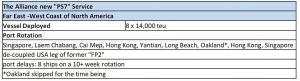
  • On the Transpacific Southwest ‘PS7’ of THE Alliance, ONE will (at least for now) act as the sole vessel operator and provide all of the service’s eight 14,000 teu ships.
  • The first ‘PS7’ sailing from Singapore on 15/July under ONE’s 14,026 teu ONE EAGLE with full rotation includes calls at Singapore, Laem Chabang, Cai Mep, Hong Kong, Yantian, Long Beach, Hong Kong, Singapore, also calling Oakland (served after Long Beach), but the port is being skipped for the time being (until November).
  • A first sailing was offered from Laem Chabang on 15/July with the 14,220 teu YM WISDOM. Due to vessel delays, the second ‘FE5’ sailing is only deported on 2/Aug with the YM WELLSPRING.

Port Update

  • Port, vessel waiting time and dwell time

  • Canada Rail Backlog

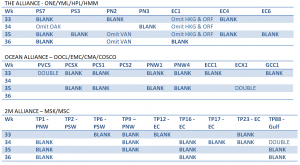
Blank Sailing