ILWU job action causing terminal gate delays in Los Angeles-Long Beach: PMA

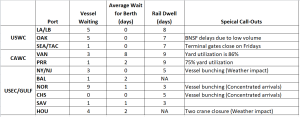
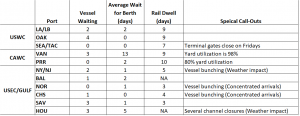
“Significant delays” have hit some marine terminals at the ports of Los Angeles and Long Beach since the middle of last week, the Pacific Maritime Association (PMA) said Monday, in the latest job action by dockworkers linked to ongoing West Coast contract negotiations.

PMA, which represents terminal employers in the talks that have dragged on for more than 10 months, said longshore workers represented by Local 13 of the International Longshore and Warehouse Union (ILWU) have since last Wednesday refused to stagger their meal breaks as required, resulting in periods when no work is being done on the docks.

“As a result, longshore workers at the Ports of LA and Long Beach are not working the terminals between 12 pm-1 pm and 10 pm-11 pm, creating significant delays,” PMA said in a statement. “Because the contract is not in place, there is no option for PMA to arbitrate the matter and require the union to man the terminals continuously without interruption.”

PMA provided media with photographs showing trucks backed up Friday at the Fenix Marine Terminal at the Port of Los Angeles and the ITS Terminal in Long Beach, long queues it said was the result of the job action.

Longshore workers normally take staggered lunch breaks when the coastwide contract is in effect so as not to disrupt cargo handling. Typically, half of the longshore workers take their break from 11 am to noon and the other half from noon to 1 pm so terminal gates remain open for eight consecutive hours.

Two sources close to the contract negotiations told the Journal of Commerce the job action was directed by Local 13 in Southern California over an intra-union matter involving a manning change. Although the change involves only terminals in Los Angeles and Long Beach, it must be included in the coastwide contract for it to take effect.

Neither the PMA nor the ILWU commented specifically on the manning issue. But the fact the PMA statement specifically noted that ILWU Local 13 had stopped complying with the staggered lunch break requirement is telling because it suggests the disruptions in Southern California are not being directed by ILWU’s international leadership.

In a statement Monday, ILWU International President Willie Adams said longshore workers in Los Angeles and Long Beach are working every day according to terms agreed upon with the PMA. “Terminal operators, however, open and close their gates at will,” Adams said.

Meanwhile, the West Coast’s share of imports from Asia continues to erode as shippers divert discretionary cargo to the East and Gulf coasts in a bid to avoid the exact type of disruption taking place in LA-LB. Fresh data from PIERS, a sister product of the Journal of Commerce within S&P Global, shows that the share of Asian imports landing on the West Coast in February slipped to 53.2 percent, down from 54.5 percent in January and 60.4 percent last May when ILWU-PMA contract talks began.

Contract talks at 10 months and counting

PMA and ILWU began negotiations last May, and while some matters such as health benefits have been resolved, there has been no agreement to date on core issues such as automation, wages, and pension benefits. Sources close to the negotiations say they see no indication that progress is being made, despite a joint ILWU-PMA release issued in late February that the two sides expected a contract resolution “soon.”

Beginning last fall, dockworkers in Oakland and the Northwest Seaport Alliance of Seattle and Tacoma have taken similar job actions on a sporadic basis, sources at the port and terminal level have told the Journal of Commerce. However, the PMA had never issued a statement on port-specific job actions until now.

Source:

Mongelluzzo, B. (2023, March 20). ILWU job action causing terminal gate delays in Los Angeles-long beach: PMA: Journal of Commerce. ILWU job action causing terminal gate delays in Los Angeles-Long Beach: PMA | Journal of Commerce. Retrieved March 21, 2023, from https://www.joc.com/article/ilwu-job-action-causing-terminal-gate-delays-los-angeles-long-beach-pma_20230320.html
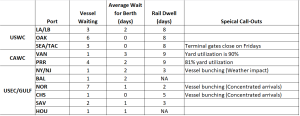
New NS Norfolk-Memphis service aims to grab East Coast cargo shift

Norfolk Southern Railway will launch a new international intermodal service between the Port of Virginia and Memphis beginning April 1 in a move to capture trans-Atlantic business from Europe and Asia as more cargo owners shift freight to ports along the US East Coast.

NS now serves Memphis primarily through Charleston, South Carolina, and Savannah, Georgia. Trains moving the roughly 900 miles between Norfolk and Memphis will take four days, roughly a day longer than Savannah trains but a day shorter than trips from Charleston.

Like Charleston and Savannah, trains will run every day and serve both terminals at the Port of Virginia — Norfolk Intermodal Terminals and Virginia International Gateway. NS service out of the Port of Virginia had previously been restricted to the Midwest, or destinations in Missouri, Kentucky, and points north.

“BCOs [beneficial cargo owners] and others are continuing to look for more options, so we’re trying to provide them with another service product for capacity to get into and out of Memphis,” Alexander Luc, group vice president of international intermodal for NS, told the Journal of Commerce Wednesday.

Luc said three out of every four import loads moving to Memphis come from ports other than Charleston and Savannah, including from the West Coast. So as the share of Asian imports shift from the West Coast to East and Gulf coast ports, new opportunities may arise to capture Memphis business through Virginia and other East Coast ports.

West Coast market share of Asian imports dropped to 54.1 percent in January from 57.2 percent in January 2022, according to PIERS, a sister product of the Journal of Commerce within S&P Global. The East Coast share of 36.2 percent in January was up from 34.8 percent a year ago The West Coast cargo bleed comes as retailers shift their discretionary freight to avoid potential disruption linked to the failure of the International Longshore and Warehouse Union and marine terminal operators to hammer out a new labor agreement after 10 months of negotiations.

“We’re not looking to just shift freight going through Savannah and Charleston today,” Luc said. “We’re targeting freight that is potentially hitting the West Coast from BCOs looking to shift their overall services and diversify their port pairings and logistics solutions.”

The Port of Virginia will place chassis in Memphis to prevent additional strain on other third-party chassis pools. The Port of Virginia owns its chassis pool, rather than relying on outside providers such as DCLI, Flexi-Van Leasing, and TRAC Intermodal.

Memphis ready for Virginia business

Luc said one reason why the service is launching in April is that Norfolk Southern wanted to ensure its Memphis-area terminal was capable of handling the new import and export volumes. The NS Rossville terminal, located about 30 minutes outside Memphis, was overwhelmed last fall with cargo from Charleston and Savannah; NS was forced to open three auxiliary lots to handle the spillover cargo.

“One of the reasons we didn’t launch this sooner is because we wanted to make sure that we were taking care of the existing business into the Memphis market,” Luc said.

Another reason: NS just last week completed an expansion project to increase the capacity of the Rossville terminal by 50 percent. It can now hold about 1,500 ocean containers, up from about 900 to 1,000 containers last fall.

To make the new Norfolk-to-Memphis service succeed, NS and the Port of Virginia are not only targeting importers using trans-Atlantic services from Europe and Asia, but also exporters moving goods through Memphis, like the cotton industry.

Cotton exporters could benefit from the Port of Virginia option given they have run into congestion issues getting their product to Houston, Charleston, and Savannah in the last 12 months. NS was restricting exports out of its Rossville terminal last spring as it dealt with an influx of imports and chassis shortages.

“We have talked to exporters in (Memphis) shipping products like cotton, and they’re certainly interested in looking for more port combinations to diversify,” Luc said. “Getting that balance will allow us to keep the equipment flowing in both directions.”

Source:

Ashe, A. (2023, March 9). New NS Norfolk-Memphis Service aims to grab East Coast Cargo Shift: Journal of Commerce. New NS Norfolk-Memphis service aims to grab East Coast cargo shift | Journal of Commerce. Retrieved March 20, 2023, from https://www.joc.com/article/new-ns-norfolk-memphis-service-aims-grab-east-coast-cargo-shift_20230309.html

Cathay Pacific back to business-as-usual soon as aircraft return

Cathay Pacific will be operating all its aircraft again by the end of next year, CEO Ronald Lam said this week, noting “light at the end of the tunnel”.

Cathay still has 67 inactive aircraft, according to CH Aviation’s database, of which 11 are under maintenance. The others, which include nine A330-300s and 22 777s, are stored in Hong Kong, Alice Springs, Ciudad Real and Xiamen.

Last month saw Cathay Cargo, as it is now branded, carry nearly 60% more freight than a year earlier, when its capacity was significantly cut owing to quarantine measures. Cathay said its cargo revenue tonne km (RFTKs) went up 154% – although load factors fell as capacity went up 206%.

“In the first two months of 2023, the tonnage increased by 42.8% against a 201.3% increase in capacity and a 147.4% increase in RFTKs, compared with the same period for 2022,” the carrier said.

Despite significant changes in Cathay’s capacity this year versus 2022, a UBS research note, published yesterday on Hong Kong International Airport’s tonnage data, failed to mention the hub carrier’s challenges. It said, instead: “While yoy volume growth in Feb may seem to be a sign of airfreight recovery, we attribute that mainly to the easy comp arising from an early start to Chinese New Year in 2023.”

Cathay, meanwhile, said Hong Kong was back in business. Mr Lam told Bloomberg TV: “Hong Kong opened up late, so there’s quite a lot of catch-up. But I think we are making good progress, and we are moving very fast as a city and as an airline. I’m very confident that given a little bit more time, we’ll be back on par with other cities and airlines.”

Chief customer and commercial officer Lavinia Lau added today that, in cargo, “ad-hoc demand from South-east Asia as well as South Asia, the Middle East and Africa also helped fill the gaps left by demand from Hong Kong and the Chinese mainland on long-haul routes”.

She added: “Turning to March and beyond, we are making good progress in increasing our capacity and rebuilding connectivity at the Hong Kong international aviation hub. By the end of March, the Cathay group will be operating approximately 50% of pre-pandemic passenger flight capacity, covering more than 70 destinations.

“We continue to add more flights to our schedule, in particular for some of our most popular destinations,” she said, noting London, Japan and Shanghai in particular.

“On the cargo side, demand from our home market, Hong Kong, as well as the Chinese mainland is increasing, with e-commerce-related traffic picking up relatively more quickly. We are progressively expanding our network coverage as more of our passenger flights are resumed.”

WorldACD meanwhile repor today global tonnages have “stabilised, following their post-lunar new year bounceback in recent weeks and their steady decline most of last year, while average rates continue their gradual softening trends”.

Source:

Lennane, A. (2023, March 17). Cathay Pacific back to business-as-usual soon as aircraft return. The Loadstar. Retrieved March 20, 2023, from https://theloadstar.com/cathay-pacific-back-to-business-as-usual-soon-as-aircraft-return/

Shippers put more pressure on ocean carriers for carbon-free services

A new alliance of major shippers is pushing ocean carriers to step up their efforts to cut back on CO2 emissions.

Zero Emission Maritime Buyers Alliance (Zemba) is a partnership of shippers Amazon, Patagonia and Tchibo with the Aspen Institute, an international non-profit organisation.

“Our goal is to enable any company interested in showing leadership to be able to access affordable zero-emission solutions as quickly as possible,” said Ingrid Irigoyen, president and CEO of the new interest group and director of the Aspen Shipping Decarbonization Initiative.

By leveraging their collective buying power, the partners are looking to speed up the shift to green fuel in ocean shipping. They plan to issue requests for proposals for zero-emission shipping to carriers this year to move products this way no later than 2025-2026.

The initiative was welcomed by the Ship It Zero coalition, a climate and public health campaign aiming to get large shippers to embrace zero emissions ocean shipping, which urged other large shippers to get on board.

“We applaud the formation of Zemba and urge Walmart, Home Depot, Target and all other major retailers to join this important collaborative platform,” said Madeline Rose, climate campaign director at Pacific Environment, a California environmental organisation.

“Just last week, Walmart and Home Depot stated that they are working with freight partners to ‘encourage’ and ‘scale up’ sustainable shipping solutions; we urge them to make good on these commitments and help create zero-emission futures for port communities, our shared oceans and our shared planet,”

Consumer pressure, increasing environmental legislation and concerns about climate change are prompting a growing number of shippers to push for emissions reductions in their supply chains, and ocean shipping is a major target. It produces about 1bn tons of greenhouse gas emissions in a year and accounts for about 3% of carbon emissions worldwide.

Next week all eyes in the industry will be on the International Maritime Organisation (IMO), which will be in session from 20 to 24 March. Interest groups have called on the organisation to set stricter targets and move toward supporting regulations.

Ship It Zero has called the meeting ‘a pivotal moment” to ensure that the shipping industry can make meaningful progress towards significant emissions reductions.

“The IMO has the opportunity to change the course of shipping emissions to align with the Paris Agreement goal of 1.5 degrees Celsius by no later than 2050,” it said.

The IMO’s current targets are to cut CO2 emissions by at least 40% by 2030 against a 2008 baseline and by 70% by 2050. These targets will be reviewed this year.

According to some research, a transition to align with the 1.5 degree Celsius target is technologically and economically feasible if it is backed with ambitious global cooperation and strong policy measures. However, Ship It Zero has warned that the growth in global shipping points to a further rise in emissions. The IMO itself has conceded that emissions could be 30% higher by 2025 if nothing is done.

Some operators have been experimenting with better alignment of vessel and cargo arrival at ports. Currently, ships are dispatched as quickly as possible to collect cargo at a port once a charter agreement has been signed, often resulting in idling time until the cargo arrives. According to a 2020 report, tankers and bulk carriers spend as much as 10% of their time waiting to get into a port. By some estimates, eliminating wait times could reduce emissions from shipping by as much as 20%.

The Australian port of Newcastle is using a vessel arrival system where incoming vessels contact the port 14 days ahead and receive instructions from the port to adjust their speed to arrive when a berth is available, which has slashed anchorage time.

Nevertheless, just-in-time vessel arrivals remain the exception, as this requires alignment of the various stakeholders.

The Ship It Zero initiative is urging ocean carriers to stop ordering LNG vessels to cut down methane emissions. Ocean carriers have made some moves in this direction, but today alternative fuels like methanol, hydrogen and ammonia are not available in sufficient quantities, are difficult to scale and more expensive.

Source:

Putzger, I. (2023, March 15). Shippers put more pressure on ocean carriers for carbon-free services. The Loadstar. Retrieved March 16, 2023, from https://theloadstar.com/shippers-put-more-pressure-on-ocean-carriers-for-carbon-free-services/

TPM23: Ocean Alliance could be next domino to fall after 2M: analyst

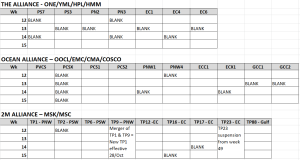
The Ocean Alliance could be the next major ship-sharing agreement to sink, possibly sometime this year, as its members chart different strategies and look to gain market share during the current “rate war” among ocean carriers, industry analyst Lars Jensen said Wednesday.

Speaking at the Journal of Commerce’s TPM23 conference in Long Beach, Jensen said ocean carriers face a market similar to the one seen during the 2008-09 financial crisis when a massive buildup of ship capacity came up against weakening demand.

While demand could recover should inventory destocking occur through the spring and US consumers keep spending, Jensen said the industry faces other headwinds, such as political scrutiny over the alliances’ anti-trust exemptions and higher costs from stringent carbon emissions rules. The result, he added, is that carriers are thinking more about “who do I want to spend the next few years with” as has happened with the pending dissolution of the 2M Alliance.

“It’s a normal downcycle we are going through, then there are some elements that are slightly different,” Jensen, CEO and partner of Vespucci Maritime and a Journal of Commerce analyst, said. “Rates are coming down faster than they went up. It is a rate war.”

“2M is the just the first domino to fall,” he added. “When it was formed, you had two parties with the same strategic interest. Now you have two parties whose interests are no longer aligned.”

Cosco has second-largest orderbook

Jensen, one of the first to predict the breakup of 2M, said at the time that Mediterranean Shipping Co.’s  large orderbook of new vessels allowed it to operate on a standalone basis across many trade lanes, without having to share space on Maersk vessels. A similar dynamic could play out with Ocean Alliance member Cosco Shipping, which has the second-largest orderbook of new ships behind MSC, Jensen said.

Cosco faces renewed urgency to fill those new vessels due to a loss of market share over the last two years that Jensen attributed to China’s COVID-19 lockdowns and the resulting shipping delays out of the country.

“I’m going to expect Cosco to be very aggressively going after market share,” Jensen said. “Who’s the easiest prey to go after? That would be customers already on your ships through your alliance partners.”

“That’s not going to sit well with [Ocean Alliance members] CMA CGM and Evergreen Marine,” Jensen said, adding that Taiwan’s Evergreen faces the additional tension of working with a China-based carrier.

Indeed, Cosco recently upsized capacity on an Asia to US Gulf service it operates on a standalone basis, but that is also offered through the Ocean Alliance. The new capacity on that Cosco service now evenly matches one that CMA CGM also offers on a standalone basis to the US Gulf.

Likewise, CMA CGM is pursuing a strategy not similar to Maersk’s, “but somewhere in the same direction,” Jensen said.

As does Maersk, CMA CGM looks to own US terminal assets after striking acquisition deals on the US East and West coasts. CMA CGM’s North American President Peter Levesque said during his appearance at TPM23 Tuesday that owning terminals allows the carrier to “determine our own destiny.”

The Ocean Alliance’s agreement is set to expire in 2027, Jensen said, but he noted the current market uncertainty and the pending breakup of 2M could hasten a decision not to renew the Ocean Alliance in 2023.

Regarding THE Alliance, Jensen said “it’s slightly stable” due to similar operating strategies and less aggressive ship ordering. However, he said the changing carrier landscape may make THE Alliance’s two biggest members, Hapag-Lloyd and Ocean Network Express (ONE), reconsider their partnerships. Jensen even posited that the two could decide to merge as a way to take on ever-larger ocean carriers.

“This is not the first time we’ve seen alliances break up and get re-formed,” he said. “The challenge is once everyone’s dance card is open, Hapag and ONE will have some thinking to do about who do we actually want to be lined up with now that everything is shifting.”

Source:

Angell, M. (2023, March 1). TPM23: Ocean Alliance could be next domino to fall after 2M: Analyst. Retrieved March 9, 2023, from https://www.joc.com/article/tpm23-ocean-alliance-could-be-next-domino-fall-after-2m-analyst_20230301.html

Hong Kong liner rapidly builds up links with Russia

Yesterday, Splash detailed the main container names operating in and out of Russia, with a slew of new capacity entering the region as many global carriers have exited in the wake of war with Ukraine.

One of the most ambitious new players is Hong Kong-registered OVP Shipping, formed in late 2020. OVP launched a first liner service linking China with Vladivostok in the middle of last year. It has seen launched a China – Novorossiysk service in mid-November, while, according to Alphaliner, its first China to St Petersburg service is underway now, and will become a fortnightly offering from next month when more chartered-in tonnage joins the OVP fleet. Alphaliner lists the Hong Kong carrier in 61st spot in its top 100 liner rankings.

While much has been written about the importance of Dubai to Russian-linked shipping operations in the wake of sanctions following the invasion of Ukraine, another important shipping enabler for Moscow has been the maritime hub of Hong Kong.

Box rates in and out of Russia remain “highly elevated” according to Linerlytica.

“New capacity continues to flow into the Russian trade with the latest newcomers Safetrans, Torgmoll/New New, Reel Shipping and OVP Shipping adding ships to the trade as congestion at the Russian Far East gateways of Vladivostok and Vostochny have generated demand for new services from Asia to the Black Sea and Baltic gateways of Novorossiysk and St Petersburg,” analysts at Linerlyica noted in its most recent weekly report describing the Russian freight scene as “thriving”.

Source:

Chambers, S. (2023, March 1). Hong Kong liner rapidly builds up links with Russia. Splash247. Retrieved March 2, 2023, from https://splash247.com/hong-kong-liner-rapidly-builds-up-links-with-russia/

Labour talks casting long shadows over ports on US coasts

Following yesterday’s news that negotiations between US west coast terminal operators and dockers had reached agreement on some issues, the International Longshoremen & Warehouse Union and the Pacific Maritime Association broke their silence to reassure industry stakeholders that talks were continuing.

They emphasised that the long process (negotiations to renew the labour contract began last May) had not disrupted port operations and expressed hope of “reaching a deal soon”.

However, stakeholders have shown impatience, warning it could result in permanent loss of cargo flowing through the west coast ports, which likely impelled the two sides to speak.

They said a tentative deal had been reached on “certain key issues, including health benefits”, and expressed their commitment to resolve the other points “as expeditiously as possible”.

But observers are not convinced this will happen soon. One industry executive said no progress had been made on the critical issue of automation, nor on the controversy over cold ironing at the port of Seattle that derailed talks for months.

The glacial pace also raises concerns about contract talks on the east coast, where the master contract between union International Longshoremen’s Association (ILA) and the US Maritime Alliance (USMX), which represents ocean carriers and terminals, is set to expire next year.

On top of familiar issues like automation, pay and benefits, there is the dispute over work allocation at Charleston’s Leatherman terminal, which has affected operations at the South Carolina port. Since the $1bn terminal opened in 2021, the ILA and Ports South Carolina have been in dispute.

The bone of contention is who is eligible to operate cranes and lift equipment. The ILA argues this has to be performed by union members, in line with the master contract for all east and Gulf coast ports. SC Ports maintains it is not party to that agreement and has a long-standing policy under which non-union state employees work cranes and lift equipment, while ILA members perform all other jobs.

“Each side believes its position is right,” commented an industry executive close to the situation, which has escalated into a legal battle.

The port has enjoyed strong growth, which boosted its throughput to 2.8m teu last year, and it has invested a lot of money to accommodate further growth. Last summer, it strengthened the wharf, brought in taller cranes and improved the container yard at the Waldo Welch container terminal, broke ground on an intermodal facility with a capacity of one million rail lifts in phase one and launched a pool of 13,000 chassis. It has also invested in deepening the harbour to 16 metres.

It is expected that the Leatherman dispute will be on the table in the ILA-USMX contract negotiations, and some stakeholders hope the talks will resolve the issue, sparing everybody a lengthy legal battle that could go all the way to the Supreme Court.

On the other hand, there is concern the issue will complicate the contract negotiations and delay any agreement.

But even without an additional stumbling block, the talks should be challenging – although both sides have expressed “mutual respect and willingness to find a compromise”.

“There are big issues on the table,” said one observer, pointing to the thorny issue of automation. “Ports need the ability to handle more cargo without building new facilities.”

The dispute has caused one move at Charleston so far: At the end of last month, Hapag-Lloyd announced it was shifting its calls to the Wando Welch terminal, after, according to some sources, experiencing some fallout from the situation in Charleston at other US ports.

Source:

Putzger, I. (2023, February 24). Labour talks casting long shadows over ports on us coasts. The Loadstar. Retrieved February 27, 2023, from https://theloadstar.com/labour-talks-casting-long-shadows-over-ports-on-us-coasts/