Blank Sailing

Blank Sailing
Blank Sailing
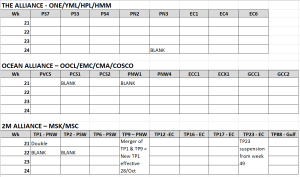
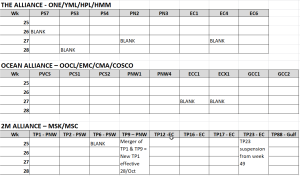
Trans-Pacific carriers are changing schedule rotations so that US-bound cargoes can be unloaded in Seattle-Tacoma rather than Vancouver and will divert even more vessels as the strike by the International Longshore and Warehouse Union (ILWU) Canada enters its second week, sources said Monday.
Meanwhile, vessel backlogs are building outside of Vancouver and Seattle-Tacoma, although the backlog changes constantly because additional vessels are arriving in the Pacific Northwest almost every day. According to the Vancouver Fraser Port Authority website, 14 container ships were at anchor or offshore of Vancouver on Monday.
Forwarders and a terminal operator told the Journal of Commerce at least six container ships that had been scheduled to call in Vancouver had been diverted to Seattle-Tacoma as of Monday. The ocean carriers make the final decision as to where vessels will rest at anchor as they await resumption of cargo handling in Vancouver.
The National Retail Federation on Friday said the ongoing longshore strike at the ports of Vancouver and Prince Rupert should not have a “major impact” in the United States, but could still affect some retailers that move merchandise through Western Canada.
Vessel rotations to the North American Pacific Northwest often have Vancouver as the first port of call before the ships proceed to Seattle-Tacoma, so Vancouver-bound containers are stowed on the top rows of the vessels, a terminal operator told the Journal of Commerce. Since the ILWU in the US announced last week that it will boycott Canadian-destined cargo in a show of support for ILWU Canada, longshoremen in Seattle and Tacoma must remove Canadian-destined containers first in order to access the US-bound boxes. Then they reload the Vancouver containers onto the vessels.
No face-to-face talks Monday
Meanwhile, contract negotiations between ILWU Canada and the British Columbia Maritime Employers Association (BCMEA) were not held on Monday, although the parties “continue to engage with the federal mediators,” according to a source familiar with the negotiations.
ILWU Canada launched its strike on July 1. Both sides remain far apart over two key issues — wages and a demand by ILWU Canada to extend its jurisdiction over maintenance work.
Employers offered a 14% wage hike over a four-year contract, while the union is seeking a 17% increase over a two-year contract, plus a lump sum payment of $8,000, according to a source familiar with the negotiations.
Source:
Mongelluzzo, B. (2023, July 10). Trans-Pacific carriers altering port rotations to avoid strike-hit Vancouver. Journal of Commerce. https://www.joc.com/article/trans-pacific-carriers-altering-port-rotations-avoid-strike-hit-vancouver_20230710.html
The container shipping industry in Western Canada is bracing for the possibility of an extended strike at the ports of Prince Rupert and Vancouver after longshore workers went on strike Saturday morning as threatened over a contract dispute.
The ports are adjusting operations to mitigate cargo buildup as both sides remain far apart on how to best fill existing heavy-duty maintenance jobs and whether the union’s remit should expand to other types of maintenance jobs at facilities, according to two sources close to the matter.
The Canada affiliate of the International Longshore and Warehouse Union and waterfront employers also face a wide divide on what they’ll accept in salary increases, paralleling the major stumbling block US West Coast employers and longshore labor finally overcame in announcing a tentative deal on June 15 after more than a year of negotiations.
Canadian shippers moving cargo through the British Columbia ports have few options for diversions. The US West Coast longshore union on Thursday signaled its solidarity in a letter to its Canadian counterpart. The International Longshoremen’s Association, which handles cargo on the US and East Coasts, went a step farther, pledging Wednesday to not handle any diverted cargo from Vancouver and Prince Rupert. Through connecting rail networks, US importers and exporters also ship goods through the British Columbia ports and have more alternative routing options.
After ILWU Canada workers began a strike at 8 a.m. Pacific time on Saturday, the Vancouver Fraser Port Authority said to mitigate backlogs it was adjusting how it directs and manages anchorage. For example, vessel anchorages in the inner harbor, where DP Centerm and GCT Vanterm operate, are now limited to 48 hours. Average rail dwell times at Vancouver marine terminals were under five days, according to port authority metrics, reflecting generally fluid cargo flow before containers stopped moving Saturday morning.
Late night bargaining sessions on Thursday and through Friday night between the Canada ILWU and employers, with from the assistance Federal Mediation and Conciliation Service, failed to produce a contract agreement to replace the one that expired at the end of March. The ILWU filed a 72-hour strike notice with the federal government on Wednesday.
Canadian West Coast employers locked out the ILWU for less than 24 hours in May 2019 after an impasse in contract negotiations. Semi-automation, centered on the then new rail project at GCT Deltaport, frustrated negotiations, and now color current talks due to the prospect of some level of automation at a planned C$3 billion (US$ 2.2 billion) Vancouver terminal, Robert Bank Terminal 2.
Federal Labor Minister Seamus O’Regan on Saturday tweeted that mediators were still at the table, adding that the Trudeau government “cannot emphasize this enough — the best deals for both parties are reached at the table.”
All eyes on Ottawa
The government took a similar approach in 2021 to Montreal port strikes, signaling support for both sides to work out their differences through negotiation and praising the merits of collective bargaining. Parliament passed back-to-work legislation after four weeks of sporadic port disruption at Montreal, ending the strike and forcing an arbitrated contract.
With Parliament out of session and unable to potentially pass back-to-work legislation, the pressure is on the Trudeau government to use its political capital to force a deal between ILWU Canada and the British Columbia Maritime Employers Association. Prime Minister Justin Trudeau is generally viewed within the Canadian shipping industry as having acted too slowly — and weakly — when containerized supply chains were significantly disrupted over the last three years.
The stakes are high this time, given the size of Vancouver and Prince Rupert, the country’s largest and third-largest ports by volume, respectively. Vancouver and Prince Rupert handle more than C$800 million (US $604 million) in trade daily, equating to a quarter of all of Canada’s trade in goods, according to the BCMEA.
Canadian industry on Wednesday urged the government to act, though, it expressed its support for collective bargaining. Canada’s supply chains are already fragile and the strike will ripple through agriculture to manufacturing industries, while consumer and businesses grapple with inflation, wrote Robin Guy, vice-president and deputy leader of government relations at the Canadian Chamber of Commerce and David van Hemmen is vice-president at the Greater Vancouver Board of Trade.
“We are seeing signs that goods destined for Canada are already being routed to other ports, adding costs and increasing the environmental footprint of trade, all to Canadians’ detriment,” the duo wrote in the Globe and Mail.
Source:
Szakonyi, M. (2023, July 2). Shipping industry braced for extended strike at BC Ports. Journal of Commerce. https://www.joc.com/article/shipping-industry-braced-extended-strike-bc-ports_20230702.html
Update with comments from OEC Chief Executive Marc Bibeau
Dockworkers on Canada’s West Coast plan to strike Saturday, saying they were “left with no choice” after failing to make progress during recent negotiations with maritime employers. The planned strike, which has no defined end date, would include Vancouver, Canada’s largest port and a gateway for goods landing in the US Midwest.
So far, there have been no operational slowdowns reported at British Columbia ports, and cargo is moving promptly, the head of one of Canada’s largest ocean forwarders said, who added that a strike would heap further economic pain on all port stakeholders who are already dealing with slower trade.
The International Longshore and Warehouse Union Canada (ILWU Canada) and the British Columbia Maritime Employers Association (BCMEA) said in separate statements Wednesday that the union sent formal notice that its members will walk off the job as of 8 a.m. West Coast time on July 1.
ILWU Canada said it filed the 72-hour strike notice because the BCMEA has “refused to negotiate on the main issues, and we feel we are left with no choice but to take the next step in the process.” The union, though, urged maritime employers to negotiate in “good faith” on wages and automation during contract talks that will continue ahead of the planned strike.
ILWU Canada said in its statement that its main goals are higher wages, protections for workers against automation and restricting the use of nonunion labor at port-related operations.
“We call on the BCMEA to drop all concessions and get serious about negotiating with the union in good faith,” it said, without addressing the specific concessions requested by the BCMEA.
Grain vessels will still be served during a strike, the BCMEA said, adding it is still negotiating with ILWU Canada about serving passenger ships.
The BCMEA said talks with the union, facilitated by federal mediation, will resume Thursday. The talks have been under federal mediation since March 28 when ILWU Canada first asked for the intervention.
The employers’ group said its members have put forth multiple offers “in good faith, with the objective of making progress and achieving a fair deal at the table.” It said it is willing to submit to binding arbitration if ongoing talks fail to reach a deal.
“Despite today’s regrettable development, we remain ready to reengage with our labor partners through the federal mediation process, with the desire of reaching a fair and balanced deal at the table that keeps our ports stable and goods flowing for Canadians,” the BCMEA said.
The potential impact of a strike on container operations at Vancouver is unclear at this point. Only five container ships are at berth at the port currently, with two of those having arrived Wednesday. It was not clear when they are expected to depart.
Marc Bibeau, president and chief executive of OEC Group Canada, told the Journal of Commerce that the Vancouver and Prince Rupert container ports are currently “100% fluid with no congestion and no delays.”
He said that he is “cautiously optimistic” that a deal can be struck soon to shorten, if not completely avert a strike. The talks between the two sides in Canada have only gone on for three months compared with the protracted, 13-month negotiation period for a US West Coast labor deal. The federal government may also look to intervene more forcefully if a strike were to hit British Columbia ports, Bibeau said.
With a tentative deal at US West Coast ports all but assuring labor peace, Bibeau said Canadian ports risk losing more cargo amid an already soft market that has hurt all port stakeholders.
“The economy is already soft, so we can’t afford to lose more volume, which also affects the labor pool” Bibeau said. “Both sides have to come to a deal because volumes are already down double digits.”
The Canadian strike threat comes two weeks after the ILWU on the US West Coast and waterfront employers reached a tentative deal on a new six-year contract after 13 months of contentious talks.
Source:
Angell, M. (2023, June 28). ILWU Canada plans to strike British Columbia ports on Saturday. Journal of Commerce. https://www.joc.com/article/ilwu-canada-plans-strike-british-columbia-ports-saturday_20230628.html
Job actions stopped
This week began on a tense note, as sources said negotiators for the ILWU and PMA were working under a self-imposed 72-hour deadline to reach a deal before a possible coastwide employer lockout or strike. US Labor Secretary nominee Julie Su also arrived in San Francisco Monday, urging negotiators to reach an agreement and remaining in the Bay Area to offer further assistance until the tentative contract was agreed.
Terminal operators along the West Coast told the Journal of Commerce productivity was back to normal and dispatch orders were filled on the Thursday night shift and the Friday day shift at the Seattle-Tacoma, Oakland and Southern California gateways. “Things are running pretty well,” a source said.
ILWU locals last week resumed a series of on-again, off-again job actions up and down the coast that varied from terminal to terminal and were designed to pressure PMA negotiators to give into the union’s demands, according to press statements by the PMA.
Those actions included the insufficient dispatching of workers, including lashers who secure the top row of containers to the vessel for safety purposes. As a result, some vessels were delayed a day or longer from leaving port. Crane productivity in Seattle-Tacoma dropped from the normal 25 container moves per crane per hour into single digits, sources said.
Source:
Mongelluzzo, B. (2023, June 16). ILWU scores 32% wage increase, $70 million bonus in tentative new contract. Journal of Commerce. https://www.joc.com/article/ilwu-scores-32-wage-increase-70-million-bonus-tentative-new-contract_20230616.html
The tentative West Coast longshore labor agreement that was reached late Wednesday will initiate a lengthy — but normal — process in which officers of the International Longshore and Warehouse Union (ILWU) and waterfront employers over the next few months will explain details of the six-year contract to their respective membership and urge ratification of the agreement.
Based on past contracts negotiations, ILWU locals and local employers will finalize so-called side contracts for their regions that do not require approval at the coast level. The ILWU will then schedule a caucus with officers of the locals to go over details of the coastwide agreement, after which the local officers will hold meetings in their regions to discuss the agreement with their membership.
Finally, a date will be set for a coastwide vote by the ILWU membership. The Pacific Maritime Association (PMA), which has 70 members representing shipping lines and terminal operators, will also discuss and take a ratification vote on the agreement.
In past contract years, the entire process took about three months to complete, which means the ratification process this year may run into the early fall.
Still, Ed DeNike, president of SSA Containers, the largest terminal operator on the West Coast, said he is “almost 100% certain” the ILWU and PMA will ratify the contract. DeNike told the annual meeting of the Agriculture Transportation Coalition (AgTC) Thursday in Tacoma that the 13 months of negotiations were “hard,” and neither side feels particularly good about the tentative deal. But both sides felt pressure to reach an agreement this week to prevent the negotiations from completely unraveling, he said.
“When [the negotiating process] is over with, you have a sinking feeling that you screwed up,” DeNike said. “When both sides feel that way, it’s actually good.” SSA operates three container terminals in Seattle, three in Long Beach, and Oakland’s largest terminal.
Job actions by ILWU locals should be over
The tentative contract, which was reached late Wednesday with the assistance of US Labor Secretary nominee Julie Su, is expected to put an end to the on-again, off-again work disruptions by ILWU locals that began last fall and affected all major ports along the West Coast to one degree or another. Those labor tactics included failing to dispatch sufficient numbers of workers, the late dispatching of workers and operating cranes far below normal productivity levels.
Three sources told the Journal of Commerce that operations in Seattle-Tacoma, Oakland and Los Angeles-Long Beach went smoothly during the Wednesday night shift and were proceeding normally during Thursday’s day shift.
DeNike, though, expressed concern that the large volumes of discretionary cargo that retailers have diverted to East and Gulf coast ports this past year will not return quickly enough, or at a magnitude necessary to cover the increased labor costs in the new contract.
He noted that SSA accounts for about 25% of total ILWU worker-hours paid on the West Coast, adding SSA’s cargo volumes so far this year are down about 60% in Seattle, 30% in Oakland and 25% in Long Beach.
“This contract that we just agreed to yesterday is going to increase that cost,” DeNike said.
Source:
Mongelluzzo, B. (2023b, June 15). Tentative west coast longshore deal triggers lengthy ratification process. Journal of Commerce. https://www.joc.com/article/tentative-west-coast-longshore-deal-triggers-lengthy-ratification-process_20230615.html
Cargo handling at West Coast ports was largely normal Tuesday after the International Longshore and Warehouse Union (ILWU) and maritime employers agreed to a cooling off period late Monday during a joint meeting with Julie Su, the Biden administration’s nominee for Labor Secretary, sources said.
The two sides will attempt to use the apparent truce to reach agreement on the highly contentious issue of wages, which triggered disruptive job actions by ILWU locals over the past week and appeared to put the 13-month-long contract negotiations at a low point. Negotiations were due to resume Tuesday.
Su met with the ILWU and Pacific Maritime Association (PMA) in San Francisco in a bid to break the stalemate.
The job actions by ILWU locals in the Pacific Northwest and Southern California ceased for the night shift Monday, sources said, and West Coast ports began Tuesday’s day shift amid normal operations.
“We’re pretty stable here this morning,” a source with knowledge of Southern California port operations told the Journal of Commerce Tuesday. “There were no issues [Monday] night.”
A number of terminals in Los Angeles and Long Beach were shorted key workers last week by ILWU locals, causing a vessel backlog because ships could not leave port.
A spokesperson at the Port of Oakland said all terminals were open and operating normally for the Tuesday day shift following a quiet night shift Monday.
A source told the Journal of Commerce Tuesday that operations in Seattle and Tacoma, which had suffered the worst of the work slowdowns last week, were “kind of back to normal” on the second shift Monday and the day shift Tuesday.
Impatience within the PMA, in part due to months of delay in talks last year over automation matters and jurisdictional issues — but especially over the labor unrest up and down the West Coast — is growing. One source told the Journal of Commerce the possibility of a lockout by employers, which seemed remote just a few weeks ago, has risen and is now “50-50.”
Far apart on wages
The coastwide contract negotiations have yet to reach a conclusion after 13 months, and the current hangup over wages could be the most problematic issue of all. The ILWU is reportedly demanding an increase of $7.50 per hour in the straight-time wage for each year for the six-year life of the new contract, or a staggering $45 hike per hour. The current wage is $46.23 per hour, according to the PMA’s 2022 Annual Report, so the ILWU is seeking to essentially double the straight-time hourly wage for general longshore workers. But after two years of record profits for carriers in 2021 and 2022 that ran well into the tens of billions, longshore workers are looking to cash in.
The PMA and ILWU declined to comment. Sources told the Journal of Commerce the PMA is offering a wage package that is significantly less than what the ILWU seeks.
PMA members are keenly aware that any deal agreed to with the ILWU will serve as a floor for upcoming negotiations with the Office Clerical Union, which represents about 500 workers at roughly 15 marine terminals and ocean carriers in and around Los Angeles-Long Beach. A six-year contract with the OCU expires on July 1 and a scenario where there is simultaneously no ILWU contract and no OCU contract is a recipe for disruption that could be escalated to an entirely new level.
Compensation agreed to with the ILWU will also serve as a basis for upcoming talks with the International Longshoremen’s Association (ILA) on the East and Gulf coasts.
The ILWU’s wage demand will affect only the straight-time wage that is paid to all longshore workers regardless of their work categories. Under the coastwide contract that expired last July 1, ILWU marine clerks and foremen receive skill-differential pay on top of the base wage. Marine clerks earn 15%, 25% and 30% skill differential pay on top of the hourly wage, depending on their work categories. All foremen earn a 30% wage differential on top of the base hourly wage, according to the PMA Annual Report.
The report listed the earnings of longshore workers who worked 2,000 hours annually, or a 40-hour work week, in 2022 as $197,514 for general longshore workers, $220,042 for marine clerks and $306,291 for foremen.
Source:
Mongelluzzo, B. (2023, June 13). West Coast Ports “stable” after ILWU, PMA agree to cooling off period. Journal of Commerce. https://www.joc.com/article/west-coast-ports-stable-after-ilwu-pma-agree-cooling-period_20230613.html
(Updating with results of strike authorization vote).
Members of Canada’s International Longshore and Warehouse Union (ILWU) have voted in favor of a strike should the union and maritime employers not come to terms over a new coastwide contract.
The British Columbia Maritime Employers Association (BCMEA) said in a statement Monday that ILWU Canada has “confirmed a mandate in favor of a strike action if needed.”
The authorization, which was voted on last week, comes one day ahead of talks scheduled for Tuesday on a new collective bargaining agreement covering the ports of Vancouver and Prince Rupert. The Canadian government’s Federal Mediation and Conciliation Service (FMCS) will oversee the talks.
“The BCMEA remains committed to bargaining in good faith and seeking a fair and balanced deal that recognizes the expertise of the waterfront workforce, while ensuring West Coast ports remain competitive, resilient and affordable for all Canadians,” BCMEA’s first statement said.
The prior five-year agreement between the two sides expired at the end of March,
In response to a potential strike, the Canadian International Freight Forwarders Association (CIFFA) asked the federal government in a letter last week to do all it can to avert a work stoppage.
CIFFA warned that a disruption at Vancouver, Canada’s largest port, could cost more than the estimated C$40 million to C$100 million per week from similar job actions at the smaller Port of Montreal. The group added that its members are already dealing with the fallout of separate longshore work disruptions of the ports of Seattle and Tacoma.
“The continued challenges south of our border, where labor actions at ports on the West Coast have forced the closure of some terminals, disrupting supply chains and creating instability and uncertainty, make it even more difficult for Canadian businesses to export or import,” CIFFA’s letter said. “It’s frustrating that instead of taking advantage of the unreliability of US ports, to the benefit of workers and firms, we are instead imitating them.”
‘Cooling off’ end June 21
Should union members go ahead with a strike, the soonest it could happen would be June 24, following a 72-hour notice that would be given at the June 21 end of the “cooling-off” period mandated by the FMCS.
Along with wage increases, the talks are centering around plans to build a new container terminal in Vancouver, the proposed Roberts Bank 2, and how potential automation might impact longshore labor demand.
Source:
Angell, M. (2023, June 12). Update: ILWU Canada votes to strike if contract talks fail. Journal of Commerce. https://www.joc.com/article/update-ilwu-canada-votes-strike-if-contract-talks-fail_20230612.html
A vessel backlog that developed earlier this week at the ports of Los Angeles and Long Beach amid a lack of longshore labor was cleared Friday, a sign that progress was being made in coastwide contract negotiations between the International Longshore and Warehouse Union (ILWU) and maritime employers.
Talks between the ILWU and the Pacific Maritime Association (PMA), which represents ocean carriers and marine terminals, continued in San Francisco Friday for a third straight day. That in itself was another positive indicator, sources said, with negotiations hitting the 13-month mark this weekend.
Sources said the normal complement of workers – known as “lashers” — who secure the top row of containers on a vessel was dispatched Thursday night and early Friday in Los Angeles and Long Beach, allowing ships to be worked without disruption. The ILWU locals in Southern California refused to dispatch sufficient lashers earlier this week, causing delays that resulted in a backlog of vessels.
“It’s good today,” a source close to vessel operations in Los Angeles-Long Beach said Friday. “Our labor (orders) were filled last night and today.”
Disruption continues in Seattle, Tacoma
Kip Louttit, executive director of the Marine Exchange of Southern California, said the backlog of container ships that were forced to slow-steam or stop at anchor had cleared by the day shift on Friday. Four vessels scheduled to arrive by midday Friday would most likely go directly to berth, Louttit said.
Cargo handling in Oakland, meanwhile, was normal for a second straight day.
“The Port of Oakland’s marine terminals are open and operating normally (Friday),” a spokesperson for the port said in a statement to the Journal of Commerce. ”The number of vessels waiting for a berth in Oakland is five, which is about average.”
Operations at Seattle and Tacoma, however, were “still bad” Friday, another source said, as job actions by dockworkers continued. Crane productivity at the Port of Seattle, which plunged to less than 10 percent of normal this week and was only slightly better in Tacoma, remained exceptionally poor on Friday.
The PMA said in a statement Friday that Seattle and Tacoma “continue to suffer significant slowdowns as a result of targeted ILWU work actions.”
The ILWU declined comment.
The fact that the ILWU and PMA held contract negotiations Friday for the third straight day is viewed by sources with knowledge of the talks as a positive sign. In recent weeks, the two sides had been meeting about once per week and were reportedly making little progress, which was demonstrated by the cargo-handling disruptions launched last week by ILWU locals that were intended to pressure the PMA into making concessions on wages.
The two sides have been far apart on the wage issue, with the ILWU reportedly demanding an almost 100% increase in the straight-time hourly wage, with the PMA’s offer said to be in the low single-digits.
“Even though some port operations have improved, the ILWU’s repeated disruptive work actions at strategic ports along the West Coast are increasingly causing companies to divert cargo to more customer-friendly and reliable locations along the Gulf and East Coasts,” the PMA said in its statement. “It is difficult to win back cargo once it’s diverted.”
Source:
Mongelluzzo, B. (2023c, June 9). LA-lb vessel backlog cleared as west coast negotiators remain at bargaining table. Journal of Commerce. https://www.joc.com/article/la-lb-vessel-backlog-cleared-west-coast-negotiators-remain-bargaining-table_20230609.html