Blank Sailing

Blank Sailing
Gemini Cooperation partners Maersk and Hapag-Lloyd on Friday announced a revamp of some Asia-Europe and Mediterranean alliance services, with extra port calls and larger ships, mainly beginning in April.
Five services are covered by the adjustments, which are being made to give “stronger market coverage and faster products on key Asia-North Europe and Mediterranean trades,” Hapag-Lloyd said in an advisory.
The most significant change on Asia-Europe services has been made on the AE3/NE3 loop, which will see the introduction of a Baltic rotation with calls at Aarhus (Denmark) and Gothenburg (Sweden), significantly enhancing market coverage in that region.
Southampton will become the final European outbound call to Asia, strengthening UK export flows, while Spain’s Algeciras will be dropped from the rotation, the carriers said.
In Asia, the service will call at Shenzhen’s Yantian port, “improving optionality for customers favoring Pearl River Delta connectivity,” Hapag-Lloyd said.
While the service will continue to start from Shanghai, the call at Ningbo has been relinquished.
The new rotation is: Shanghai, Yantian, Tanjung Pelepas (Malaysia), London Gateway, Aarhus, Gothenburg, Rotterdam, Southampton, and Singapore.
The Gemini partners confirmed that Antwerp would be added to the AE1/NE2 service, but the loop would no longer call at APM Terminals TC1 facility in Tangier. The call at Tanger Alliance TC3 terminal will continue.
The Antwerp call, initially announced by the carriers in an advisory earlier this month, will expand the “hinterland reach and improving access to key Benelux and European cargo flows,” Hapag-Lloyd said Friday.
The first westbound sailing will be made by the 23,664-TEU Hamburg Express that will depart Shanghai on March 6 and call Antwerp on April 21. The revised rotation is: Shanghai, Yantian, Tanjung Pelepas, Rotterdam, Hamburg, Antwerp, London Gateway, Tangier (TC3), and Singapore.
Hapag-Lloyd said the NE4/AE4 loop will revert to its previous rotation without the Baltic loop, which is now covered by the NE3. “This creates one of the fastest, direct Ningbo-Germany connections in the market, responding to strong customer demand,” the carrier said.
Consequently, Maersk said calls will be added at Ningbo and Algeciras, but Yantian will be dropped.
The full loop comprises Qingdao, Ningbo, Tanjung Pelepas, London Gateway, Bremerhaven and Hamburg in Germany, Rotterdam, Algeciras, and Tanjung Pelepas.
Details please refer to the JOC news.
Source: JOC
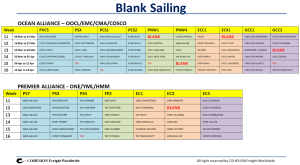
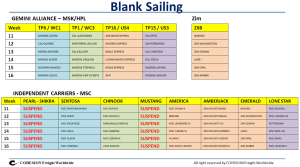
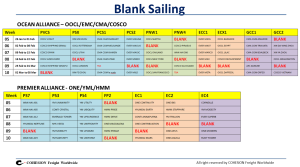
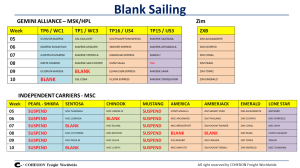
Close to 40 transpacific services are set to be blanked over the next fortnight, with more to come in what is looking like an absolute near-term bloodbath on the lane.
Indeed, the port of LA last month reported a 12% year-on-year decline in processed volumes.
With Cosco having blanked all three of its standalone West Coast services, Linerlytica is reporting a total of 37 blankings across the major networks between weeks eight and nine, and a further 19 scrubbed over the course of March.
Port of LA executive director Gene Seroka said January imports landed at 491,000 container units, down 13% from last year’s high, and the consumer confidence index at its lowest point in 11 years.
“Everyone from Wall Street to Main Street to my street is paying attention. On the export side, we handled 100,000 teu, an 8% drop year over year – our lowest monthly output in almost three years.”
However, there near-term struggle was expected to ease, with Linerylytica and Mr Seroka expecting a uptick. The analysis suggested capacity will swing back up quickly in March, with additional capacity likely to be added from the end of April onwards.
This additional capacity will come in part from the Premier Alliance and Wan Hai, which will introduce two new US west coast services.
And Mr Seroka indicated that cargo, while down year on year, was looking better than “weak”, noting: “Purchase orders are not being cancelled; this is something we’ve witnessed in other years that were far bumpier from an economic output standpoint.
“Furthermore, I watch the purchase orders that go out – these go six months in advance to the factories in Asia – and right now those purchase orders are looking stable. This is a good sign.”
And Mr Seroka suggested that volumes this year would likely sit “at or near” last year’s levels, pointing out that he had kept in mind that this was compared with the “v-shaped” 2023 volumes, when importers were scrambling to get cargo in ahead of tariffs.
Looking at total throughput, he also pointed out that January’s result was “only” 2% off the California gateway’s three-year average.
There are those that would challenge the upbeat tone of the port director, as Linerlytica has indicated US consumer confidence was very definitely trending downwards.
It wrote in its weekly market update: “Growth in US consumer spending on goods is trending downwards, and for container shipping it is noteworthy that furniture spending growth is now negative.”
Source: Theloadstar
Hapag-Lloyd will likely use its $4.2 billion takeover of Zim Integrated Shipping Services as the springboard for a significant expansion of its intra-Asia business through Zim’s Hong Kong-headquartered affiliate Gold Star Line.
Hapag’s existing intra-Asia coverage is limited to a series of slot charters with other shipping lines. It also utilizes intra-Asia services established by its Gemini Cooperation partner Maersk, which had several regional carriers including MCC and Sealand Asia before being consolidated within Maersk.
By comparison, Gold Star has a network of 20 liner services operated by 40 owned and chartered ships totaling 100,000 TEUs serving Asia, India and South Africa. But they are also China-centric, linking ports such as Shanghai and Ningbo to specific Southeast Asia countries including Indonesia, Vietnam and Thailand while also connecting China with India, Africa and the Middle East.
There is no or very little coverage to markets such as Japan, Taiwan or within the Southeast Asia region.
The gaps in Gold Star’s extended Asia and regional coverage give Hapag-Lloyd tremendous scope to expand its Asia network to those countries either through new services or adding ports on existing Gold Star services, Dafni said Friday. He said Gold Star’s network growth was restricted partly due to parent company Zim’s trade priorities and Israeli ownership.
Alphaliner, in its newsletter this week, said Hapag-Lloyd’s takeover of Gold Star Line will help the German carrier to “enlarge its Asian footprint.”
Improved connectivity, faster transits expected
Aside from new services, Dafni said growth would probably also come from significant cost savings through the elimination of costly feeders and slot charters.
Gold Star’s extensive intra-Asia services will feed cargo into Hapag’s mainline hub-and-spoke Gemini Cooperation network with Maersk, offering Southeast Asia and regional exporters improved connectivity with more destinations and faster transit times. Similarly, import volumes via the Gemini network will increase volumes from the main Asia hubs to neighboring countries.
“Feedering will shift from being a cost for Hapag-Lloyd to becoming a profit and revenue generator as third-party cargo shifts to its Asia services,” Dafni said.
Hapag-Lloyd and Gold Star Line said it was premature to comment on what would happen to Gold Star under new ownership.
The Zim deal “includes Gold Star Line, but no decision has yet been made about what will happen to the brand. It is simply too early to talk about it,” a Hapag-Lloyd spokesperson told the Journal of Commerce.
A senior source close to Gold Star Line said it was “too early to evaluate the impact.”
“We are still learning about the deal and waiting for the relevant approvals,” the source said.
Details please refer to the JOC news.
Source: JOC
The Ocean Alliance and Ocean Network Express (ONE) will remove some ships and consolidate US port calls in their jointly-operated trans-Atlantic network. The move follows an uneven year in the trade, with US exports to Europe up strongly but Europe’s exports to the US slowing.
Ocean Alliance partner CMA CGM said Friday its trans-Atlantic network will change effective in April. The new network, CMA CGM said, will provide the US East Coast with “stronger coverage [and] reinforced frequency” and better leverage CMA CGM’s US and European terminals.
The biggest change will be the end of the “Unity Bridge” service between major Northern European ports and the ports of Charleston and Savannah. Unity Bridge, which operates with four ONE ships and one Evergreen Marine vessel, will make its last westbound departure from Le Havre on March 16.
The south Atlantic US ports will instead be included on the rotation for the higher-capacity Liberty Bridge service, which currently calls the ports of New York-New Jersey, Norfolk and Baltimore.
The new Liberty Bridge service will drop Baltimore as of the first westbound sailing from Southampton on March 27. Charleston and Savannah will be added after the Norfolk call.
The new trans-Atlantic network comes after the Ocean Alliance and ONE revised their one-year-old vessel sharing agreement filed with the Federal Maritime Commission (FMC) on Feb. 6 to consolidate their north and south Atlantic networks into a broader North American trans-Atlantic service.
The new agreement will see seven ships deployed in the revised trans-Atlantic network, compared with the 11 ships the carriers deployed under the separate north and south Atlantic networks. ONE will go from providing four ships to the soon- expiring south Atlantic network to two ships under the revised trans-Atlantic network.
Cosco and OOCL will also remove a ship, providing two to the new network. Evergreen will also remove a ship, providing one to the new network.
Details please refer to the JOC news.
Source: JOC
Panama Ports Company (PPC) is seeking “extensive damages” after launching arbitration proceedings against the government of Panama following the decision of the country’s Supreme Court last week to void the company’s concessions to operate the Cristobal and Balboa ports. PPC had held the concessions for 28 years.
The port company, 90% controlled by Hutchison Port Holdings, a subsidiary of Hong Kong-listed conglomerate CK Hutchison, said Wednesday the Panamanian government has already started to take control of the terminals that bookend the Panama Canal even though the court decision has yet to be published and finalized.
“The steps taken by the state have included unexpected site visits and instructions that PPC provide unrestricted access to physical, commercial, and intellectual property and information, as well as to employees, on the basis that the state is systematizing and executing a port transition plan through coordinated actions of state authorities,” PPC said in a statement.
APM Terminals (AMPT), which was appointed by the Panama Maritime Authority as interim administrator of the two terminals a day after the court’s decision, would not comment on whether it had taken part in the site visits or other actions following the court ruling.
“At this moment, we have no further comments to share other than what we have released on our website,” an APMT spokesperson said. “For any next steps we refer to the relevant authorities in Panama.”
CK Hutchison on Wednesday said it “continues to consult with its legal counsel and reserves all rights, including recourse to additional national and international legal proceedings.”
Details please refer to the JOC news.
Source: JOC
The container ships from Maersk and Hapag-Lloyd will be escorted through the Red Sea by warships from Europe.
When Maersk and Hapag-Lloyd are to send their first Gemini container ships through the Red Sea, the ships will be protected by warships. These will be European naval vessels stationed in the region.
Hapag-Lloyd confirmed this in a written response to ShippingWatch after the two container shipping companies announced on Tuesday that they would be sending two of their ships through the Red Sea and the Suez Canal from mid-February.
Until now, container ships have sailed south of Africa on their way between Asia and Europe due to the risk of armed attacks from the Yemeni Houthi movement.
On westbound voyages, the Gemini route ME11 will be served by the ship Albert Maersk, while Astrid Maersk will handle eastbound voyages, according to a press release from the two shipping companies.
Maersk and Hapag-Lloyd do not wish to comment further on the security situation in the Red Sea.
Several European countries have warships in the waters in and around the Red Sea as part of the EU’s naval operation Eunavfor Aspides. The operation’s mandate currently runs until February 28 this year, and the goal is for the warships to protect civilian shipping from armed attacks.
The US Navy is also present with a number of warships in the area around the Red Sea.
Source: SHIPPINGWATCH
The container line has no intentions of sailing through the Arctic, where navigation is dangerous and puts pressure on the environment, according to CEO Søren Toft.
Mediterranean Shipping Company (MSC), the world’s largest container carrier, denies having plans to operate via the Arctic region.
In a post on LinkedIn, the company’s chief executive, Søren Toft, writes that MSC does not wish to use the passage north of Russia known as the Northern Sea Route.
“Our position at MSC is clear. We do not and will not use the Northern Sea Route,” Toft writes in the post, referring to the intensified debate on the Arctic.
He justifies MSC’s rejection of Arctic shipping on the grounds of uncertainty and environmental concerns.
”Safe navigation cannot be assured. The risks for crews remain too high. And increased traffic would put additional pressure on fragile ecosystems and local communities,“ writes Toft.
In addition, according to Søren Toft, MSC does not need to sail through the Arctic.
”Our fleet and network allow us to transport our customers’ cargo safely and reliably around the world without doing so,” he writes.
Russia and China in particular are eager to sail via the Northern Sea Route. The possibility of using the passage remains limited, but as climate change causes the ice to melt, sailing via the Arctic is becoming more accessible to merchant ships.
Source: SHIPPINGWATCH
Blank Sailing
Following successful test voyages, Maersk is back in the conflicted region with a service of 14 ships connecting the Middle East and India with the US East Coast.
Maersk is now resuming operations through the Red Sea and the Bab el-Mandeb Strait with all ships on its so-called MECL service, the carrier has informed ShippingWatch and announced broadly in a press release on Thursday morning CET.
Specifically, this is a service connecting the Middle East and India with the US East Coast. Currently, a total of 14 ships are sailing on Maersk’s MECL service south of Africa’s Cape of Good Hope.
They have been doing so since the beginning of 2024, when most shipping companies redirected their ships away from the Red Sea after the Yemeni Houthi movement carried out several armed attacks on merchant ships in the area.
However, the route south of Africa is significantly longer and can add up to 14 days to voyages from Asia to Europe.
Maersk has informed ShippingWatch that the recently announced return will free up capacity, as the ships will sail shorter distances, and the shipping company’s MECL service will therefore consist of only 12 ships by the end of the first quarter.
In recent days, violent protests in Iran have prompted the US to threaten a possible military response. This was followed by Iran warning of harsh retaliation against US bases. In response, the US and the UK withdrew military personnel from their bases in Qatar, among others, yesterday afternoon.
Maersk emphasizes that the shipping company is prepared if the situation in the Middle East deteriorates.
“.Maersk has contingency plans in place should the security situation deteriorate, which may necessitate reverting individual MECL sailings or the wider structural change of the MECL service back to the Cape of Good Hope route,” the shipping company writes.
“The safety of crew, assets, and customers’ cargo remains the highest priority.”
The Maersk Detroit also departed from North Charleston on Jan. 10 and will be the first eastbound vessel to use the route through the Suez Canal.
“All subsequent voyages will follow this route,” writes Maersk.
However, a full-scale return may still be a long way off.
In December, Maersk’s head of Northern Europe, Ole Trumpfheller, told the German media outlet Deutsche Verkehrs-Zeitung that it will take up to six months to reconfigure the shipping company’s routes between Asia and Europe.
Johan Sigsgaard, product manager for Ocean at Maersk, further described in a market update this week that a return will cause disruptions, especially for container shipping companies.
“There is no doubt that there will be added volatility to supply chains once container liners begin the shift back to East-West transits through the Red Sea, just as we saw when the industry started sailing via the Cape of Good Hope,” he explained, adding:
“So the acceleration of vessel arrivals into Europe means overstocking is a distinct possibility.”
Gratitude to the Suez Canal
Rumors of Maersk’s possible return to the Red Sea began circulating as early as November.
A rather strange sequence of events unfolded after the shipping group’s chief executive, Vincent Clerc, visited the chairman of the Suez Canal Authority, Osama Rabie.
After the meeting, the authority announced on social media platform X that Maersk and its competitor CMA CGM would return to the area at the beginning of the following month.
However, Maersk and its alliance partner Hapag-Lloyd then sent a correction to several media outlets, stating that no timeline had yet been set for when Maersk would return to the Red Sea.
Now, however, it appears that the Suez Canal Authority was simply a step ahead of events. The cooperation between Maersk and the important maritime canal is seemingly intact and, according to Maersk itself, has played a significant role in making a return possible.
“The strategic partnership between Maersk and the Suez Canal Authority has played a key role in the planning of the return,” the shipping group wrote today, Thursday, continuing:
”Collaboration with the Suez Canal Authority and other strategic partners in the region continues to be critical to ensure that the structural change of the MECL service and any next steps in a gradual trans-Suez return happens in a way that ensures the safety of the operations and safeguards predictability and stability for customers.”
Thursday’s announcement also emphasizes why it is important for Maersk to return to Suez:
“The route through the Suez, the Red Sea, and the Bab el-Mandeb Strait is the fastest, most sustainable and most efficient way to serve customers with transport between Asia and Europe.”
Details please refer to the news.
Source: SHIPPINGWATCH