MSC revamps Asia-USEC network

Mediterranean Shipping Co. is reworking its trans-Pacific network starting next month to offer more reliable, direct China services into US Northeast and Southeast ports, while providing coastwide direct service from Southeast Asia.

MSC said in a Thursday customer advisory that it is changing some port calls on its three main East Coast services to “enhance service reliability and schedule stability.” The new networks consolidate some China calls and will change some calls to Florida ports.

MSC’s Empire Service will drop a Qingdao call, with the service now only calling Shanghai, Ningbo and Busan on the front haul. Empire’s US rotation will drop the ports of Jacksonville and Miami in favor of calls to Norfolk and Port Everglades on the backhaul.

The service’s new rotation will commence with the scheduled May 27 departure of the 6,178-TEU MSC Leo VI from Shanghai. The carrier said Empire would be “less exposed to port congestion risks” due to the rotation change.

Qingdao will be added to MSC’s Amberjack service into the US Southeast. However, MSC will no longer provide direct service from Yantian and Xiamen but instead focus the service on northeast Asia ports. The service will also replace a call to Norfolk with a call to Jacksonville.

MSC said the Amberjack changes would improve transit times and network stability. The new rotation goes into effect with the service’s estimated May 20 departure from Qingdao.

MSC also said it would rework its Emerald service from Southeast Asia to drop a call to Taiwan’s Kaohsiung in favor of Xiamen, providing a direct service from that port into the largest US East Coast ports. The new rotation is expected to take effect with the May 18 departure from Singapore of the 7,000-TEU Zim Topaz.

Source: JOC
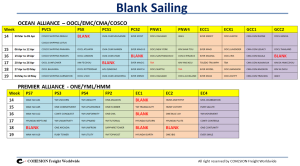
CMA CGM taps Jaxport as newest call for Asia express service

CMA CGM will add the Port of Jacksonville to its trans-Pacific express service, adding to the port’s roster of direct Asia services and tapping the recent modernization of Jaxport’s main marine terminal.

The Jacksonville Port Authority said in a statement Wednesday the Ocean Alliance will include the port on its Chesapeake Bay Express (CBX) service rotation as of this June. The CBX, operated exclusively by CMA CGM, calls Vietnam, China and South Korea before its eastbound rotation that includes US calls at Norfolk, Charleston and Savannah before Jacksonville.

The CBX had previously called Miami, which is no longer on its rotation, according to its schedule. Ocean Alliance had previously been planning to add Jacksonville to one of its Gulf Coast services but instead settled on including it on the CBX. Jaxport will see the first CBX call with the June 27 expected arrival of the 7,327-TEU CMA CGM Passion.

Jaxport Chief Executive Eric Green said in the statement the introduction of the CBX “expands routing flexibility between the Southeast United States and key Asian markets.” Jaxport added that its position on the CBX rotation will mean “opportunities for equipment repositioning and expedited transit for US export cargoes.”

Details please refer to the JOC news.

Source: JOC

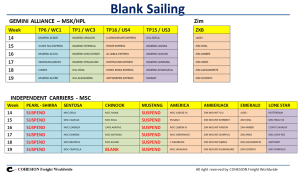
MSC consolidates USWC, Asian calls to boost trans-Pacific reliability

Mediterranean Shipping Co. (MSC) is reducing the number of West Coast port calls it makes on one of its trans-Pacific services and changing its Asian port rotations in a bid to improve schedule reliability and service consistency.

MSC said in a customer advisory late last week that its Orient service from China would no longer call Oakland, effective as of the April 30 departure of the 8,827-TEU MSC Naomi from Qingdao.

MSC said it made the change so “the service will be less exposed to port congestion risks, allowing for improved schedule reliability and more consistent on-time arrivals.”

Although not in MSC’s advisory, the Orient service, whose only West Coast call will be the carrier’s Long Beach terminal, has also effectively dropped Portland, Oregon, as a regular call, even though the port was listed on the rotation in earlier Orient service brochures.

MSC, which has offered intermittent service to Portland since the pandemic, last called Portland with a post-Panamax container ship in May 2025, according to Sea-web, a sister company of the Journal of Commerce.

The carrier, meanwhile, is adding Vietnam’s Haiphong as a regular call to its Sentosa service from Southeast Asia to Long Beach and Oakland. The new call from Haiphong, MSC’s first direct service from that port into Long Beach, will be in effect as of the April 16 departure from Haiphong of the 16,616-TEU MSC Lorenza.

MSC said the change “will offer improved transit times compared to the previous routing, while optimizing port coverage within a more stable network structure.”

Dropping Haiphong on Chinook service

However, MSC will be dropping Haiphong as a call on its Chinook service into the Pacific Northwest, leaving Vietnam’s Vung Tau, major Chinese ports, and South Korea’s Busan on the service. The new Chinook rotation will be in effect as of the April 13 departure of the 10,114-TEU Express Athens from Vung Tau.

Details please refer to the JOC news.

Source: JOC

Houston cuts free time on reefer importers amid ongoing high dwells

The Port of Houston is reducing the free time given to refrigerated container imports at its marine terminals because shippers continue to leave reefer cargo past the port’s allotted grace period.

The Board of Commissioners for the Port Houston Authority approved Monday a change to the terminal tariffs that will reduce the free time for a refrigerated container to four days from the current seven-day period in place for all containers. The policy change comes as reefer imports, while still a small part of the port’s business, grow faster than Houston’s dry cargo imports.

The tariff change will take effect May 1. Reefer shippers will still have an additional three days of free time available if a container requires an inspection by US Customs and Border Protection or the Department of Agriculture (USDA).

In asking for the tariff change, Chief Port Operations Officer Ryan Mariacher said the move would align Houston’s policies with how other ports handle refrigerated containers.

“This supports the shippers that need to expedite the handling of these commodity types,” Mariacher said. “We want to be a transit facility, not a storage facility.”

Mariacher did not say how long refrigerated containers are dwelling at the port. But in June 2025, when the port approved a higher rate of demurrage on refrigerated boxes, he said some shippers had been leaving their reefer shipments at the port for a week or more.

Details please refer to the JOC news.

Source: JOC

Asia-Europe air cargo space tightens as rates, fuel surcharges soar

Shippers of Asia-Europe air cargo are being hit with a double whammy of rapidly rising freight rates and soaring fuel surcharges as Middle East cargo gets rerouted, China picks up production after Lunar New Year and jet fuel prices double.

An estimated 30% of Asia-Europe air cargo is routed via the Middle East, and with options through the region severely constrained by the ongoing US-Iran war, a rush for Asia-Europe air cargo capacity is pushing up rates with hefty fuel surcharges rolled out on top.

While data from Freightos shows spot rates on China-Europe are up about 13% compared with last week, the rates from South Asia to Europe have increased 82% since before the war started. The Baltic Air Index had Singapore outbound rates up 47.6% last week compared with the previous week as Middle East airspace closures drove diversions from Gulf hubs to Asian gateways, tightening capacity.

Judah Levine, head of research at Freightos, said rates climbed sharply following the outbreak of war and the airspace closures, but in the last few days prices have leveled off on many lanes.

“That may reflect some capacity recovery by Emirates, as well as Etihad, or the addition of direct Asia-Europe capacity by European airlines and carriers from the Far East,” he said.

Several freighter operators and integrators have repositioned capacity to serve growing demand on Asia-Europe markets, but a protracted regional conflict could see rates climb even higher.

“If this continues, we will see increases of 100% to 200% on the short-term market,” Van de Wouw noted. “In fact, I am picking up anecdotal evidence that this is already happening in selected markets.”

Fuel surcharges on the rise

Airlines are reviewing their fuel surcharges weekly instead of every month as the war-driven spike in prices piles additional cost on top of what is already a significant portion of a carrier’s expenses.

Cathay Pacific’s cargo fuel surcharge will increase from HK$3.20 ($0.41)/kg on March 19 to HK$12.9 ($1.65)/kg from March 20. Lufthansa Cargo raised its air freight surcharge from €0.85 ($0.97)/kg to €1.20 ($1.27)/kg, effective March 16, while IAG Cargo has hedged more than 60% of its fuel for 2026 and has not announced any new fuel surcharge.

Jet fuel typically accounts for 20% to 30% of an airline’s total cost base, and with international carriers forced to fly longer distances to avoid Middle East conflict zones with reduced payloads, those costs are mounting fast.

Maersk told customers in an advisory Friday that its fuel surcharges will be reviewed on a weekly basis and adjusted in line with developments in aviation fuel prices, based on established market indexes. For contract renewals where no fuel surcharge mechanism is in place, Maersk has proposed that 15% of the rate is allocated to fuel.

Demand is also growing for multimodal alternatives, with road freight being used to move cargo from Asia to Europe and between transport hubs in the Middle East as an alternative to air.

Details please refer to the JOC news.

Source: JOC

As war rages, multimodal demand surges on Asia-Europe landbridge

Major ocean carriers are offering land-based solutions for cargo going to and from the war-hit Persian Gulf, with the only ocean entry point via the Strait of Hormuz effectively closed to shipping.

Maersk is delivering Gulf-bound cargo to ports in the region for onward transport by another mode.

“We are using Salalah [Oman] and Khor Fakkan [UAE] for cargo that comes from the east and are securing trucking capacity to take it into the Gulf,” said Maersk CCO Karsten Kildahl. “For cargo that comes from Europe, we focus mainly on Jeddah [on the Red Sea] and are deploying trucks to take the cargo 1,500 km across the Arabian Peninsula through the desert.”

Mediterranean Shipping Co. is using its Asia-Mediterranean Dragon and Jade services to move cargo inland to the Persian Gulf via King Abdullah and Jeddah ports in Saudi Arabia. Key inland destinations in the Gulf include Damman, Riyadh, Jubail, Bahrain, Kuwait, Hamad, Jebel Ali and Abu Dhabi.

CMA CGM has reopened its export bookings with immediate effect from Iraq, Kuwait, Qatar, Bahrain, Saudi Arabia and the UAE, and is deploying multimodal solutions around feeder ships and trucking.

Options include carrier haulage from Iraq, Kuwait, Qatar and Bahrain via bonded landbridge to Sohar in Oman. From the UAE, solutions are CMA CGM land bridge to Sohar and trucks from Iraq, Kuwait, Qatar, Bahrain and Dammam via bonded landbridge across Saudia Arabia to Jeddah.

In general for Asia-Europe needs, DHL Global Forwarding said customer enquiries for both road and rail solutions “have risen notably” as reliability improves and shippers look for alternatives to higher cost air freight.

“To address these needs, DHL Global Forwarding is working continuously on more alternative and multimodal transport concepts that further strengthen connectivity between Asia and Europe,” a DHL spokesperson said, declining to provide volume figures.

Rising demand for Asia-Europe land transport

Forwarders are reporting rising demand for road and rail transport from Asia to Europe as transit times and reliability improve and cross-border procedures become more predictable.

Transit times for road from China to Europe are between 12 and 19 days, while rail freight transits are 10 to 25 days. Rates from Chinese terminals to European terminals are volatile and vary from week to week, influenced by demand, bottlenecks on the Poland-Belarus border, and disruption in ocean shipping.

An automotive shipper based in Europe said trucking solutions out of Asia had matured and currently offered better pricing than in the past.

Details please refer to the JOC news.

Source: JOC

Carriers seek to offload stranded Asia-Middle East containers at Indian ports

An estimated 100,000 TEUs of Far East-originated cargo that has become stranded en route to the Middle East is set to land across Indian ports as ocean carriers divert from the war zone, market sources in India say.

All major long-haul liners are seeking temporary supply chain asylum at Indian docks to offload containers that departed ports in China and Southeast Asia in recent days, according to local industry sources who spoke with the Journal of Commerce.

Representatives from Maersk, CMA CGM, Hapag-Lloyd, Ocean Network Express, and Cosco Shipping are already in discussions with authorities at the Indian West Coast ports of Nhava Sheva, Mundra, Pipavav and Kandla to strike yard space deals for the storage of diverted loads, the sources said.

With a planned rerouting count of approximately 40,000 TEUs, Maersk is also considering Gangavaram Port on India’s southern East Coast as an additional discharge point, the sources added.

Maersk could not be reached for comment.

Carriers at Nhava Sheva are primarily engaging with PSA International’s flagship Bharat Mumbai Container Terminals (BMCT), which now has measurable spare cargo-handling space following the 2025 terminal expansions that doubled annual throughput capacity to 4.8 million TEUs.

BMCT has already handled a few ships diverted to Nhava Sheva to drop boxes, including Hapag-Lloyd’s 24,000-TEU Damietta Express, while terminal berthing data updated Thursday points to a lineup of nine ad-hoc calls through March 19. The terminal can stack up to 25,000 TEUs on dock, with capacity for 3,000 reefer plug-ins for refrigerated cargo, without causing major operational pressure on the quayside, sources noted.

Port and customs authorities in Nhava Sheva are collaborating to identify and allocate dedicated extra yard space off the dock in line with recent government directives to ease Middle East supply chain pain points.

Mediterranean Shipping Co. is already a significant regional transshipment player at Mundra and Vizhinjam in the south, riding on its strategic partnerships with Adani Ports, and there are no indications the carrier will stop using those ports to handle stranded cargo.

Details please refer to the JOC news.

Source: JOC

LA terminals to extend gates to mitigate disruption during bridge closure

Long Beach, California — Port and marine terminal executives say they have a plan to minimize disruption during the two-year redecking of a key bridge at the entry of the Los Angeles harbor that includes keeping truck gates open longer and on weekends.

The California Department of Transportation (Caltrans) will close the 63-year-old Vincent Thomas Bridge, which handles about 53,000 vehicles a day, including 3,400 heavy-duty trucks, in one direction from March 23 to Nov. 1, followed by a complete closure through November 2028.

In addition to extra truck gates, port stakeholders in Los Angeles have been working with Caltrans for two years to develop and improve a detour route of surface streets that connect with major Southern California freeways. Local police agencies will provide continuous traffic control to respond to accidents and other events that disrupt traffic flow.

A system of more than 40 Caltrans cameras — and more than 700 cameras throughout the ports’ six container terminals — will provide real-time information on traffic conditions, enabling terminal operators to respond immediately to delays, according to Port of Los Angeles Executive Director Gene Seroka.

With 6,000 to 8,000 trucks operating in the harbor every day, an open line of communication among Caltrans, terminals and truckers will be crucial to ensuring minor disruptions don’t turn into prolonged congestion, said Matt Schrap, chief commercial officer of Forum Mobility and former CEO of the Harbor Trucking Association (HTA).

The HTA must now impress upon ocean carriers the need for additional free time for container storage at the terminals if traffic disruptions related to the $1.5 billion redecking project delay pickups, he added.

In the meantime, the port will continue to push its proposal to construct a new, taller bridge that would allow super-post Panamax vessels to call the Yusen Terminals, TraPac and West Basin terminals, Seroka said.

Details please refer to the JOC news.

Source: JOC

CBP lays out initial tariff refund plan that requires ‘minimal’ work from importers

US Customs and Border Protection (CBP) will need 45 days to set up the process for importers to begin receiving refunds for tariffs charged under the International Emergency Economic Powers Act (IEEPA). But those shippers will not have to sue the administration for relief, according to a declaration filed with US Court of International Trade (CIT).

CIT earlier in the week ordered CBP to immediately refund the estimated $166 billion in IEEPA tariffs paid by shippers before the US Supreme Court ruled President Donald Trump did not have the authority to impose them. Refund payments will also include interest, which would cost the US government an additional $23 million for each day that passes prior to payment, according to an estimate from the CATO Institute.

However, because “existing administrative procedures and technology are not well-suited to a task of this scale,” it would have taken more than 4 million hours for agency workers to manually examine shipment documentation to determine refund amounts, CBP said in the filing.

Crucially, the process being set up by CBP “would spare the hundreds of thousands of small businesses who are owed refunds from having to litigate to obtain them,” Neil Bradley, executive vice president and chief policy officer of the US Chamber of Commerce, said in a statement Friday. As of March 4, more than 2,000 importers had already filed lawsuits with CIT seeking refunds since the Feb. 20 Supreme Court ruling.

Shippers would receive the refund as a single payment, regardless of how many shipments or different cargoes they imported, according to the filing. CBP estimates there are more than 330,000 importers eligible for refunds on more than 53 million customs entries.

Details please refer to the JOC news.

Source: JOC