
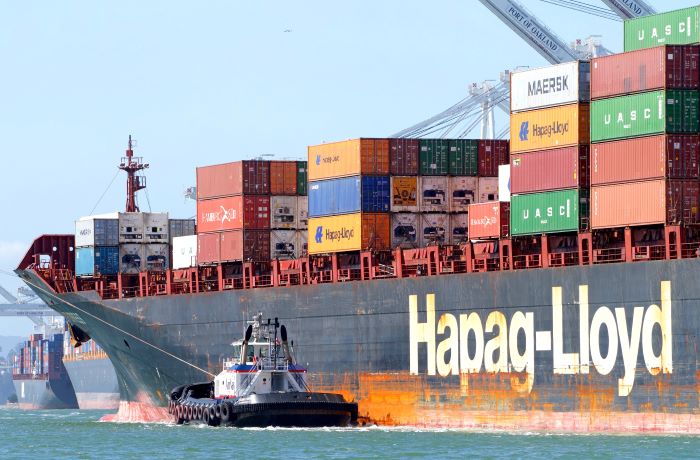
The head of US trades at Hapag-Lloyd said the carrier will not be able to add more containerships to the trans-Pacific for the rest of the year, despite expectations that Asian imports into the US will stay strong through the end of 2021.
The message from Uffe Ostergaard during a Thursday webinar underscores how US import demand is outpacing capacity, forcing retailers and others to prioritize which goods must be in the country and which can wait until next year. The unprecedented volume pressures that began in the spring have been greater than the new capacity container lines have shifted from other trades to the trans-Pacific.
“I would never have imagined we would see five-digit trans-Pacific rates,” said Ostergaard, Hapag-Lloyd’s president, Americas.
With extra trans-Pacific carrier capacity at its limit, shippers face elevated freight rates through 2022, he said. Ostegaard stressed that trucking capacity remains well below pre-COVID-19 levels.
He said Hapag-Lloyd will have added 500,000 TEU of additional capacity through the end of 2021 to meet the elevated demand. And it has another 210,000 TEU of newbuilds on order.
However, the additional ships and other assets needed to get freight to market right now will be scarce for the foreseeable future, barring a sudden drop in demand. Alphaliner’s last survey showed the idled containership fleet stood at 171 ships, or roughly 645,500 TEU, which is 2.7 percent of the global capacity.
“It’s not like we have a whole fleet of ships sitting somewhere that are waiting to be deployed,” Ostergaard said. “Everything is working. We don’t believe we will be able to get our hands on any additional ships in the second half of 2021.”
Curveballs hit sagging system
Ostergaard said that the containership industry has faced so many “curveballs” this year, including the Suez blockage and the Yantian closure, that have made it increasingly difficult to maintain schedule reliability and provide the capacity that shippers want.
Ostergaard’s views echo that of Charles van der Steene. Maersk’s head of North American sales, who said that delays and port congestion have completely offset the capacity that Maersk has injected into the trans-Pacific.
The number of container ships at anchorage along the US West Coast has dropped from 62 in the first quarter to 52 at the start of June, Ostergaard said. While there are fewer ship delays in the Los Angeles-Long Beach ports, the congestion has shifted to the Oakland and Pacific Northwest ports, he said, adding that ships are taking up to a week to unload.
“Those are the kinds of things creating a lot of delays, but also impacting overall carrier capacity because so much of it is just waiting there,” Ostergaard said.
Ocean capacity, of course, is not the only limit facing shippers right now. Citing the JOC.com For-Hire Trucking Employment Index, Ostergaard said the level of employment in the US trucking industry remains at about where it was in 2018. Across most major US coastal and inland freight hubs, the lead time to secure a truck is seven days or more.
Drayage capacity warning
The space constraints at marine terminals are one of the biggest limits on the ability to unload vessels in a timely manner, Ostergaard said. But until more trucks can be deployed to move import loads out, terminals will remain congested, he added.
“Truck availability is the biggest concern going into Q3 and Q4,” Ostergaard said. “I don’t see how it will get resolved.”
Tight rail capacity is also hurting cargo fluidity, but it is not a nationwide problem like trucking, Ostergaard said. However, truck and chassis supply are keeping Midwest railyards full, resulting in further bottlenecks in the supply chain.
“A lot of the rail yards are congested,” he said. “Congested yards prevent cargo from ports from moving inland and the storage costs associated with those containers increase.”
With limited ability to give more capacity to customers, Ostergaard said the carrier’s near-term initiatives at least aim to make it easier for shippers to deal with the current market. He said Hapag-Lloyd has hired 100 new customer service representatives for its US offices, which will be reopening shortly.
The carrier is also offering new online services that will make it easier for shippers to handle delays. One new service will allow shippers to buy added free time for a container at a “significant discount” in the event of container being held at a terminal or a warehouse.
The new services “don’t create additional slots on ships, but it gives customers much better ability to have access to information when changes happen,” Ostergaard said.