Blank Sailing
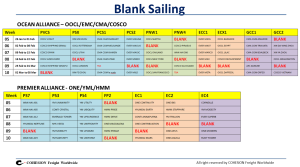
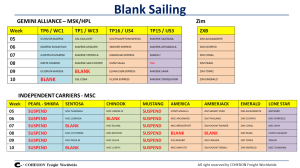

Blank Sailing
Following successful test voyages, Maersk is back in the conflicted region with a service of 14 ships connecting the Middle East and India with the US East Coast.
Maersk is now resuming operations through the Red Sea and the Bab el-Mandeb Strait with all ships on its so-called MECL service, the carrier has informed ShippingWatch and announced broadly in a press release on Thursday morning CET.
Specifically, this is a service connecting the Middle East and India with the US East Coast. Currently, a total of 14 ships are sailing on Maersk’s MECL service south of Africa’s Cape of Good Hope.
They have been doing so since the beginning of 2024, when most shipping companies redirected their ships away from the Red Sea after the Yemeni Houthi movement carried out several armed attacks on merchant ships in the area.
However, the route south of Africa is significantly longer and can add up to 14 days to voyages from Asia to Europe.
Maersk has informed ShippingWatch that the recently announced return will free up capacity, as the ships will sail shorter distances, and the shipping company’s MECL service will therefore consist of only 12 ships by the end of the first quarter.
In recent days, violent protests in Iran have prompted the US to threaten a possible military response. This was followed by Iran warning of harsh retaliation against US bases. In response, the US and the UK withdrew military personnel from their bases in Qatar, among others, yesterday afternoon.
Maersk emphasizes that the shipping company is prepared if the situation in the Middle East deteriorates.
“.Maersk has contingency plans in place should the security situation deteriorate, which may necessitate reverting individual MECL sailings or the wider structural change of the MECL service back to the Cape of Good Hope route,” the shipping company writes.
“The safety of crew, assets, and customers’ cargo remains the highest priority.”
The Maersk Detroit also departed from North Charleston on Jan. 10 and will be the first eastbound vessel to use the route through the Suez Canal.
“All subsequent voyages will follow this route,” writes Maersk.
However, a full-scale return may still be a long way off.
In December, Maersk’s head of Northern Europe, Ole Trumpfheller, told the German media outlet Deutsche Verkehrs-Zeitung that it will take up to six months to reconfigure the shipping company’s routes between Asia and Europe.
Johan Sigsgaard, product manager for Ocean at Maersk, further described in a market update this week that a return will cause disruptions, especially for container shipping companies.
“There is no doubt that there will be added volatility to supply chains once container liners begin the shift back to East-West transits through the Red Sea, just as we saw when the industry started sailing via the Cape of Good Hope,” he explained, adding:
“So the acceleration of vessel arrivals into Europe means overstocking is a distinct possibility.”
Gratitude to the Suez Canal
Rumors of Maersk’s possible return to the Red Sea began circulating as early as November.
A rather strange sequence of events unfolded after the shipping group’s chief executive, Vincent Clerc, visited the chairman of the Suez Canal Authority, Osama Rabie.
After the meeting, the authority announced on social media platform X that Maersk and its competitor CMA CGM would return to the area at the beginning of the following month.
However, Maersk and its alliance partner Hapag-Lloyd then sent a correction to several media outlets, stating that no timeline had yet been set for when Maersk would return to the Red Sea.
Now, however, it appears that the Suez Canal Authority was simply a step ahead of events. The cooperation between Maersk and the important maritime canal is seemingly intact and, according to Maersk itself, has played a significant role in making a return possible.
“The strategic partnership between Maersk and the Suez Canal Authority has played a key role in the planning of the return,” the shipping group wrote today, Thursday, continuing:
”Collaboration with the Suez Canal Authority and other strategic partners in the region continues to be critical to ensure that the structural change of the MECL service and any next steps in a gradual trans-Suez return happens in a way that ensures the safety of the operations and safeguards predictability and stability for customers.”
Thursday’s announcement also emphasizes why it is important for Maersk to return to Suez:
“The route through the Suez, the Red Sea, and the Bab el-Mandeb Strait is the fastest, most sustainable and most efficient way to serve customers with transport between Asia and Europe.”
Details please refer to the news.
Source: SHIPPINGWATCH
100 days after the latest attack in the Red Sea, shipping continues to stay away in large numbers. But one segment has returned to a greater extent, according to a new analysis.
On Sept. 29, the most recent attack took place on shipping in the Red Sea when the ship Minervagracht was attacked by the Yemeni Houthi movement.
Although it has now been 100 days, and even though the Houthi movement has declared a complete halt to its attacks on shipping, shipping companies are still hesitant to sail through the Red Sea and thus also the Suez Canal.
This is stated in a fresh analysis by the shipping organization Bimco, which compares the number of transits in the fourth quarter of 2025 with 2023, before the attacks began.
“Despite this, traffic through the Suez Canal has not increased significantly and in the first week of 2026 remained 60% below the corresponding week in 2023, before ships started diverting around the Cape of Good Hope,” writes Niels Rasmussen, chief shipping analyst at Bimco, in an update.
Since January 2024, the quarterly tonnage that has sailed through the Suez Canal has been between 51 and 64% lower than in 2023.
In 2025, transits were between 57 and 64% lower, according to Bimco, which also provides information on how traffic has been distributed across ship segments.
Product tankers sail through more frequently
In the dry cargo segment, transits were 55% lower, while capacity in the container segment had fallen by as much as 86% since 2023. Conversely, oil tanker transits were 32% lower, and for product tankers the decline was 19%.
Bimco estimates that product tankers have returned to the Red Sea and the Suez Canal to a greater extent in order to take advantage of rising freight rates. In 2024, the reduction for product tankers was 45% below the 2023 level.
Virtually all container ships have avoided the Red Sea since the attacks began. However, CMA CGM recently announced that two of its services will once again sail through the waters. CMA CGM is the only major shipping company to have sailed some of its ships through the Red Sea with French military escort throughout the period.
Maersk has also sailed its first ship through the Red Sea, but has not yet announced any further voyages. The shipping company has announced that it is moving towards a gradual return, provided that the security situation remains stable.
“A normalization of ship transits now appears more likely than at any point during the last two years, but it remains unknown if, or how fast, this may happen,” says Bimco’s Niels Rasmussen.
“A return to the Suez Canal would reduce shipping companies’ costs significantly but also hurt ship demand. A full normalization is estimated to reduce container ship demand by approximately 10%, while other sectors could see 2-3% reductions,” he adds.
Source: SHIPPINGWATCH
The big picture: Container gateways on the US West Coast in 2025 were able to hold onto market share gained in 2024 as importers frontloading seasonal merchandise from Asia due to tariff uncertainties took advantage of transit times that are at least two weeks shorter than East Coast routings. West Coast gateways remained relatively free from congestion throughout the year, and those conditions are likely to continue given the weak import volumes forecast for the first quarter of 2026.
A look back: Similar to the wider trans-Pacific market, US West Coast ports benefited from tariff-related frontloading in the first half of 2025, but that growth turned to double-digit percentage declines in the fall. Amid the roller-coaster demand movements, the ports of Los Angeles, Long Beach, Oakland and the Northwest Seaport Alliance of Seattle and Tacoma handled 59.2% of US imports from Asia through November, exactly the same share as in the first 11 months of 2024, according to PIERS, a Journal of Commerce sister product within S&P Global.
To handle the somewhat volatile swings in volumes — a record 1.2 million TEUs of laden imports crossed West Coast terminal docks in July, for example — port stakeholders continued to incorporate the lessons they learned during the COVID-19 pandemic. Improved shipment forecasts and information sharing among carriers, marine terminals, truckers, chassis providers, railroads and warehouses resulted in lower truck turn and container dwell times at the marine terminals and fluid operations at warehouses and inland rail terminals.
A look ahead: Cargo volumes at West Coast ports in 2026 will likely be impacted by macroeconomic forces in the US. With inflation increasing, consumer confidence declining and unemployment on the rise, US imports from Asia are not expected to see the typical pre-Lunar New Year surge in January and February. And unless some clarity and predictability in the Trump administration’s tariff policies are forthcoming, retailers are likely to be conservative in ordering spring and summer merchandise, extending year-over-year declines in West Coast imports through the first half of 2026.
The next inflection: If container lines return to the Suez Canal, East and Gulf coast ports could regain some of the market share they lost to the West Coast in the past two years.
Source: JOC