Blank Sailing
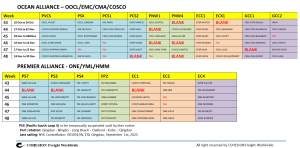
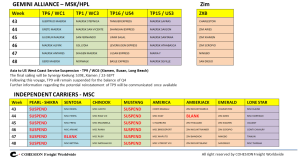

Blank Sailing
The Gemini Cooperation diverted two US-flag vessels in a trans-Pacific service away from China due to that country’s retaliatory port fees, with one of the alliance partners warning of a multimillion-dollar hit that carriers face on US-flag ships because of the fees.
Maersk and Hapag-Lloyd advised customers on Tuesday that two US-flag ships in their jointly-operated TP7/WC5 service will no longer call Ningbo. This week’s voyage of Hapag-Lloyd’s Potomac Express will discharge westbound cargo for China in Busan, South Korea, and then be transshipped on another ship. The Denmark-flagged Maersk Luz will carry outbound freight from Ningbo to South Korea’s Kwangyang port, which will then be loaded on the Potomac Express.
Next week’s voyage of the Maersk Kinloss will also discharge westbound China cargo in South Korea for transshipment on an unidentified ship, with eastbound cargo from Ningbo being shipped on a Gemini shuttle ship.
The service switch-up comes as China’s recently unveiled port fees on US-flag ships went into effect on Oct. 14, the same day as similar US port fees took effect on Chinese-built ships and carriers. While China has exempted US-flag ships built in China from the fees, both of Gemini’s affected ships were built in South Korea.
China plans to charge US-flag, non-Chinese vessels $56 per net ton, approximately similar to what the US is levying. Based on their net tonnage, each of the Gemini ships would incur a $2.5 million charge.
Hapag-Lloyd looks to adjust
Stuart Sandlin, Hapag-Lloyd’s North American president, said Wednesday at the Virginia Maritime Association trade conference in Norfolk that the carrier’s five US-flagged, South Korean-built ships would face a total of $125 million in Chinese port fees annually. The US-flag international fleet can also carry commercial cargo to and from China, in addition to any government or military cargo for other Asian countries. Sandlin said Hapag-Lloyd is now looking at how to split up that business to avoid the fees.
“We have a US-flag group, and we have a non-US-flag group, and that makes it a lot more difficult because of the current geopolitical situation,” he said. “We’re working to see how we actually manage through that.”
There are currently 57 ships in the US-flag international fleet, according to Sea-web, a sister company of the Journal of Commerce within S&P Global. Those US-flag ships made 163 calls globally year to date. The US-flag Matson Waikiki, which called Shanghai on Tuesday, faces a $1.7 million fee.
Among US-flag carriers, CMA CGM’s APL division runs the only fleet solely built in China.
Source: JOC
The prospect of a ceasefire has also sent Maersk’s shares down to their lowest level since June.
Maersk will consider resuming transport through the Red Sea where attacks on merchant ships since the end of 2023 have forced container shipping companies, among others, to reroute south of Africa.
“We will consider resuming transport through the Red Sea once a long-term and sustainable security solution has been established,” Maersk told Reuters in the wake of the latest news about a peace plan for Gaza.
On Thursday, Israel and Hamas agreed on the first phase of a peace plan for Gaza, orchestrated by US President Donald Trump.
This gives hope that Yemen’s Iran-allied Houthi forces may stop their attacks on commercial shipping in the Red Sea. However, the Houthis have not yet commented on the ceasefire agreement or signaled any change in policy.
“There is a clear link between the security risk in the Bab al-Mandab Strait and the conflict in Gaza, but it is too early to assess how progress in Gaza will affect the situation in the Red Sea,” Maersk says, according to Reuters.
The Bab al-Mandab Strait connects the Red Sea with the Gulf of Aden and forms the entrance to the Suez Canal from where ships can take a shortcut to the Mediterranean.
The Houthi movement recently told ShippingWatch that it will only stop its attacks in the Red Sea once the war in Gaza is over.
It states that the group’s “military operations,” which are in response to Israel’s “gruesome massacres” and “unjust siege,” are directly linked to developments in Gaza.
“Therefore, the cessation of these supportive military operations is conditional on a complete and actual cessation of the aggression against Gaza,” the movement’s communications unit HOCC said in a written response to ShippingWatch.
Details please refer to the ShippingWatch news.
Source: SHIPPINGWATCH
In Antwerp, Belgium, port operations are facing delays due to work stoppages by lashers, who secure cargo on ships.
This week, two of Europe’s key ports—Rotterdam, the continent’s largest, and Antwerp-Bruges—are experiencing disruptions from dockworker strikes, according to Reuters and local media reports
In Rotterdam, a strike by lashers from International Lashing Services and Matrans Marine Service began Wednesday at 3:15 p.m. CEST and is set to continue until Friday afternoon, October 10. The action, driven by disputes over a new collective agreement, has halted critical operations. “Without lashers, the whole port grinds to a halt,” said Niek Stam, FNV union chairman, in a statement on October 7.
The Port of Rotterdam acknowledged on Wednesday that the strike will likely impact traffic, though the full extent remains unclear. Hutchison Ports, a terminal operator in Rotterdam, noted potential delays or stoppages in deep-sea and feeder operations, while areas not requiring lashers will function normally.
In Antwerp-Bruges, port pilots have disrupted operations for four days, protesting federal pension reforms, according to port authorities cited by Reuters. The port, which typically handles 60-80 ships daily, managed only 31 on Tuesday, with some ships waiting and others rerouting.
Source: SHIPPINGWATCH
Rotterdam and Antwerp are facing increasing congestion this week as strike action from auxiliary companies significantly disrupts container handling operations at Europe’s two busiest ports.
Flemish pilotage services have only been working during office hours since Monday in a dispute over recent federal pension reforms, severely disrupting vessel arrivals and departures in the Belgian hubs of Antwerp and Zeebrugge.
In Rotterdam, container lashing companies embarked on a two-day strike on Wednesday in a dispute over working conditions and wages. The strike is affecting all major terminals in Rotterdam: APM Terminals Maasvlakte II, Hutchinson Ports Delta II, ECT Delta and Rotterdam World Gateway.
A Maersk advisory said the suspension of services was significantly impacting operations, given that lashing is critical to the safe securing and release of containers onboard vessels.
Kuehne + Nagel echoed Maersk’s concerns in an advisory of its own, warning that in addition to the impact on container vessel handling, the 48-hour strike at Rotterdam will significantly disrupt inland container transport operations.
“These developments place further strain on the port, which was already significantly affected by last weekend’s storm-related closures,” Kuehne + Nagel noted.
The strikes add further pain to the overall Asia-Europe trade lane that continues to present shippers with the worst schedule reliability among the major ocean corridors. On-time performance recorded in September was 23%, according to industry analyst Xeneta.
While the performance is a slight improvement on the 17% reliability seen in August, persistent port congestion across the main North Europe gateways is a factor keeping schedule reliability at dismal levels.
Details please refer to the JOC news.
Source: JOC
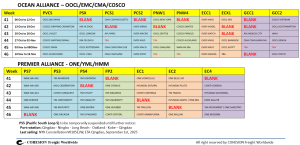
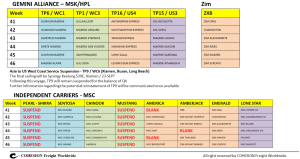
Blank Sailing
Over the weekend, US Customs released additional details about the upcoming increased port fees for vessels linked to China, set to take effect next week.
The announcement clarifies that vessel operators, not US Customs, are responsible for determining fee liability. Vessels without proof of payment may face delays, including being denied unloading, clearance, or operational access until documentation is resolved. Payments must be made through a US Treasury website, and Customs advises operators to complete payments at least three days before a vessel arrives in the US.
The fee structure includes three tiers: Annex 1 imposes $50 per net ton for ships owned or operated by Chinese entities. Annex 2 applies to Chinese-built ships arriving in the US, with operators paying the higher of $18 per net ton or $120 per container discharged. Annex 3 affects all non-US-built vehicle carriers, not limited to Chinese ones, with a fee of $14 per net ton.
Details please refer to the Splash 247 news.
Source: Splash 247
Ocean carriers are warning of skipped port calls, rerouted cargo and vessel delays on a raft of trans-Pacific and Asia-Europe and Asia-Mediterranean sailings over the next two weeks in the aftermath of the recent typhoons that have hit China.
The threat of widespread disruption comes on the eve of China’s National Day holiday that starts Wednesday and is expected to last 10 days.
Typhoon Ragasa closed ports in southern China and Taiwan for three days last week, Tropical Storm Mitag affected the Philippines and southeast China in mid-September and Typhoon Tapah struck the same region in early September.
Hapag-Lloyd said its Gemini Cooperation services with partner Maersk are among those affected by the string of tropical cyclones. The most severely impacted are Gemini’s
Pacific Southwest services, WC1 and WC3, with Nansha omitted this week on the trans- Pacific eastbound sailing by Gerd Maersk. Hapag-Lloyd said cargo will be rolled to the next WC1 voyage.
Shanghai will also be omitted this week and next week on Gemini’s WC3 service to recover schedule reliability from delays caused by the typhoons, Hapag-Lloyd said. Sailings affected are those by GSL Lydia this week, with cargo transferred to the WC2 and US2 services, and by Norwalk next week, with cargo shifted to the US2 service operated by Kandla Express and US1 served by CCNI Algol.
The delays follow call omissions last week at Yantian by the Gunvor Maersk due to Typhoon Ragasa. Hapag-Lloyd said cargo for Nansha has been discharged in both Vung Tau in Vietnam and Yantian, and will be carried back the Guangzhou international gateway port in three subsequent sailings.
The carrier said the Dortmund Express operating Gemini’s Asia-US East Coast 1 service was late berthing at Yantian last Friday due to Ragasa after having already omitted Nansha on the same service due to Typhoon Tapah.
Ocean Network Express (ONE) also highlighted delays of up to seven days on its Asia- Mediterranean MS1 and MD2 services due to the storms in the South China Sea. ONE confirmed a four-day delay by ACX Pearl operating its Japan-Straits-Malaysia service due to the disruption at Hong Kong and at Keelung in Taiwan. The carrier also said vessels are being delayed due to Typhoon Neoguri, which affected Japan and South Korea last week.
CMA CGM also warned of vessel delays following port closures at Manila and Subic due to Typhoon Bualoi, which hit the Philippines over the weekend. Delays are also likely at Haiphong after Bualoi made landfall in northern Vietnam Monday, killing at least 30 people and causing extensive flooding.
Congested ports gradually recovering
Ports in south China are gradually recovering from the impact of Ragasa, with Hong Kong back to normal operations, but some Shenzhen terminals are still heavily congested.
“The backlog [at Hong Kong and DaChan Bay] caused by Typhoon Ragasa has already been cleared,” a spokesperson for Hong Kong’s Modern Terminals told the Journal of Commerce Tuesday. A senior executive at a Hong Kong-based forwarder said Shenzhen’s western terminals, including Shekou and Chiwan, are still heavily congested.
“The terminals will remain open during the extended National Day holiday and with factories closed for the holiday, this should provide [the terminals] with some respite to clear the backlog of cargo,” the executive told the Journal of Commerce Tuesday.
Hapag-Lloyd said Shekou is still experiencing berthing delays of four to five days, with a five- to seven-day wait at Yantian.
Source: JOC
CMA CGM has announced the launch of the 2025 Cherry Express Service.
This service dedicated to cherry exports out of Chile has been designed to provide an outstanding transit time of 23 days between San Antonio, Chile and Shanghai, China.
Please note the following rotation adjustments for ACSA 1 and M2X during the service period:
ACSA 1 Rotation Adjustment: Shanghai → Ningbo → Qingdao → Busan → Callao → Chancay → San Antonio → Shanghai
M2X Rotation Adjustment: Shekou → Ningbo → Shanghai → Tianjin → Qingdao → Busan →Manzanillo → Lazaro Cardenas → Posorja → Buenaventura → Yokohama → Busan → Shekou
Source: AJOT
Ports and airports in southern China will restart operations Thursday after super typhoon Ragasa, the world’s strongest storm so far this year, made landfall in Guangdong province Wednesday, causing widespread flooding and property damage.
But supply chains in a region stretching between South China, Taiwan and the Philippines face extensive disruption even after terminals reopen and flights resume. The turmoil comes ahead of China’s National Day holiday that starts Oct. 1.
Hapag-Lloyd, in an advisory Wednesday, warned of lengthy berthing delays at key ports in South China. Cathay Pacific Airways, Hong Kong’s dominant air cargo airline, said it would take some time for flights to return to normal.
At Shenzhen’s Yantian terminal, which handles about a quarter of China’s exports to the US, Hapag-Lloyd forecast berthing delays of five to seven days after the facility reopens. The carrier said it expected a four- to five-day delay at Shekou, three to four days at Nansha, Guangzhou’s main export port; about three days in Hong Kong and delays of two days in both Kaohsiung and Keelung in Taiwan.
“As a result, we anticipate significant disruptions to our operations,” Hapag-Lloyd said in its advisory.
All ports in southern China, including Shenzhen, Hong Kong and Nansha, plus Kaohsiung, have been closed since early Monday.
CMA CGM said the Philippine Coast Guard had banned the movement of all vessels ahead of the cyclone’s arrival on Sept. 22, although terminals at Manila and Subic Bay were kept partially open. The carrier indicated Tuesday vessels were being delayed up to two days.
OOCL said in an advisory that the Hong Kong government downgraded its typhoon warning Wednesday evening, but cargo operations at terminals and depots in Hong Kong, Shenzhen, Guangzhou and nearby cities including Dongguan and Nansha remained suspended.
Flights suspended in Hong Kong
At Hong Kong International Airport, the world’s busiest cargo airport, all flights were suspended Wednesday and are not scheduled to resume until Thursday morning.
The Airport Authority of Hong Kong said 100 cargo flights will be canceled during this period, including services operated by integrators FedEx, UPS and DHL. A further 15 flights operated by carriers including Atlas Air, Kalitta Air and MSC Air Cargo will be delayed until Friday and Saturday.
In an advisory Wednesday, Cathay Pacific said flights would resume Thursday, but noted that restoring its normal schedule will be a “challenging and gradual process that will take time.”
Shenzhen Baoan International Airport, used by carriers including UPS, FedEx and Atlas Air, suspended all flights late Tuesday and won’t restart operations until Thursday, according to flight schedules.
Details please refer to the JOC news.
Source: JOC