Blank Sailing

Blank Sailing
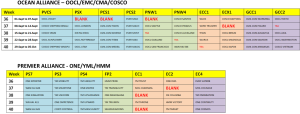
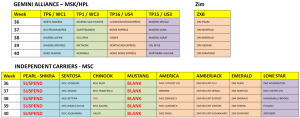
Container lines are taking preemptive steps to reduce their exposure to hefty tariffs on Chinese-built and -operated vessels calling US ports that take effect in mid-October.
The Premier Alliance of Ocean Network Express (ONE), HMM and Yang Ming Marine Transport is revamping a trans-Pacific service to avoid the US Trade Representative’s fees, and other major carriers are expected to follow suit.
Carriers say the deployment of non-China-built ships won’t be the most efficient for their networks but balk at fees that will initially equate to $1 million per voyage. The savings that come from removing China-built vessels from US services could increase to ultimately more than $500 million per year by April 2028, as the severity of the tariffs ratchets up over the next three years.
Ocean Network Express and HMM have confirmed that the Asia-Mediterranean segment of the current Mediterranean Pacific South 2 (MS2) service will operate as a standalone service, renamed Mediterranean 2 (MD2), starting early next month. The trans-Pacific leg of the MS2 will be incorporated into the alliance’s existing Asia Gulf Express 2 service, which will be rebranded as the Gulf Pacific South 2 (GS2) as of next week, limiting the deployment of 10 Chinese-built ONE container ships currently operating the MS2 service to the shortened MD2 route.
According to ONE service schedules, these vessels include seven 15,300-TEU ships built by Yangzijiang Shipbuilding Group, China’s largest privately owned shipyard, and three built by state-controlled China State Shipbuilding Corp.
Yang Ming Marine Transport has yet to announce the changes, which stand to save ONE an estimated $185 million in tariffs in the first year after the levy is implemented on Oct. 14.
With each of the MS2 deployed vessels assessed at about 74,000 net tons, ONE would face a bill of $3.7 million per ship per voyage, maxing out at $18.5 million for each of the 10 ships — a total of $185 million — after five voyages.
In announcing the MS2 service adjustment, ONE and HMM said the changes would improve connectivity and transit times to certain markets.
HMM said the new Mediterranean Service 2 (MD2) would provide an express service from western Mediterranean to Busan and central China. Similarly, GS2 — which HMM calls the Korea Middle East–Pacific South (KMP) loop — will provide direct services from Dubai to the US West Coast and the US West Coast to Dalian and Xingang, HMM said.
Details please refer to the JOC news.
Source: JOC
Tight feeder capacity between secondary ports in Asia and the region’s main transshipment hubs are hitting both exports from Asia and imports to the region from the US and Europe, forwarders and carriers say.
Shippers are having to wait up to a month to secure space on some carriers serving Thailand and Indonesia, according to forwarders who spoke with the Journal of Commerce.
The difficulties have led to transshipment delays and rolled cargo, which have caused increased yard density at some ports that has exacerbated delays, shipping sources say. The problems have been compounded by bad weather, including typhoons in China, carriers said.
Forwarder Rhenus Logistics said the feeder capacity shortages began in June and have been the result of a tariff-related cargo surge from Southeast Asia.
Carriers being particular on US export choices
The disruption at transshipment hubs, including those in Asia, has led carriers to pick and choose which export cargo from the US to accept.
“If it’s a direct lane, they have a very high appetite,” said M. Can Fidan, executive vice president of business development at New York-based forwarder MTS Logistics. “If it’s a transshipment or if it is off their hub-and-spoke lanes, then they are not.
A Hong Kong-based freight forwarder said it is fortunate the disruption largely comes after the cargo rush caused by shippers consigning shipments early to beat the Trump administration’s mid-August tariff deadline.
“Transshipping cargo to and from second-tier markets like Thailand, the Philippines and Vietnam is a mess right now, with cargo rolling and delays at the key hub ports,” the source said. “But it would be significantly worse if these countries hadn’t cut tariff deals with the US at the end of July.”
Multiple-day delays
Highlighting congestion and cargo delays at key Asian gateways, CMA CGM, Hapag-Lloyd and Kuehne + Nagel all reported disrupted operations at Singapore, Shanghai, Ningbo, Qingdao and Malaysia’s Port Klang in recent customer advisories.
Shanghai is also heavily congested with a two- to three-day delay at the city center Waigaiqiao terminals and up to a four-day wait at the deepwater Yangshan terminals due to continuing disruption caused by the port’s closure during Typhoon Co-May at the end of July, carriers said. The typhoon was one of three tropical storms to disrupt port operations in eastern and southern China since mid-July.
Hapag-Lloyd said vessels are having to wait up to three days to berth at Ningbo due to the bunching of vessels and up to two days at Qingdao.
Details please refer to the JOC news.
Source: JOC
The true toll of US tariffs on China is just beginning to be felt on the trans-Pacific.
Months of frontloading that drove an earlier peak season have come to an end, and US retailers are pulling back on ordering for the rest of the year in the face of a slowing US economy and higher tariff costs. Shippers and consignees are also racking up stiffer demurrage and storage bills because demand uncertainty is slowing their pickup of containers from marine terminals.
A sense of uncertainty — if not alarm — about future demand and tariff levels on China has slowed, and even paralyzed, some orders from small and medium-sized importers, four veteran forwarders told the Journal of Commerce. While China bookings haven’t cratered as they did in April when the Trump administration temporarily raised the US tariff level to 145%, forwarders warn of a renewed weakness in the market caused by more than just the end of peak season.
Demurrage levels on the rise
Customers importing lower-value goods have even begun abandoning containers as the cost of the tariffs outweighs what the items can be sold for. Even those who tapped bonded warehouse space face the prospect of no more reprieves in tariffs — and a hefty storage bill, the forwarder source said. Other customers are shifting toward origin-controlled cargo, in which the seller bears all shipping and customs costs until it delivers the goods to the buyer, he said.
Rising demurrage levels at major US ports also speak to increased deterioration in the trans-Pacific market. Demurrage levels have been rising all year but spiked in July to an average of 8.1 days, up from 3.8 days in January, according to data from transportation management visibility software vendor GoComet.
Details please refer to the JOC news.
Source: JOC
The Port of Houston will open a new berth in December at one of its two container terminals, bringing it a step further to be able to handle up to five post-Panamax vessels simultaneously.
Port Houston Authority said in a statement to the Journal of Commerce Tuesday that it expects to complete Wharf 7 at the Bayport Terminal this December, nearly two years after construction began. Cranes for the new wharf are expected to arrive in March 2026, with the port planning to use Bayport’s existing crane fleet in the interim.
The 1,000-foot wharf will allow Bayport to service five post-Panamax ships at once, up from four currently. Port Houston said the new wharf will “decrease the anchor wait time for vessels, allowing for quicker turnaround time for our customers.”
The work at Bayport coincides with ongoing work to expand the Houston Ship Channel to allow two-way traffic for post-Panamax vessels. Port Houston expects to complete widening of a five-mile portion of the Houston Ship Channel between the Bayport and Barbours Cut container terminals by the third quarter of 2025, with the full project done by 2029.
Details please refer to the JOC news.
Source: JOC
Orient Overseas Container Line (OOCL) later this month will begin offering a trans-Pacific express service to Mexico’s West Coast, adding to the list of new ocean services that have sprung up as China reorients its trade networks.
OOCL said Monday that its Trans-Pacific Latin Pacific 8 (TLP8) service will start with an Aug. 20 departure from Shanghai. The TLP8’s Asia rotation covers Shanghai and Qingdao, and the eastbound voyage includes Mexico’s Ensenada and Manzanillo, along with a westbound call at Yokohama.
The TLP8 is offering 17-day transit between Qingdao and Ensenada. The Port of Ensenada has one berth capable of handling post-Panamax ships up to 6,000 TEUs in capacity.
The TLP8 joins three other OOCL trans-Pacific services that connect Mexico, along with the West Coast of South America, to Asia.
OOCL added its last Asia-Mexico-South America service, TLP5, back in May 2024. Last year also saw Mediterranean Shipping Co. and CMA CGM add new trans-Pacific services between Asia, Mexico and South America.
Source: JOC