Blank sailing
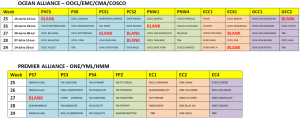
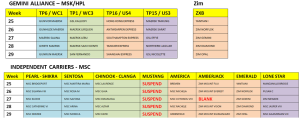

Blank sailing
One month after a four-day strike by customs workers at Mexico’s Port of Manzanillo, cargo operations at the country’s busiest container gateway have yet to show any noticeable improvement, stakeholders say.
Despite ongoing efforts to clear out logjams triggered by the brief strike, berth waiting times for arriving vessels at Manzanillo have risen to their highest this year — 1.8 days, according to data from maritime visibility provider Vizion and data and analytics company Dun & Bradstreet.
Terminal operators had previously said they expected the congestion to clear by early June, but extended weekend hours at the port and an increase in customs personnel have not yet had an impact on the delays.
Carlos Tamayo, director of logistics in Mexico for logistics provider C.H. Robinson, told the Journal of Commerce that customers have seen delays of up to two weeks due to the congestion.
“Container throughput [at Manzanillo] has decreased by approximately 50% as a result of extended wait times for entering and exiting the port,” Tamayo said. “For freight that hasn’t shipped yet, we’re advising customers to move up bookings by at least three to four weeks and consider alternate ports like Lázaro Cárdenas.”
Shippers who use Manzanillo might face additional costs if they don’t meet their scheduled gate-out window due to congestion.
Details please refer to the JOC news.
Source: JOC
Fragmented union bargaining and government backstops during contract talks are factors behind the longshore strikes and other labor unrest that have gripped Canada’s West Coast ports during the last two years, a report commissioned by the Labor Ministry report has found.
The report, released Thursday, suggests British Columbia’s longshore unions need to bargain with employers on a province-wide basis, rather than a port- or employer-specific basis, to avoid further unrest that jeopardizes Canada’s supply chains. It also urged early government intervention to head off strikes.
The 156-page report, which was commissioned by the Labor Ministry and developed by Canadian labor relations experts Vincent Ready and Amanda Rogers, looks into the labor disputes that have hit British Columbia’s ports. It was commissioned in July 2023 by Labor Minister Steve MacKinnon after longshore workers rejected a contract proposal that led to a 13-day strike at Vancouver and other Canadian West Coast ports.
The inquiry found that while “there exists a mature bargaining relationship among the parties, it is far from healthy, and is marred by ongoing conflicts, misaligned priorities and a fiercely protectionist stance by the union.”
Mike Leonard, president of the British Columbia Maritime Employers Association (BCMEA), said in a statement that if the report’s findings are put in place, it “will advance long-term stability at Canada’s West Coast ports to the benefit of all parties.”
ILWU Canada could not immediately be reached to comment on the report.
Details please refer to the JOC news.
Source: JOC
Ocean shipping rates from Asia to Europe shot up ahead of this week’s June 1 freight-all-kinds (FAK) increases by carriers, with the substantial price hikes supported by mounting delays at severely congested port hubs at both ends of the trade lane.
While port bottlenecks absorb capacity on Asia-Europe, surging demand on the trans-Pacific is prompting carriers to shift vessels to the booming China-US trade lane, putting further upward pressure on Asia-Europe rates.
“Carriers are redeploying ships from Asia-Europe and other routes to the trans-Pacific routes, with the capacity in Asia-Europe dropping 17% in the week starting June 16 vs. the end of May,” HSBC noted in its weekly transportation update.
“However, we think these are insufficient to address the cargo rush [on the trans-Pacific], while capacity reallocation could cause shortages in other corridors,” according to the bank’s analysts.
Drewry highlighted in a recent market update that since late March, labor shortages and low Rhine River water levels have pushed up berth waiting times by 37% in Antwerp, 49% in Hamburg and 77% in Bremerhaven.
In Asia, Shanghai and Singapore, the world’s busiest and second-busiest ports, respectively, are battling congestion driven by a rush of exports to the US during a 90-day tariff cooldown.
Rate hikes, surcharges
As capacity tightens, carriers are rolling out significant rate increases from Asia to both North Europe and the Mediterranean, as well as implementing “peak season surcharges” on some Mediterranean routes.
Source: JOC
Singapore has joined Shanghai, the world’s second-busiest and busiest ports, respectively, in facing congestion driven by a rush of exports to the US during a 90-day tariff cooldown, according to forwarder and carrier sources.
Operations in Singapore have been “heavily disrupted,” with transshipment cargo delayed by up to two weeks, forwarder Kuehne + Nagel said in an update Wednesday on its SeaExplorer visibility platform. According to a Monday update from container carrier Hapag-Lloyd, ships are waiting up to three days to berth at Singapore’s primary terminals due to vessel bunching and congestion.
That Singapore is the world’s largest transshipment hub makes it convenient for carriers to transship cargo as they redeploy vessels from European and other long-haul trades to US-focused services. Congestion at other Asian ports is also contributing to a backlog of ships in Singapore.
Shanghai congestion worsens
The situation has also deteriorated in Shanghai, with carriers reporting wait times of up to five days, compared with about three days last week, according to K+N.
The largest global forwarder said shippers are diverting cargo away from Shanghai to Ningbo to avoid delays, slowing operations in Ningbo. Similarly, congestion has worsened at Port Klang, Malaysia’s gateway terminal complex, with “heavily disrupted operations” and vessel wait times of up to three days, K+N said in its SeaExplorer update.
And in South Asia, the ports of Colombo, Sri Lanka; Mundra, India; and Chittagong, Bangladesh, “are also seeing increased waiting times at the moment,” Hua Joo said.
Vessel schedules from Ocean Network Express (ONE) this week provide an example of how the additional pressures in Singapore and Port Klang are impacting network fluidity. ONE’s 3,000-TEU Wan Hai 331, deployed on its Japan-Straits-Malaysia service, was four days late departing Hong Kong last Friday, but berthing delays in Singapore and Port Klang have increased these delays to eight days, with the ship scheduled to arrive in Singapore on June 3.
Schedules for June and July indicate ONE has lengthened the estimated time of arrival from four days to up to seven days from Hong Kong to Singapore for a raft of vessels operating on intra-Asia and Europe-Mediterranean services to account for berthing delays in Singapore.
Other ports in Asia, including Tianjin, Qingdao, Shenzhen, Nansha and Hong Kong in China; Busan, South Korea; Yokohama, Japan; Ho Chi Minh, Vietnam; and Manila, Philippines, are also dealing with declining port performance, K+N said.
The number of vessels waiting at key ports in Asia has been trending upward again in the last two weeks after plunging from a high at the start of May, according to Portcast’s ship tracking index. There were 62 ships waiting to berth at Shanghai on Wednesday, approximately double the number in mid-May. The vessel backlog outside Singapore hit 55 on May 14, before plunging as low as 23 on May 21, Portcast data shows.
Attention turns to US West Coast
During Evergreen Marine’s annual general meeting Thursday, chairman Chang Yen-yi said port congestion would spread to US West Coast ports next month as vessels from Asia, including extra capacity that carriers are deploying during the current tariff pause, start arriving at Los Angeles and Long Beach.
Similar to during the pandemic, the sharpest limits to capacity during an import surge will be outside the truck gates, not at the marine terminals. As containers exit the ports, the influx of international intermodal shipments will test rail car supply, and importers and consignees could face less availability of warehousing and chassis.
Source: JOC