Blank Sailing
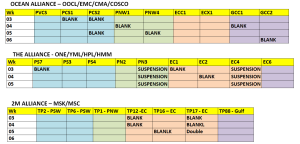

Blank Sailing
Maersk plans to eliminate Panama Canal vessel transits on a north-south service between Oceania and the US East Coast, citing the ongoing drought that has reduced ship transits and container carrying capacity through the waterway.
The Copenhagen-based carrier said Wednesday that its OC1 service linking Australia and New Zealand with the ports of Philadelphia and Charleston will instead use a 50-mile rail service across the Isthmus of Panama to handle cargo between the Atlantic and Pacific.
As a result, the OC1 service will be broken into two loops, Maersk said. The Pacific loop will drop off northbound cargo at Balboa for the land bridge service via rail to Manzanillo, where the Atlantic loop will retrieve the cargo and resume waterborne service.
The carrier did not say whether the nearly 26-day transit time from New Zealand to Philadelphia would change due to the land bridge. It said that while northbound cargo will not be delayed, southbound cargo may see some delays.
Other Maersk services from Asia to the US East Coast will continue to use the Panama Canal.
Along with the Panama Canal, Maersk said the OC1 would omit Cartagena, Colombia, as a call. It also directed shippers to the option of its PANZ service between Oceania and the US West Coast.
Maersk said the decision to omit the Panama Canal crossing on OC1 was “based on current and projected water levels in Gatun Lake,” which provides the water to raise and lower vessels in the canal’s locks. As of Wednesday, the Panama Canal Authority (ACP) said Gatun Lake was at 81.6 feet, compared with a five-year average water level for January of 86.9 feet.
Low water levels have forced the ACP to only allow 24 ships of any size to transit the canal daily, down from the 35 to 40 ships it could handle before the ongoing drought that has reduced Gatun’s water levels. Ships must also carry less cargo as the canal is limiting the maximum depth of neo-Panamax vessels to 44 feet from 50 feet. Smaller Panamax vessels, such as the ones in the OC1 service, are restricted to a 39.5-foot depth versus the typical 45 feet.
In early December, ocean carriers in THE Alliance said they were preparing to divert east-west vessel services from the Panama Canal due to the potential for transits being reduced to as few as 18 by February. But with better-than-projected water levels on Gatun Lake, the ACP did not implement that further reduction.
Source:
Angell, M. (2024a, January 10). Maersk opts for rail crossing on a north-south service to bypass Panama Canal. Journal of Commerce. https://www.joc.com/article/maersk-opts-rail-crossing-north-south-service-bypass-panama-canal_20240110.html
Maersk on Sunday said it would pause any further transits through the Red Sea for at least 48 hours after one of its container ships was attacked twice within 24 hours by Houthi rebels who do not appear deterred by the presence of a multinational naval force meant to restore security in the region.
The second attack against the Maersk Hangzhou this weekend represented an escalation in hostilities as Houthis used small boats to get within 65 feet of the 14,000-TEU vessel in an attempt to board the ship, which Maersk said was not damaged by missiles fired by the attackers. Until Sunday, the Iran-backed Houthis have attacked ships by firing missiles and launching drones from southern Yemen.
“Maersk can … confirm that after the initial attack on the vessel, four boats approached the vessel and engaged fire in an expected attempt to board the vessel,” the carrier said in a statement Sunday. “A helicopter was deployed from a nearby navy vessel, and in collaboration with the vessel’s security team, the boarding attempt was successfully repelled.
“In light of the incident — and to allow time to investigate the details of the incident and assess the security situation further — it has been decided to delay all transits through the area until 2nd January,” Maersk added.
Maersk said the vessel, bound for Port Suez after initially departing Singapore, was continuing its sailing northbound.
Responding to the 23rd attack on a commercial ship since Nov. 19, US Navy helicopters sank three of the four small vessels involved, killing the crews, the US Central Command said Sunday.
The attacks against the Maersk Hangzhou came one week after the carrier, responding to the creation of the naval task force, said it would resume some sailings through the Red Sea and Suez Canal once operationally possible. But Maersk warned in its Dec. 24 announcement that its resumption of Suez transits could change if the security situation deteriorated further.
Naval escorts not a sufficient deterrent yet
It was not immediately known what effect the Maersk attacks would have on other carriers, namely Cosco and CMA CGM, that had also been sending some of their ships through the Suez. At first blush, it is likely to send even more capacity diverting around the Cape of Good Hope in southern Africa.
At the very least for ocean carriers, it means that a protection regime has not materialized that guarantees freedom of navigation through the Bab al-Mandab strait and eliminates or significantly reduces the risk of attack in the area. No organized system of naval escorts or convoys has come into existence, nor have land-based threats been eliminated or seriously confronted. Rather, senior ocean carrier executives tell the Journal of Commerce, the Operational Prosperity Guardian coalition is relying on deterrence created by its physical presence and its ability — for the most part successfully thus far — to intercept air-based weapons to keep the Suez route open to at least some shipping traffic.
But it’s clearly not enough, illustrating the difficulties the US is facing in balancing its desires to protect freedom of navigation while seeking to avoid escalating the Israeli-Hamas war into a full-blown regional conflict. As long as broader US goals conflict with those of protecting shipping and an effective protective regime fails to materialize, ships will continue to be diverted around the much longer Cape of Good Hope route, disrupting supply chains.
Geopolitical analysts warn that the patrols can help shield vessels, but the Houthi rebels are well-placed to keep up attacks via relatively cheap drones and missile attacks from the shore of southern Yemen. S&P analysts and container lines carriers tell the Journal of Commerce that earlier suspicions that rebels were targeting vessels tied to Israel were incorrect, putting any ships — regardless of shipowner — in danger.
“If the Houthis keep up the pace of attacks and have a steady supply of drones and missiles [which seems likely], the cost of maintaining a naval escort operation — including the costs of operating the ships at distance — will rapidly rise into the tens of billions of dollars,” Bruce Jones, a geopolitical analyst and TPM23 speaker, wrote in Foreign Policy.
Detail please refer to JOC News.
Source:
Szakonyi, M. (2023, December 31). Maersk Pauses Red Sea routings after new attacks. Journal of Commerce. https://www.joc.com/article/maersk-pauses-red-sea-routings-after-new-attacks_20231231.html