
Shippers need to add two weeks of lead time to their ocean supply chains to account for container ships being rerouted around southern Africa amid ongoing attacks on commercial shipping in the Red Sea, according to the chief of the Port of New York and New Jersey.
While off-schedule ships are periodically crowding marine terminals, the port is not seeing any major impact from the longer transits as vessels divert from the Suez Canal, Bethann Rooney said.
Speaking at a state of the port event in Jersey City, Rooney, port director for the Port Authority of New York and New Jersey (PANYNJ), said Monday that about 45% of the port’s cargo volumes typically move through the Suez Canal, either on both voyage legs or combined with a transit through the Panama Canal.
Rooney added that while the port is expecting a normal year as far as volumes — the PANYNJ’s budget forecast is for 3% growth in 2024 — the diversions away from the Suez Canal and the drought limiting ship transits through the Panama Canal “will surely impact what goes on there on the port.”
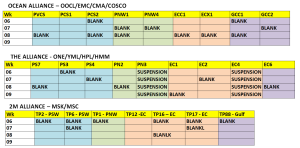
So far, Maersk and Mediterranean Shipping Co. have routed four services to the US East Coast offered under the 2M Alliance via the African Cape with two of those still using the Panama Canal for their eastbound trans-Pacific voyage.
THE Alliance members Hapag-Lloyd, Ocean Network Express and HMM are using a combination of Cape routings and Panama Canal transits on three East Coast services. Ocean Alliance member CMA CGM has rerouted two Indian subcontinent and one East Asia service via southern Africa.
Ocean carriers have been adding extra loaders and resetting schedules to account for the longer journey around the African Cape. Even so, Rooney said shippers need to plan that any vessel leaving Asia for the US East Coast will be two weeks later than usual due to the Cape routing.
“All of our services that go through the Suez Canal have for the most part decided to go around the Cape of Good Hope,” Rooney said. “That adds between 10 and 14 days to the transit. But it’s at least a consistent addition of that time.”
Some vessel bunching, but no congestion
With schedules in flux due to the longer routes or delays entering the Panama Canal, Rooney said New York-New Jersey marine terminals are sometimes getting hit with more than one ship in the same vessel service at the same time.
The Cape routings “have led to some vessel bunching, albeit pretty mild,” Rooney said. “What terminals are experiencing now as we’re beginning to see these vessels rerouted is a couple of days where there are more ships than they would typically handle.”
However, the vessel bunching is not creating any measurable slowdown at the port. Year to date, the PANYNJ said ships are only having to wait a little over one day at anchorage for a berth. The vessel bunching has also not increased dwell times for import containers and truck turn times at marine terminals.
While the Cape routings have only been in effect for the last month, there has yet to be any wholesale move by shippers back to West Coast ports.
Data from the Association of American Railroads (AAR) shows the two East Coast Class I railroads — Norfolk Southern and CSX Transportation — handled 365,483 containers through the first four weeks of 2024, down 2.4% from the year-earlier period. West Coast Class I railroads BNSF Railways and Union Pacific Railroad handled 500,534 containers during the same period, up 3.2% from a year earlier.
Ocean carriers are working to smooth out schedules to get back on track with regular weekly arrivals. Maersk said Friday it blanked three scheduled departures between Jan. 10-29 because of “delays affecting performance of our services on Asia to US East Coast trade, resulting in arrival behind schedule of certain voyages.”
Source:
Angell, M. (2024c, January 30). Ny-NJ port chief sees delays, but no congestion, from Suez Diversions. Journal of Commerce. https://www.joc.com/article/ny-nj-port-chief-sees-delays-no-congestion-suez-diversions_20240130.html
The on-time performance of ocean carriers on the Asia-Europe trade lane in December fell to levels not seen since October 2022 and is likely to deteriorate further as the container fleet continues to divert around southern Africa to avoid ongoing attacks on commercial shipping in and around the Red Sea.
Carriers have also warned shippers to prepare for further disruption to their supply chains as ports are omitted to try to make up time lost to the longer voyages, adding unplanned transshipment moves to cargo bound for Europe and the Mediterranean.
“Rotations will be changed and vessels will be added to limit the disruption on sailing schedules of the rerouting via the Cape,” Mediterranean Shipping Co. said in a customer advisory this week. MSC added that its ships would not be transiting the Red Sea, either eastbound or westbound, “until Red Sea passage is safe again.”
Arrival delays caused by the sudden changes to voyage routings were reflected in schedule reliability data. On the Asia-North Europe corridor, schedule reliability in December fell 9.2 percentage points from November to 46.4%, according to Sea-Intelligence Maritime Analysis.
It was the lowest reliability since October 2022 when severe congestion choked ports at both ends of the trade lane. Ships arrived in North European ports almost five days late on average in December, one day later than in November.
On the backhaul Europe-Asia trade lane, the on-time performance of vessels in December declined 8 percentage points to 64.8%.
Asia-Mediterranean schedule reliability fell 3.2 percentage points to 63.5% last month. Sea-Intelligence data shows the average arrival delay for ships in the Mediterranean was just short of seven days in December, up 2.59 days from November.
Details please refer to JOC news.
Source:
Knowler, G. (2024c, January 26). Red Sea diversions drag carrier schedule reliability to 2022 levels. Journal of Commerce. https://www.joc.com/article/red-sea-diversions-drag-carrier-schedule-reliability-2022-levels_20240126.html
Zim Integrated Shipping has launched its first standalone express container service between Asia and the Port of Vancouver, augmenting the carrier’s slot-sharing agreement with Mediterranean Shipping Co. for service to the west coast of Canada.
Zim’s Pacific Northwest Xpress (ZPX) service kicked off with the Jan. 21 departure of the GSL Valerie from Vietnam’s Port of Cai Mep. It’s scheduled to arrive in Vancouver on Feb. 12.
The ship will be one of seven with an average capacity of 3,500 TEUs that will be in the ZPX service string, according to Sea-Intelligence Maritime Analysis. The ZPX’s eastbound rotation includes Cai Mep, Yantian, Kaohsiung, Xiamen, Ningbo, Shanghai and Vancouver, with an additional call on the westbound voyage at Busan.
The ZPX joins the Zim North Pacific (ZNP) service between China and Vancouver. MSC operates that service, where Zim charters space through its cooperative working agreement with the carrier.
While Zim saw its most recent operating results dragged down by weak freight demand, the carrier nonetheless has been looking to add capacity in certain trades. It restarted an Asia-US West Coast express service in late 2023 due to increased demand from e-commerce shippers and added a north-south express service to tap increased demand for refrigerated produce cargo into US Southeast ports.
Source:
Angell, M. (2024b, January 24). Zim launches its own Asia-Western Canada Express service. Journal of Commerce. https://www.joc.com/article/zim-launches-its-own-asia-western-canada-express-service_20240124.html
Maersk and Mediterranean Shipping Co. have reset schedules for container services between Asia and the US East Coast through the end of March due to the ongoing diversion of ships away from the Suez Canal. The 2M Alliance partners are telling shippers that vessels will return to regular weekly departures as they adjust to longer voyages around southern Africa.
Maersk said in a Wednesday advisory that four US East Coast services jointly operated with MSC will continue to forgo Suez Canal transits and reroute around the Cape of Good Hope as the security risk in the Red Sea “remains at a significant level.” Houthi militants based in Yemen have been launching drone and missile attacks against commercial shipping since mid-December.
The latest attacks came Wednesday when the Iranian-backed Houthis fired three missiles at the US-flagged Maersk Detroit during a transit through the Gulf of Aden, according to US Central Command. A US Navy guided missile destroyer intercepted two of the missiles, while a third landed in the sea. Maersk confirmed the attack in a statement to the Associated Press, adding that another US-flagged vessel, the Maersk Chesapeake, also came under attack.
Maersk said it adjusted schedules on the four other services “to preserve weekly departures for our services with the goal of offering more predictability, reliability, and consistency, despite the associated delays that come with the current reroutings.”
The TP17/America service between South China and the US East Coast will divert around the Cape of Good Hope for 15 east and westbound voyages departing between Jan. 24 and March 26. Maersk said it will add another vessel to the TP17 service, starting with the Maersk Sana departing Hong Kong on Feb. 18, to compensate for the “longer transport times.”
The Red Sea vessel updates show that a transit from Singapore to Newark will now take between 27 and 28 days, while the pro forma schedule for the TP17 shows an estimated transit time of 25 days.
Similarly, a transit from Vietnam’s Vung Tau to Newark will now take 33 days compared with TP17’s pro forma transit time of 25 days.
The TP11/Elephant service from Southeast Asia will also divert 16 westbound and eastbound voyages around the African Cape between Jan. 25 and March 30, according to Maersk, with westbound weekly departures resetting with the Maersk Saigon’s Feb. 22 departure from Singapore. The update shows that a voyage from Oman’s Port of Salalah to Newark will take between 24 and 25 days via the African Cape compared with an 18-day pro forma voyage time through the Suez Canal.
The TP12/Empire and TP16/Emerald services will use the African Cape for eastbound voyages to North Asia from the US for departures through Feb. 29 and March 18, respectively. The Red Sea update shows the Cape reroutings will affect 11 scheduled US departures through March 18.
The TP12 will omit eastbound calls at Salalah starting with the Jan. 25 US departure of the Georg Maersk.
The two services, though, will continue to use the Panama Canal for their voyages from Asia to the US East Coast.
Source:
Angell, M. (2024, January 24). 2M adjusts Asia-US East Coast ship schedules to account for cape reroutings. Journal of Commerce. https://www.joc.com/article/2m-adjusts-asia-us-east-coast-ship-schedules-account-cape-reroutings_20240124.html
Maersk has warned customers to prepare for “significant disruption” to global networks as the ongoing Red Sea diversions cause the carrier and 2M Alliance partner Mediterranean Shipping Co. to cut port calls across the Middle East and Mediterranean.
Shippers are already facing both a capacity shortage and soaring freight rates on westbound services as rerouting vessels around the Cape of Good Hope to avoid drone and missile attacks in and around the Red Sea launched by Houthi militants based in Yemen adds at least two weeks to Asia-Mediterranean services.
“The situation in and around the Red Sea-Gulf of Aden is deeply volatile with all available intelligence at hand confirming that the security risk continues to be at a significantly high level,” Maersk said in a statement Wednesday.
“While we continue to hope for a sustainable resolution in the near future and do all we can to contribute towards it, the situation currently remains untenable, and we encourage customers to prepare for complications in the area to persist and for there to be significant disruption to the global network,” the carrier added.
The changes to 2M port rotations on Asia-Europe and Middle East services will see Jeddah being omitted on MSC/Maersk’s Condor/AE7 service, while on the Griffin/AE55 service the ports of Salalah and King Abdullah will be omitted eastbound with ships instead calling Colombo for onward connections to the Middle East.
The Jade/AE11 service will omit Port Said, King Abdullah, Abu Dhabi and Jebel Ali eastbound, while Port Said and Gioia Tauro will be cut westbound. Jeddah will be omitted on the Phoenix/AE12 service with Port Said being cut eastbound and King Abdullah and Piraeus calls omitted on both eastbound and westbound services.
Other carriers are also adjusting port rotations or cutting entire services as they try to manage the impact the Red Sea situation is having on their shipping schedules.
CMA CGM has adjusted its services from North Europe and the Mediterranean to India and Oceania. Malta has been omitted on the southbound routes, with all Mediterranean calls routed through Valencia. On the northbound route, all Mediterranean calls have been omitted, with import volumes to be transshipped either in Tanger Med “whenever a berth is available” or in Hamburg.
Hapag-Lloyd said it has been forced to suspend its GEM service connecting the East Mediterranean and Turkey with the Persian Gulf via the Suez Canal and Red Sea “until further notice” as continuing the route would require double the number of vessels to maintain a weekly service.
At the same time, the carrier announced it is adding a trucking service from the Persian Gulf across Saudi Arabia to Jeddah, although a spokesperson for Hapag-Lloyd acknowledged that there was “very limited capacity” available on the overland route.
Detail please refer to JOC news.
Source:
Knowler, G. (2024b, January 24). Ocean carriers slash port calls as Red Sea Disruptions Grow. Journal of Commerce. https://www.joc.com/article/ocean-carriers-slash-port-calls-red-sea-disruptions-grow_20240124.html
Demand for air and rail shipments from Asia to Europe is soaring with essential shipments being switched to the alternative transportation modes to avoid delays from ocean carriers diverting ships around southern Africa.
The predicted rise in air freight rates and volumes from Asian origins to Europe is beginning to materialize, while rail operators and forwarders are reporting a surge in bookings for China-Europe rail services.
Air cargo volume from Vietnam to Europe — a major trade route for apparel — spiked 62% in the week ending Jan. 14, according to rate benchmarking platform Xeneta. The volume is up 16% compared with the same week last year.
“This is the first signal in Xeneta data that the Red Sea crisis is impacting air freight,” Niall van de Wouw, the analyst’s chief air freight officer, said in a statement Friday. “This is typically a quieter time of year for air freight so to see increases of this magnitude, with higher volumes than at any point in 2023, is significant.”
Data from WorldACD also shows double-digit percentage increases in demand to Europe from Asia-Pacific, the Middle East and South Asia in the last two weeks, which the Netherlands-based analyst said could be a result of the longer ocean voyages.
“Although it’s unclear yet to what extent this has contributed to air cargo demand, those elevated tonnage figures to Europe … likely reflect some contribution from modal shift on these lanes from sea to air and to sea-air,” the analyst noted.
Also taking off is demand for rail freight on the China to Europe network that has been depressed since the Russian war with Ukraine brought shipments via the northern corridor to a virtual standstill in the first quarter of 2022.
Igor Tambaca, managing director of Asia-Europe focused Rail Bridge Cargo, told the Journal of Commerce that he has seen a 68% increase in rail requests from shippers this year and 43% more actual bookings.
“Customers tend to use the northern route to be faster into Europe, especially the express rail solution that has a transit time of 12 to 13 days,” he said.
Tambaca noted that for ethical reasons, some shippers preferred not to rail through Russia and used the middle corridor instead, although that route is also used for rail shipments directly into Turkey, Israel and Jordan.
Detail please refer to JOC news.
Source:
Knowler, G. (2024, January 19). Red Sea disruption drives Asia-Europe shippers to air, rail alternatives. Journal of Commerce. https://www.joc.com/article/red-sea-disruption-drives-asia-europe-shippers-air-rail-alternatives_20240119.html
Attacks have continued against merchant vessels transiting the Red Sea, despite missile strikes by British and US forces, with a UK minister saying the industry must adapt.
Yesterday saw Iran-backed Houthi militia targeting a US-flagged vessel and the US military launching strikes on Houthi sites in Yemen.
However, the US strikes, the fourth in as many days, part of the joint UK-US Operation Prosperity Guardian, have seemingly failed to restore the faith of vessel owners.
According to data compiled by Alphaliner, by Monday, 338 vessels had diverted around the Cape of Good Hope, 192 on westbound voyages and 146 heading east.
Added to this has been rising regional tension, exacerbated by Iranian strikes against militants in Pakistan and retaliation.
Forwarder association Fiata has called on governments and key industry decision-makers to develop tools for global monitoring and to provide a coordinated effort to facilitate maritime transport in the region, as surcharges continue to drive costs up.
“Approximately 18 shipping lines have stopped or rerouted on the waterway due to ongoing attacks, with increased transit times of around 12 days via the Cape of Good Hope,” it said.
UK business minister Nusrat Ghani yesterday said there were limits to what governments could do, urging businesses to adapt to the continuing uncertainty.
Ms Ghani told a UK newspaper: “It is first and foremost for business to manage supply chains, with government intervention reserved for those areas where it is necessary, such as in cases of market failure.”
Despite this, the business minister unveiled a programme, which she said would seek to assist through the removal of import barriers, “where feasible”.
And it seems carriers have acted to try and decrease the delays from rerouting around the African coast, Alphaliner noting those on westbound sailings had increased vessel speed by about 1.5 knots, to an average of 16.5 knots, which it said, “helps to make Cape of Good Hope Asia-Europe sailing just ‘fast’ enough for ships to arrive exactly one week later than via their original routing”.
Source:
Wallis, K. (2023, December 22). Surging e-commerce demand lifts Hong Kong air cargo into peak season. Journal of Commerce. https://www.joc.com/article/surging-e-commerce-demand-lifts-hong-kong-air-cargo-peak-season_20231222.html
Maersk and Hapag-Lloyd on Wednesday unveiled a new operational partnership called “Gemini Cooperation” that will begin early next year and revolve around a global “hub-and-spoke” network of owned or controlled terminals in key locations.
Hapag-Lloyd will exit THE Alliance and link up with Maersk in February 2025 after the dissolution of the Maersk-Mediterranean Shipping Co. 2M Alliance. The Gemini Cooperation will operate a fleet of 290 vessels with an overall capacity of 3.4 million TEUs serving the major global trade lanes.
The cornerstone of the new partnership will be the hub-and-spoke network the carriers believe will enable them to achieve schedule reliability above 90%, a level that has not been achieved in years and would differentiate Gemini from other alliances.
“It is a realistic target,” Hapag-Lloyd CEO Rolf Habben Jansen told reporters during a press briefing. “When you have an efficient network at scale you can have a hub and spoke model, and to have control over the hubs and terminals is absolutely critical.”
The Gemini network will be structured around 12 terminal hubs owned or controlled by Maersk or Hapag-Lloyd in Asia, the Middle East, the Mediterranean, North Europe, and North and South America. It will cover seven global trades and offer 26 mainline services, with 32 dedicated regional shuttle services to and from the key hubs to ensure connections to many major ports.
The carriers will be part of the Gemini partnership for three years, after which a 12-month notice period will be required should either wish to withdraw. Maersk will provide 60% of the capacity and Hapag-Lloyd 40%, but Habben Jansen noted that both carriers would continue to operate other services outside the Gemini network using capacity not allocated to the new partnership.
Maersk is the world’s second-largest container shipping line by capacity with just over 4 million TEUs; Hapag-Lloyd is sixth at 1.8 million TEUs.
Streamlined port calls
Habben Jansen said he was confident the 90% on-time reliability would be achievable as the network would be more reliable and interconnected than traditional alliance setups, something the partners expect would improve the ability of services to cope with external disruptions.
“We will reach this [reliability] through a combination of streamlined port calls, controlled hubs and dedicated shuttle services,” he said. “All loops will have two to three main port calls per region so the risks of delays will be significantly less, and by controlling the hub terminals we can also control priority and waiting times. The shuttles will operate with a high frequency from hub terminals to final destinations.”
Gemini will release its preliminary ocean schedules in the third quarter, with the full operating schedules to be available in the fourth quarter.
Maersk said in a statement it would continue to work with its 2M partner MSC between now and the end of the 2M agreement in January 2025, “followed by a smooth transition to the new Gemini network.”
“We are pleased to enter this cooperation with Hapag-Lloyd, which is the ideal ocean partner on our strategic journey,” Maersk CEO Vincent Clerc said in a statement Wednesday.
“By entering this cooperation, we will be offering our customers a flexible ocean network that will be raising the bar for reliability in the industry,” Clerc added. “This will strengthen our integrated logistics offering and meet our customers’ needs.”
Habben Jansen emphasised that the cooperation with Maersk would not result in any change to the individual strategies deployed by the two carriers.
“Although we don’t have the same strategy — we are more a pure ocean player and they have an end-to-end focus — we have a shared goal around quality and sustainability that are two important parts of the cooperation we are setting up,” he told reporters, comparing the Gemini partnership to cooperation seen in the airline industry.
“Not all cooperations need to stop in five or 10 years,” Habben Jansen noted. “Look at the cooperation between Lufthansa and United, airlines that have been working together for decades. I do not see why something like that could not happen in shipping.”
Alliance reorientation
Hapag-Lloyd has been part of THE Alliance since 2017 along with Ocean Network Express (ONE), Yang Ming and HMM; its exit will withdraw 25% of the alliance’s capacity. While Hapag-Lloyd had planned to remain a member of THE Alliance until 2030, Habben Jansen said the partnership with Maersk better served its goals.
“This is not a decision against THE Alliance, which has been a long-standing, trusted and successful partnership for us,” he said. “It is a next step to build something new that we believe will enable us to generate even more value for our customers by pairing our Hapag-Lloyd customer service with much higher operational quality in a robust and resilient network.”
But Habben Jansen noted that without Hapag-Lloyd, one of THE Alliance’s largest members, the three remaining carriers would need to “reorient themselves.”
That’s a view shared by Lars Jensen, CEO of Vespucci Maritime and a Journal of Commerce analyst.
“This leaves ONE, Yang Ming and HMM in a very vulnerable position, unable to field a network matching those of Ocean Alliance, MSC and Gemini,” Jensen wrote in a LinkedIn post. “The pressure is then on these three carriers to either lure a new partner out from Ocean Alliance or re-invent a new service concept.”
Source:
Knowler, G. (2024, January 17). Maersk, Hapag-Lloyd Launch New “gemini cooperation” partnership. Journal of Commerce. https://www.joc.com/article/maersk-hapag-lloyd-launch-new-gemini-cooperation-partnership_20240117.html
Shippers in Asia are facing a double whammy of soaring freight rates and a capacity crunch on intra-Asia trades as vessels operating deep-sea services are delayed due to longer transits around the Cape of Good Hope, shipping executives say.
Exporters are already seeing equipment shortages just as intra-Asia trade is close to peaking as the return of containers back to Asia is delayed due to vessel diversions driven by ongoing attacks on commercial shipping in the Red Sea by Houthi militants.
The impact will be especially felt on key services such as China-Vietnam and China-Thailand, where deep-sea services are accounting for an increasing share of the intra-Asia volumes on those trade lanes, figures show.
Deep-sea services accounted for about 64% of total quarterly capacity between China and Vietnam in the fourth quarter 2023, up from almost 58% a year prior, figures prepared for the Journal of Commerce by transport consultancy MDS Transmodal show. Blue water services provide approximately 50% of the capacity between China and Thailand, up slightly from a year earlier, and 90% of space between China and Singapore, MDS figures show.
Shipping and forwarding executives said the problems are likely to hit the peak shipping period ahead of the start of the Lunar New Year on Feb. 10 as factories across Asia, especially China, rush to complete orders before closing for about two weeks.
“Space and equipment will be tight before the Lunar New Year for the whole market,” May Yau, Asia pricing director at FIBS Logistics in Hong Kong, told the Journal of Commerce.
She said intra-Asia shippers will be disproportionately affected by equipment shortages as mainline carriers focus on deep-sea trades.
“Carriers have started to limit the release of equipment for short-haul and instead are prioritizing long-haul,” Yau added.
Carriers rerouting vessels via the Cape of Good Hope “has significantly impacted capacity supply and demand,” she said.
A senior intra-Asia shipping executive told the Journal of Commerce the Red Sea and Panama Canal disruptions have not yet had an impact on intra-Asia trades, but they will in time.
“Four weeks before the Lunar New Year we are really into the peak season for intra-Asia trades and there is a big requirement for space in the market,” the source said. “We’ve seen volumes rise 5% in January compared with December. Ships are full.”
Coming capacity shortfall
Peter Sand, chief analyst at rate benchmarking platform Xeneta, said total intra-Asia volumes grew 25% from September to October. In November, volumes increased 19% year on year, he added.
Research firm Linerlytica indicated the capacity shortfall will kick in at the end of this month as vessels on trans-Pacific and Asia-Europe services sail via southern Africa to avoid delays at the Panama Canal and the attacks in the Red Sea.
Details please refer to JOC news.
Source:
Wallis, K. (2024, January 16). Intra-asia shippers face capacity crunch, equipment shortages as rates surge. Journal of Commerce. https://www.joc.com/article/intra-asia-shippers-face-capacity-crunch-equipment-shortages-rates-surge_20240116.html