Shippers put more pressure on ocean carriers for carbon-free services

A new alliance of major shippers is pushing ocean carriers to step up their efforts to cut back on CO2 emissions.

Zero Emission Maritime Buyers Alliance (Zemba) is a partnership of shippers Amazon, Patagonia and Tchibo with the Aspen Institute, an international non-profit organisation.

“Our goal is to enable any company interested in showing leadership to be able to access affordable zero-emission solutions as quickly as possible,” said Ingrid Irigoyen, president and CEO of the new interest group and director of the Aspen Shipping Decarbonization Initiative.

By leveraging their collective buying power, the partners are looking to speed up the shift to green fuel in ocean shipping. They plan to issue requests for proposals for zero-emission shipping to carriers this year to move products this way no later than 2025-2026.

The initiative was welcomed by the Ship It Zero coalition, a climate and public health campaign aiming to get large shippers to embrace zero emissions ocean shipping, which urged other large shippers to get on board.

“We applaud the formation of Zemba and urge Walmart, Home Depot, Target and all other major retailers to join this important collaborative platform,” said Madeline Rose, climate campaign director at Pacific Environment, a California environmental organisation.

“Just last week, Walmart and Home Depot stated that they are working with freight partners to ‘encourage’ and ‘scale up’ sustainable shipping solutions; we urge them to make good on these commitments and help create zero-emission futures for port communities, our shared oceans and our shared planet,”

Consumer pressure, increasing environmental legislation and concerns about climate change are prompting a growing number of shippers to push for emissions reductions in their supply chains, and ocean shipping is a major target. It produces about 1bn tons of greenhouse gas emissions in a year and accounts for about 3% of carbon emissions worldwide.

Next week all eyes in the industry will be on the International Maritime Organisation (IMO), which will be in session from 20 to 24 March. Interest groups have called on the organisation to set stricter targets and move toward supporting regulations.

Ship It Zero has called the meeting ‘a pivotal moment” to ensure that the shipping industry can make meaningful progress towards significant emissions reductions.

“The IMO has the opportunity to change the course of shipping emissions to align with the Paris Agreement goal of 1.5 degrees Celsius by no later than 2050,” it said.

The IMO’s current targets are to cut CO2 emissions by at least 40% by 2030 against a 2008 baseline and by 70% by 2050. These targets will be reviewed this year.

According to some research, a transition to align with the 1.5 degree Celsius target is technologically and economically feasible if it is backed with ambitious global cooperation and strong policy measures. However, Ship It Zero has warned that the growth in global shipping points to a further rise in emissions. The IMO itself has conceded that emissions could be 30% higher by 2025 if nothing is done.

Some operators have been experimenting with better alignment of vessel and cargo arrival at ports. Currently, ships are dispatched as quickly as possible to collect cargo at a port once a charter agreement has been signed, often resulting in idling time until the cargo arrives. According to a 2020 report, tankers and bulk carriers spend as much as 10% of their time waiting to get into a port. By some estimates, eliminating wait times could reduce emissions from shipping by as much as 20%.

The Australian port of Newcastle is using a vessel arrival system where incoming vessels contact the port 14 days ahead and receive instructions from the port to adjust their speed to arrive when a berth is available, which has slashed anchorage time.

Nevertheless, just-in-time vessel arrivals remain the exception, as this requires alignment of the various stakeholders.

The Ship It Zero initiative is urging ocean carriers to stop ordering LNG vessels to cut down methane emissions. Ocean carriers have made some moves in this direction, but today alternative fuels like methanol, hydrogen and ammonia are not available in sufficient quantities, are difficult to scale and more expensive.

Source:

Putzger, I. (2023, March 15). Shippers put more pressure on ocean carriers for carbon-free services. The Loadstar. Retrieved March 16, 2023, from https://theloadstar.com/shippers-put-more-pressure-on-ocean-carriers-for-carbon-free-services/
TPM23: Ocean Alliance could be next domino to fall after 2M: analyst

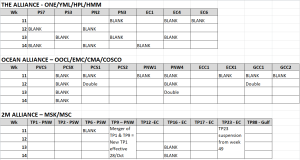
The Ocean Alliance could be the next major ship-sharing agreement to sink, possibly sometime this year, as its members chart different strategies and look to gain market share during the current “rate war” among ocean carriers, industry analyst Lars Jensen said Wednesday.

Speaking at the Journal of Commerce’s TPM23 conference in Long Beach, Jensen said ocean carriers face a market similar to the one seen during the 2008-09 financial crisis when a massive buildup of ship capacity came up against weakening demand.

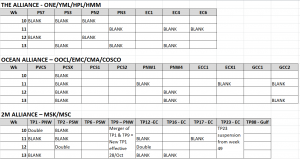
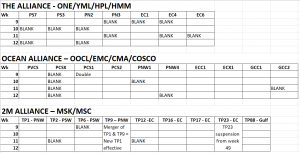
While demand could recover should inventory destocking occur through the spring and US consumers keep spending, Jensen said the industry faces other headwinds, such as political scrutiny over the alliances’ anti-trust exemptions and higher costs from stringent carbon emissions rules. The result, he added, is that carriers are thinking more about “who do I want to spend the next few years with” as has happened with the pending dissolution of the 2M Alliance.

“It’s a normal downcycle we are going through, then there are some elements that are slightly different,” Jensen, CEO and partner of Vespucci Maritime and a Journal of Commerce analyst, said. “Rates are coming down faster than they went up. It is a rate war.”

“2M is the just the first domino to fall,” he added. “When it was formed, you had two parties with the same strategic interest. Now you have two parties whose interests are no longer aligned.”

Cosco has second-largest orderbook

Jensen, one of the first to predict the breakup of 2M, said at the time that Mediterranean Shipping Co.’s  large orderbook of new vessels allowed it to operate on a standalone basis across many trade lanes, without having to share space on Maersk vessels. A similar dynamic could play out with Ocean Alliance member Cosco Shipping, which has the second-largest orderbook of new ships behind MSC, Jensen said.

Cosco faces renewed urgency to fill those new vessels due to a loss of market share over the last two years that Jensen attributed to China’s COVID-19 lockdowns and the resulting shipping delays out of the country.

“I’m going to expect Cosco to be very aggressively going after market share,” Jensen said. “Who’s the easiest prey to go after? That would be customers already on your ships through your alliance partners.”

“That’s not going to sit well with [Ocean Alliance members] CMA CGM and Evergreen Marine,” Jensen said, adding that Taiwan’s Evergreen faces the additional tension of working with a China-based carrier.

Indeed, Cosco recently upsized capacity on an Asia to US Gulf service it operates on a standalone basis, but that is also offered through the Ocean Alliance. The new capacity on that Cosco service now evenly matches one that CMA CGM also offers on a standalone basis to the US Gulf.

Likewise, CMA CGM is pursuing a strategy not similar to Maersk’s, “but somewhere in the same direction,” Jensen said.

As does Maersk, CMA CGM looks to own US terminal assets after striking acquisition deals on the US East and West coasts. CMA CGM’s North American President Peter Levesque said during his appearance at TPM23 Tuesday that owning terminals allows the carrier to “determine our own destiny.”

The Ocean Alliance’s agreement is set to expire in 2027, Jensen said, but he noted the current market uncertainty and the pending breakup of 2M could hasten a decision not to renew the Ocean Alliance in 2023.

Regarding THE Alliance, Jensen said “it’s slightly stable” due to similar operating strategies and less aggressive ship ordering. However, he said the changing carrier landscape may make THE Alliance’s two biggest members, Hapag-Lloyd and Ocean Network Express (ONE), reconsider their partnerships. Jensen even posited that the two could decide to merge as a way to take on ever-larger ocean carriers.

“This is not the first time we’ve seen alliances break up and get re-formed,” he said. “The challenge is once everyone’s dance card is open, Hapag and ONE will have some thinking to do about who do we actually want to be lined up with now that everything is shifting.”

Source:

Angell, M. (2023, March 1). TPM23: Ocean Alliance could be next domino to fall after 2M: Analyst. Retrieved March 9, 2023, from https://www.joc.com/article/tpm23-ocean-alliance-could-be-next-domino-fall-after-2m-analyst_20230301.html

Hong Kong liner rapidly builds up links with Russia

Yesterday, Splash detailed the main container names operating in and out of Russia, with a slew of new capacity entering the region as many global carriers have exited in the wake of war with Ukraine.

One of the most ambitious new players is Hong Kong-registered OVP Shipping, formed in late 2020. OVP launched a first liner service linking China with Vladivostok in the middle of last year. It has seen launched a China – Novorossiysk service in mid-November, while, according to Alphaliner, its first China to St Petersburg service is underway now, and will become a fortnightly offering from next month when more chartered-in tonnage joins the OVP fleet. Alphaliner lists the Hong Kong carrier in 61st spot in its top 100 liner rankings.

While much has been written about the importance of Dubai to Russian-linked shipping operations in the wake of sanctions following the invasion of Ukraine, another important shipping enabler for Moscow has been the maritime hub of Hong Kong.

Box rates in and out of Russia remain “highly elevated” according to Linerlytica.

“New capacity continues to flow into the Russian trade with the latest newcomers Safetrans, Torgmoll/New New, Reel Shipping and OVP Shipping adding ships to the trade as congestion at the Russian Far East gateways of Vladivostok and Vostochny have generated demand for new services from Asia to the Black Sea and Baltic gateways of Novorossiysk and St Petersburg,” analysts at Linerlyica noted in its most recent weekly report describing the Russian freight scene as “thriving”.

Source:

Chambers, S. (2023, March 1). Hong Kong liner rapidly builds up links with Russia. Splash247. Retrieved March 2, 2023, from https://splash247.com/hong-kong-liner-rapidly-builds-up-links-with-russia/

Labour talks casting long shadows over ports on US coasts

Following yesterday’s news that negotiations between US west coast terminal operators and dockers had reached agreement on some issues, the International Longshoremen & Warehouse Union and the Pacific Maritime Association broke their silence to reassure industry stakeholders that talks were continuing.

They emphasised that the long process (negotiations to renew the labour contract began last May) had not disrupted port operations and expressed hope of “reaching a deal soon”.

However, stakeholders have shown impatience, warning it could result in permanent loss of cargo flowing through the west coast ports, which likely impelled the two sides to speak.

They said a tentative deal had been reached on “certain key issues, including health benefits”, and expressed their commitment to resolve the other points “as expeditiously as possible”.

But observers are not convinced this will happen soon. One industry executive said no progress had been made on the critical issue of automation, nor on the controversy over cold ironing at the port of Seattle that derailed talks for months.

The glacial pace also raises concerns about contract talks on the east coast, where the master contract between union International Longshoremen’s Association (ILA) and the US Maritime Alliance (USMX), which represents ocean carriers and terminals, is set to expire next year.

On top of familiar issues like automation, pay and benefits, there is the dispute over work allocation at Charleston’s Leatherman terminal, which has affected operations at the South Carolina port. Since the $1bn terminal opened in 2021, the ILA and Ports South Carolina have been in dispute.

The bone of contention is who is eligible to operate cranes and lift equipment. The ILA argues this has to be performed by union members, in line with the master contract for all east and Gulf coast ports. SC Ports maintains it is not party to that agreement and has a long-standing policy under which non-union state employees work cranes and lift equipment, while ILA members perform all other jobs.

“Each side believes its position is right,” commented an industry executive close to the situation, which has escalated into a legal battle.

The port has enjoyed strong growth, which boosted its throughput to 2.8m teu last year, and it has invested a lot of money to accommodate further growth. Last summer, it strengthened the wharf, brought in taller cranes and improved the container yard at the Waldo Welch container terminal, broke ground on an intermodal facility with a capacity of one million rail lifts in phase one and launched a pool of 13,000 chassis. It has also invested in deepening the harbour to 16 metres.

It is expected that the Leatherman dispute will be on the table in the ILA-USMX contract negotiations, and some stakeholders hope the talks will resolve the issue, sparing everybody a lengthy legal battle that could go all the way to the Supreme Court.

On the other hand, there is concern the issue will complicate the contract negotiations and delay any agreement.

But even without an additional stumbling block, the talks should be challenging – although both sides have expressed “mutual respect and willingness to find a compromise”.

“There are big issues on the table,” said one observer, pointing to the thorny issue of automation. “Ports need the ability to handle more cargo without building new facilities.”

The dispute has caused one move at Charleston so far: At the end of last month, Hapag-Lloyd announced it was shifting its calls to the Wando Welch terminal, after, according to some sources, experiencing some fallout from the situation in Charleston at other US ports.

Source:

Putzger, I. (2023, February 24). Labour talks casting long shadows over ports on us coasts. The Loadstar. Retrieved February 27, 2023, from https://theloadstar.com/labour-talks-casting-long-shadows-over-ports-on-us-coasts/

MSC Services Expansion

MSC expanding standalone services to grow its network outside 2M

THE Mediterranean Shipping Company (MSC) is focused on expanding its standalone services outside the 2M Alliance, reports London’s Loadstar.

The carrier has tapped into the Indian export market to the US with an expansion of its Sentosa loop, which offers a connection of Indian ports of Mundra and Nhava Sheva to Long Beach and Oakland.

MSC stated the enhanced service will deploy twelve 11,500 to 16,650 TEU vessels, instead of the current seven.

MSC also announced it was relaunching its Dragon service, from Asia to the Mediterranean. It said the Dragon service would connect Asia to Israel, Italy, and the south of France, and “offer the fastest transit times into the Mediterranean”.

The carrier has not nominated vessels that will operate the revised loop, which is to start from Shanghai on March 15 and will include direct calls at Ashdod and Naples.

Vespucci Maritime consultant CEO Lars Jensen stated it appeared to be “the first divergence” between the 2M carriers since the announcement last month of the parting in January 2025.

“I expect to see continued divergence and potentially an earlier formal breakup, but for now the timing is 2025,” said Mr Jensen.

Source: Hong Kong Shipping Gazette

MSC TransPacific services update Amberjack & Emerald

Starting in May, the MSC Amberjack service will operate on the following rotation, connecting south and central China and South Korea to the U.S. east coast:

Qingdao – Ningbo – Shanghai – Busan – Panama Canal – Kingston – Charleston – Savannah – Norfolk – Kingston – Panama Canal – Busan – Qingdao

Calls at Jacksonville and Wilmington will be removed and switched to the Emerald service (see below), starting with the vessel MOUNT EVEREST, ETA Qingdao on 6 May.

Also from May, the Emerald service will follow a new rotation, removing Norfolk, but adding Jacksonville and Wilmington to compensate for the removal of these ports on the Amberjack service: Xiamen – Yantian – Shanghai – Busan – Panama – Canal – Cristobal – Savannah – Jacksonville – Wilmington – New York – Suez Canal

Source: AJOT.com

US CUSTOMS – POSTAL CODE REQUIRED FOR CHINA-ORIGIN GOODS (Effective March 18, 2023)

Effective March 18, 2023, it is anticipated that U.S. Customs and Border Protection will require the input of valid postal codes into the ACE entry process for all China-Origin Goods.

The ACE deployment schedule indicates the following.

The UFLPA Region Alert will add three new validations that will be performed when Country of Origin is China for Entry and for Manufacturer Identification Code (MID) creation for both Trade and CBP users.

  • Postal code will be a required field
  • Users will receive an error message if the postal code provided is not a valid Chinese postal code
  • Users will receive a warning message when a Uyghur region postal code has been provided
  • Ability to update an existing MID with a postal code
  • Includes EDI Impacts

Full information can be found in Trade User Information Notice: Uyghur Forced Labor Prevention Act Region Alert/U.S. Customs and Border Protection.


TS Lines closes Vancouver service and repurposes fleet for intra-Asia

Taiwanese intra-Asia carrier TS Lines has sold three containerships as it refocuses resources on its core intra-Asia services.

Last week, Greek broker Intermodal reported that TS Lines had sold 2019-built 1,096 teu TS Shanghai and TS Yokohama and the 2006-built 962 teu TS Moji to a European buyer for $40m.

A source at TS Lines confirmed the sale and that it would not be chartering the ships back.

The buyer has been identified as German tonnage provider HR Schiffahrt, and brokers said there was talk that TS Lines had also put the 2007-built 2,553 teu TS Manila up for sale.

The Loadstar has reported that TS Lines would be axing its Asia-Europe and Asia-US east coast services, jointly operated with China United Lines and SeaLead Shipping, respectively.

Today, the TS Lines source revealed it had also permanently called time on its North West 1 service that connected China with Vancouver, Canada, which began in October 2021 and ceased in November last year.

The source said: “As we’re taking delivery of a dozen newbuildings this year and considering that asset values have been falling, we decided to sell a few ships to adjust our fleet size.”

The source however, declined to confirm the sale of TS Manila, bought for $6m in August 2020 and valued at around $14m.

Like many other regional carriers, TS Lines entered long-haul tradelanes when freight rates hit historical highs, only to depart these routes after market conditions normalised. Chairman Chen Te-sheng recently said the next two years were expected to be challenging, although TS Lines still hoped to complete its Hong Kong Stock Exchange listing this year.

TS Lines has 1,100, 2,900 and 7,000 teu ships being delivered from Fujian Mawei Shipbuilding and Shanghai Waigaoqiao Shipbuilding this year. The 1,100 teu vessels are designed for China-Japan routes; the 2,900s are intended for East Asia-Australia/New Zealand services, while the 7,000 teu ships are expected to be assigned to services connecting East Asia with India and the Persian Gulf.

A broker suggested TS Lines might be “cashing out of older ships” as asset values plummeted in tandem with weaker market conditions. TS Moji had a valuation of $9m when TS Lines bought the ship in May 2021, but was reportedly sold to HR Schiffahrt for $7m.

TS Shanghai and TS Yokohama were ordered from Kyokuyo for $17m each in 2018, their value peaked at around $51m each in October 2021, but had plummeted to $16.5m at the time of the recent sale.

Source: theloadstar

Taiwan, M. L. in. (2023, February 13). TS lines closes Vancouver Service and repurposes fleet for intra-asia. The Loadstar. Retrieved February 14, 2023, from https://theloadstar.com/ts-lines-closes-vancouver-service-and-repurposes-fleet-for-intra-asia/