Truckers fighting ILWU, LA-LB terminal operators over chassis paperwork proposal

A proposed rule that would require truck drivers working the ports of Los Angeles and Long Beach to provide proof of ownership or lease for all private chassis — or else be sent for a safety inspection prior to picking up cargo — would needlessly increase the gateway’s already high truck turn times, according to trucking companies.

Truckers this week are pushing back on the proposal, which was made by the International Longshore and Warehouse Union (ILWU) in concert with waterfront employers represented by the Pacific Maritime Association (PMA) and due to be implemented on Wednesday. But the start date has been delayed while the sides attempt to negotiate a resolution.

The requirement to show proof of ownership or lease for private chassis is due to affect truckers calling at five marine terminals — Everport, TraPac and Yusen at the Port of Los Angeles and Long Beach Container Terminal and Total Terminals in Long Beach.

“To ensure a smooth and efficient out-gate transaction, we kindly request that drivers have these documents accessible when leaving TTI premises,” Total Terminals said in a customer notice last Friday that was obtained by the Journal of Commerce. “This proactive measure will help prevent any potential issues or delays.”

The paperwork provided by truckers must include the chassis number to be accepted.

Truckers and officials from the PMA met on Tuesday and were scheduled to continue talks on Wednesday to mediate the disagreement. The Harbor Trucking Association (HTA), ILWU and PMA did not respond to a request for comment.

Truckers warn of rising turn times

Truckers say implementing the paperwork measure would push average truck turn times in Los Angeles-Long Beach, already among the highest in the US, even higher. The average truck turn time in Los Angeles and Long Beach was 74 minutes in October and has been more than an hour in all but two months since January 2019, according to data from the HTA.

Details please refer to the JOC news.

Source:

Ashe, A. (2023, December 13). Truckers fighting ilwu, LA-lb terminal operators over chassis paperwork proposal. Journal of Commerce. https://www.joc.com/article/truckers-fighting-ilwu-la-lb-terminal-operators-over-chassis-paperwork-proposal_20231213.html

Canadian shippers urge Ottawa to act as Montreal port talks hit impasse

Contract talks involving longshore workers at the Port of Montreal appear stalled after the union’s chief negotiator said maritime employers have yet to make an offer on a new pay package. With a looming deadline before dockworkers could walk off the job, shippers are urging the federal government to act now to avoid yet another strike at Canada’s second-busiest port.

Michel Murray, the national representative for Local 375 of the Canadian Union of Public Employees (CUPE), which represents Montreal’s dockworkers, told a panel of Canadian Parliamentarians Thursday that a negotiation period overseen by the government has ended without a new wage proposal from maritime employers.

In late October, Local 375 asked Canada’s Federal Mediation and Conciliation Service to intervene as talks began with Montreal’s Maritime Employers Association (MEA) for a new four-year collective bargaining agreement. Murray on Thursday said that process “ended two days ago and … the management side hasn’t [submitted] its wage offer yet.”

The MEA are the direct employers of CUPE members. But Murray took MEA’s ocean carrier and marine terminal members to task for not showing up during the contract talks, saying it demonstrated that port employers are not taking the talks seriously.

“The shipping lines were not seated at the bargaining table,” he said. “We have to make sure the real decision makers are seated at the bargaining table.”

The end of the federal government’s oversight of the contract talks triggered the start of a 21-day “cooling off” period under Canadian law. The union can call a strike after that period, which could occur as soon as Jan. 4 following a 72-hour notification to employers.

Details please refer to JOC news.

Source:

Angell, M. (2023, December 8). Canadian shippers urge ottawa to act as Montreal Port Talks hit impasse. Journal of Commerce. https://www.joc.com/article/canadian-shippers-urge-ottawa-act-montreal-port-talks-hit-impasse_20231208.html


Shippers weigh costly routing changes against possibility of East Coast strike

In dialogue among shippers, carriers and non-vessel-operating common carriers (NVOs) for the upcoming Asia-to-North America contract cycle, a new issue is being raised: the possibility of labor disruption, including a strike along the US East and Gulf coasts for the first time in decades.

International Longshoremen’s Association (ILA) President Harold Daggett on Nov. 4 told his rank and file to be prepared for that possibility if no agreement with carriers is reached by Sept. 30, 2024, when the current collective bargaining agreement expires.

With memories still fresh of West Coast disruptions during contract negotiations in 2022 and 2023 (and in many prior rounds), and supply chains being monitored closely by senior management following the pandemic upheavals, shippers who have built East and Gulf coast routings into their supply chains are taking no chances. They are raising the need for contingency plans in discussions with carriers and NVOs ahead of 2024 contract renewals, industry sources tell the Journal of Commerce.

But any diversions away from established routings, rail and trucking vendors, and distribution center networks will be inconvenient and costly. So part of the calculus will inevitably be this: There hasn’t been a coastwise strike along the East and Gulf coasts in the region since 1977, nearly a half century ago, so what are the odds a strike will really occur this time?

The answer gets into a complex mix of dynamics, including the state of the carrier industry, perceptions of carriers in Congress and election year presidential politics. But any analysis of the factors that could impact whether or not a strike occurs next year will be insufficient given inherent unpredictability of labor negotiations.

Some insiders, for example, predicted in 2022 that West Coast negotiations would be quickly wrapped up — only to be proved wrong when the talks and associated port disruptions stretched on for many months thereafter. They were ultimately only concluded in July of this year, and ratified in August, following intervention by the Biden administration, which was motivated by the need to avoid further supply chain disruption.

Details please refer to JOC news.

Source:

Tirschwell, P. (2023, December 5). Shippers weigh costly routing changes against possibility of East Coast Strike. Journal of Commerce. https://www.joc.com/article/shippers-weigh-costly-routing-changes-against-possibility-east-coast-strike_20231205.html

THE Alliance diverts ships through Suez ahead of Panama Canal transit cuts

Ocean carriers of THE Alliance will halt Panama Canal transits through February for ships on three of its weekly container services between the US and Asia, opting instead for longer sea routes through the Suez Canal.

The move comes as the Panama Canal Authority (ACP) puts severe limits on ship transits in response to the ongoing drought in the region, which is already causing mounting delays for vessels. Those limits are due to get even tighter in the coming months.

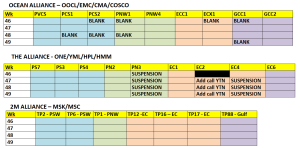
Hapag-Lloyd said Friday that two services to the US East Coast, the EC1 and EC2, along with the EC6 service that calls the Gulf Coast, will use the Suez Canal for their US-bound voyages “during the dynamic Panama Canal situation.”

A live tracking tool the carrier is now offering to shippers showed that 10 ships spread among the three services will depart from South Korea’s Port of Busan between the end of November and mid-December and take the westbound voyage through the Suez Canal instead of eastbound voyage through the Panama Canal.

On the return voyage, seven ships among the three services have been scheduled to depart US ports since mid-November, using the Suez Canal for the backhaul. In addition, three ships on the EC1 departed Savannah at the start of November and used the Cape of Good Hope to return to Asia.

The live tracking tool did not indicate how long the Suez rerouting would last. But a source familiar with the situation told the Journal of Commerce that THE Alliance expects to reroute vessels through the end of February. Another source said no permanent change for these services has been made yet, prompting the use of the live updates to show which ships are being rerouted.

The Suez Canal route from Northeast Asia takes about five to eight days longer than through the Panama Canal, but THE Alliance will deploy more ships into the services to maintain their schedules.

Canal trips halved by 2024

The service changes come as the Panama Canal grapples with its worst drought in more than a half-century, limiting the amount of fresh water that can be pumped into the Canal’s locks from Gatun Lake. That has winnowed the number of ships that can transit the canal, forcing the maximum ship draft to be lowered to 44 feet from 50 feet.

In an October announcement, the ACP said it will only allow 18 ships of any size to transit the canal each day starting Feb.1. That is down from the 32 daily transits allowed as of August due to the draft restrictions resulting from the drought. At peak capacity, the canal can handle between 34 and 42 ships per day.

The ACP has also suspended auctions for last-minute reservation slots for ships to use the canal, causing more vessels to wait longer for an open slot. Northbound ships on average are waiting just over 11 days for an open reservation slot as of December, up from three days as of the start of November.

Container ships have been spared from most of the actions the ACP has taken in response to the drought because they have regular reservation slots. Even so, there will only be 15 reservation slots for post-Panamax vessels, such as container ships, available by February, down from 20 slots available at the start of November.

Carrier surcharges

Most of the effects of the canal’s restrictions have shown up in surcharges that carriers plan to start levying on shippers. CMA CGM and Hapag-Lloyd plan to start charging $150 and $130 per TEU, respectively, for Panama Canal services.

Mediterranean Shipping Co. will start charging an extra fee of $297 per TEU in mid-December on imports from Asia that transit the canal to the US. MSC will also charge $140 per TEU on containers that transit the canal from the West Coast of South America to the US East and Gulf coasts.

Jennifer Matuszak, director of global freight at Vinmar International, told the Journal of Commerce that while the canal’s restrictions have not had much impact yet, she is concerned about how the February transit limits will affect US resin exporters such as Vinmar.

“Other than a few blank sailings, which could be for any number of reasons, we have not seen any impact yet in terms of delays or restrictions,” Matuszak said. “But with less slot capacity available as of February onward, I am extremely concerned and monitoring the situation.”

She said shippers can use intermodal rail from the Gulf Coast to reach West Coast ports as an alternative to the Panama Canal. That will add to transit time, “but no solution is going to be perfect, and we manage the situation as we face it,” she said.

The biggest change for Vinmar as a shipper, though, is monitoring weather to get ahead of potential disruptions. In addition to Panama’s drought, northern Brazil also saw reduced water levels on the Amazon River that forced restrictions on shippers to Manaus, a destination for resins shippers.

On the other end of the Amazon, Brazil’s Navegantes region was hit with floods, delaying shipments to that southern port. India’s Mundra port, a major transshipment hub, was also hit with monsoon rains that limited cargo moves.

Matuszak said she now sets up calendar reminders to check on seasonal weather patterns at her customers’ preferred ports.

“This year, weather has been the wildcard,” she said. “I never had to do a reminder for weather in my 20 years in the shipping business.”

Source:

Angell, M. (2023, December 1). The alliance diverts ships through Suez ahead of Panama Canal Transit cuts. Journal of Commerce. https://www.joc.com/article/alliance-diverts-ships-through-suez-ahead-panama-canal-transit-cuts_20231201.html

Bleak outlook for liner shipping – unless carriers take drastic action

Supply will outpace demand in container shipping in both 2024 and 2025, according to international shipping organisation Bimco, and this will exert further pressure on freight and charter rates.

Ocean carriers have already pushed back deliveries of some ultra-large vessels into next year, and are likely to try to re-negotiate with yards to slide further newbuilding delivery dates as far back as possible.

In its Q4 market overview and outlook, Bimco says following estimated growth of 7% this year, the container fleet is expected to expand by 8.8% next year to more than 30m teu, and by another 6.4% in 2025.

“Even at the best of times, ship demand would not see similar growth,” it says.

In contrast to the containership capacity supply explosion, Bimco expects flat-to-1% growth in global container volumes this year, and modest growth of between 3% and 4% in both 2024 and 2025.

The only bright spots in the demand outlook are for the secondary trades.

“Despite only contributing about 23% of global import volumes, the current growth drivers in the container market are the Indian subcontinent and Middle East, South and Central America and sub-Saharan Africa regions,” says Bimco.

Meanwhile, the shipping organisation said it had seen some postponements of newbuild delivery dates.

“Our forecast for fleet growth in 2023 has been adjusted downwards, as it appears that more ships planned for delivery in 2023 than expected have been delayed until 2024,” said Bimco. It said cellular container fleet exceeding 30m teu by late 2024 would represent a huge 26% expansion of capacity since December 2020.

However, an expected ramping-up of scrapping in the sector in 2024 and 2025, due to tougher environmental regulations and falling time charter rates, could prove a mitigating factor.

Containership scrapping will struggle to reach 200,000 teu this year, but analysts are suggesting this could be doubled or even trebled next year, as shipowners retire elderly tonnage as daily hire rates are expected to fall to sub-economic levels.

Moreover, a further slowing of service speeds will soak up tonnage, as will diversions from the Panama Canal via the longer Suez Canal or Cape of Good Hope routes, as well as other geopolitical issues and the occasional ‘black swan’ event.

Nevertheless, as it stands, Bimco’s outlook for the liner industry remains bleak, unless carriers are prepared to take radical action in terms of capacity management strategies over and above blanking programmes.

“Our forecast predicts that the weakening that began in 2022, and took hold in 2023, will continue in 2024 and 2025,” says Bimco.

“However, there have recently been signs that freight rates have gone so low that liner operators are prepared to act. Though we do not believe liner operators will be able to significantly increase freight rates, we do believe they will be significantly more focused on adjusting their operated fleet to actual demand.”

Source:

Wackett, M. (2023b, December 4). Bleak outlook for liner shipping – unless carriers take drastic action. The Loadstar. https://theloadstar.com/bleak-outlook-for-liner-shipping-unless-carriers-take-drastic-action/

Fleet-heavy ocean carriers also stuck with too many containers

Not only do ocean carriers have too many ships, they also have too many containers to fill vessels that are being deployed.

In its latest Container Equipment Forecaster report, Drewry says it expects the global pool of shipping containers to contract, both this year and next.

Some 55 million teu of equipment services the fully cellular global fleet of some 6,000 ships, a total capacity of 28m teu, but thousands of surplus boxes lie stacked in empty-container depots, incurring storage charges on top of a daily lease-hire rate.

Drewry forecasts the box pool will have declined by 2.6% this year, and expects another decrease in 2024.

“The last time the container pool posted a year-on-year decline was at the time of the global financial crisis between 2008 and 2009, when the total number of containers in service fell by 3.7%, to 26.9m teu,” said the consultant.

However, as with their chartered-in ships, carriers must honour the terms of equipment lease agreements, which are commonly between five and 13 years, with renewals often agreed at between one and eight years.

For example, the second-largest container lessor, Textainer, reported during an earnings call a remaining average tenure of “approximately six years” for its 4.3m teu fleet.

Indeed, the business plan of the lessors appears to be as watertight as the charter parties’ agreements for the expensive long-term hires of the ships which carriers negotiated at the height of the post-pandemic demand boom.

And Textainer was bullish during its Q3 results presentation this month. president and CEO Olivier Ghesquiere said: “Overall market conditions have remained unchanged from the last quarter, yet our contracted revenue and profitability continue to be supported by our long-term lease contracts and fixed-rate financing policy.”

Moreover, for the 50% of boxes that are carrier-owned, lines are struggling to offload ageing equipment into the saturated second-hand market.

Details please refer to the news.

Source:

Wackett, M. (2023, November 28). Fleet-heavy ocean carriers also stuck with too many containers. The Loadstar. https://theloadstar.com/fleet-heavy-ocean-carriers-also-stuck-with-too-many-containers/


Carriers weigh options as Panama Canal restrictions become a fact of life

Persistent drought-driven restrictions on container ships traversing the Panama Canal are in the cards for at least the next several years, barring a dramatic upswing in rainfall. Those restrictions, which effectively reduce the maximum stowage capacity of larger vessels and limit the overall number of transits, will likely force carriers to alter networks as they try to push higher costs onto shippers.

The canal first began restricting daily transits in July and said it will ease them when water levels rise. Panama’s rainy season is historically in April and May.

But the soonest the Panama Canal Authority says it could see significant relief is 2028, and that’s if the government of Panama course-corrects after years of underinvestment and supports $2 billion in investment to build a new reservoir and more pipelines.

Container lines, including Ocean Network Express (ONE), are urging the government to act. Current and past canal administrators, in consultation with the US Army Corps of Engineers, have stressed the need for investment to protect the water basin to avoid underutilization of the waterway.

“We greatly appreciate the current weather conditions are a factor,” ONE CEO Jeremy Nixon wrote in a letter to Panamanian President Laurentino Cortizo Cohen on Oct. 30. “However, we also understand that no significant projects have gone ahead in Panama to increase the fresh water supply to the locks from other catchments areas.”

ONE’s neo-Panamax ships — those with capacities ranging from 10,000 to 15,000 TEUs that can transit the canal thanks to the new set of locks that opened in 2016 — have experienced delays and restricted stowage, Nixon told Cohen in the letter, a copy of which was obtained by the Journal of Commerce.

Draft limits are reducing the capacity of container ships transiting the canal by approximately 20% across all size classes, said Michael Kristiansen, president of Panama-based consultancy CK Americas. Larger vessels lose approximately 350 TEUs of capacity for each foot of draft lost; with draft now limited to 44 feet, down from the designed 50 feet, larger ships must forgo about 2,100 TEUs of otherwise usable space.

Some carriers have been forced to offload cargo at terminals at either end of the canal, and then rail those boxes across the isthmus. Container lines have been generally spared from long transit delays, however, thanks to pre-scheduled transit appointments.

Rethinking routing

Concerns over the restrictions — and shipper complaints over a lack of service reliability — have reached such a level that ONE is considering other routings via the Suez Canal, Nixon said in his letter. To avoid the draft limits and get US imports from Asia to the Midwest, Zim Integrated Shipping Services this month added a call at the Port of Lázaro Cardenas in Mexico, while CMA CGM has been making more ad-hoc calls to the Pacific Coast port.

With Panama Canal transit windows pre-booked, containers lines aren’t diverting services, nor are they shelling out millions of dollars to skip the line, similar to what some operators of liquefied natural gas (LNG) carriers have done, according to Bloomberg. The lack of scheduled service, however, is squeezing seasonal refrigerated (reefer) operators that charter vessels on an ad-hoc basis and must wait in line similar to the bulk carriers and tankers.

Nixon also raised concern about the reduction in daily transit slots for neo-Panamax vessels, with the number falling to five starting Jan. 1 compared with the 10 available just three months ago. Kristiansen said the canal handles an average of 4.5 neo-Panamax transits daily, raising concerns that some services will be squeezed unless enough neo-Panamax LNG and bulk carriers divert away from the waterway.

ONE, similar to other container lines, invested heavily in larger vessels that were able to move through the larger set of locks, which was completed in 2016 at a cost of $5.25 billion. Ports along the US East and Gulf coasts similarly invested billions of dollars to be able to handle the larger ships, which has helped fuel a two-decade shift of trans-Pacific imports away from the West Coast.

Political solutions

But Panamanian politicians seem more focused on copper than water, amid the largest protests in three decades over mining concessions. Rising political instability and social unrest frame the upcoming national election in May.

Ultimately, the government must either expand the canal authority’s geographic remit so it can push through water management projects or limit current restrictions that prevent it from building new reservoirs. Canal officials hope construction contracts currently in the offing can be awarded by the end of 2024, with work completed in 2028.

Depending on the severity of this drought, and potentially others to come, carriers may do as ONE warned: shift service away from the canal. Deploying smaller vessels is another option.

Carriers could also adjust services to send more cargo from South Asia through the Suez Canal, though it would add distance for some origins, Kristiansen said. The US East Coast is approximately 2,200 nautical miles farther from Shanghai via the Suez Canal than via a Panama Canal routing.

Yet another option would be for carriers to change some Asia–North America services to so-called around-the-world strings, transiting the Suez on the backhaul from North America to Asia, Kristiansen said. That would require an additional deployment of ships in the string to maintain weekly service frequency. Although less than ideal, it would slightly mitigate industry-wide overcapacity.

Whether carriers can pass on the costs in a depressed trans-Pacific market, as CMA CGM is attempting to do, is another matter. Citing transit limits for neo-Panamax ships and higher tolls, CMA CGM said in a Nov. 21 advisory it will begin applying a $150-per-TEU surcharge for shipments moving through the Panama Canal.

Source:

Szakonyi, M. (2023, November 21). Carriers weigh options as Panama Canal restrictions become a fact of life. Journal of Commerce. https://www.joc.com/article/carriers-weigh-options-panama-canal-restrictions-become-fact-life_20231121.html

Strike along the St Lawrence ends

Ships will start working again along the St Lawrence river this morning, bringing an end to an eight-day strike after a deal was struck Sunday with around 360 workers and members of Unifor, Canada’s largest private-sector union, in a dispute over wages with the St Lawrence Seaway Management Corp.

“Details of the tentative agreement will first be shared with members and will be made public once an agreement is ratified,” said a union statement.

The strike shut down 13 locks on the seaway between Lake Erie and Montreal with around 150 vessels affected.

“For the first time in 55 years seaway workers took the very hard decision to go on strike. They did so to fight for a more respectful workplace and for an agreement that reflects today’s economic times,” said Lana Payne, Unifor national president. “They have shown that the best deal is reached at the bargaining table, and I congratulate the committee on their outstanding work on behalf of their members.”

Source:

Chambers, S. (2023, October 30). Strike along the St Lawrence ends. Splash247. https://splash247.com/strike-along-the-st-lawrence-ends/

Prince Rupert to build large export transload facility to balance cargo mix

The Port of Prince Rupert said Thursday it has begun construction of a rail-to-container transloading facility that will significantly increase the Western Canadian port’s capacity to export agricultural, forestry and resin products while achieving a better import-export mix.

The project will consist of a 108-acre greenfield development on Ridley Island and is scheduled for completion in the third quarter of 2026. Ray-Mont Logistics will develop and operate the facility, which will provide transloading capacity for 400,000 TEUs a year.

Ray-Mont currently operates a transloading facility on a temporary Ridley Island location.

The temporary facility will transition to the permanent Ridley Island Export Logistics Project (RIELP), which will provide significantly more transload capacity, said Brian Friesen, vice president of trade development at the Price Rupert Port Authority.

“It will be enormous in size and scale — 10 times the size of the temporary one,” Friesen told the Journal of Commerce Thursday.

The C$750 million project will help import-heavy Prince Rupert establish a more balanced import-export flow, Friesen said. The import-export ratio has varied over time. Ten years ago, imports outnumbered exports two to one. In pre-pandemic 2019, exports accounted for 25 to 30% of the port’s total container volume. This year, exports are in the low-30% range.

“So we still have a long way to go,” Friesen said.

The project will include Prince Rupert developing a road-rail utility corridor that will connect the new transload facility with Fairview Container Terminal, giving unit trains 10,000 feet in length direct access to the site from the Canadian National Railway network. The connector corridor ensures that all product movements will be within the port authority’s jurisdiction, the port said in a statement.

The total capital investment of C$750 million is being provided by the port, Ray-Mont Logistics, CN, the Canadian federal government and the government of British Columbia. Canada’s National Transportation Corridor Fund is providing C$64.8 million and the province’s Stronger BC program is providing C$25 million toward the project, according to the statement.

Prince Rupert serves Canadian, US markets

Prince Rupert, with its CN intermodal connections to eastern Canada and to the US market through Chicago, is a gateway for Asian imports. The port seeks to grow as an export gateway for Canadian and US cargo. A more robust two-way trade will generate increased container volumes and assist in the shipment of export loads and repositioning of empty containers along the CN network, Friesen said.

“The project’s large scale, unit train capabilities, access to available empty containers and proximity and integration into container terminal operations make it a unique model that promises the ability to deliver significant new service offerings to exporters that will greatly improve the quality, cost and reliability of container supply chains,” the port authority said.

Source:

Mongelluzzo, B. (2023, October 19). Prince Rupert to build large export transload facility to balance cargo mix. Journal of Commerce. https://www.joc.com/article/prince-rupert-build-large-export-transload-facility-balance-cargo-mix_20231019.html