
Shippers face delays as carriers skip South America calls due to Panama Canal woes

Shippers in Asia and Brazil are suffering from cargo delays of up to a month as ocean carriers omit calls at key transshipment ports in Central and South America to offset delays caused by limits on the number of ship transits through the drought-hit Panama Canal.

Port and freight forwarding executives say the omissions mainly affect carriers in THE Alliance.

Highlighting the delays, Fabrizio De Paulis, managing director of Brazilian forwarder De Paulis Logistics & SCM Eireli, said two consignments of reefer containers were delayed at Cartagena, Colombia, for almost two weeks because of port omissions and congestion.

Ocean Network Express (ONE) and Hapag-Lloyd confirmed they are skipping calls, especially at Cartagena and Manzanillo in Panama, although omissions are being made at other ports.

ONE said at least 12 December and January sailings on the Asia-US East Coast EC1 and EC2 services, operated as part of THE Alliance network, would skip calls at either Manzanillo or Cartagena as vessels were diverted.

Vessels operating those services, including the 13,000-TEU Ulsan Express and 13,296-TEU Al Riffa were originally to be diverted through the Suez Canal, ONE said. But due to the threat of missile and drone attacks in the Red Sea, ships are now sailing via the Cape of Good Hope.

The extra transit time has lengthened the original delay of about 10 days for arrival on the US East Coast to about one month, vessel schedules showed Tuesday.

By comparison, the latest data from the Panama Canal Authority (ACP) shows 47 vessels with transit bookings and 23 vessels without were waiting in the queue Tuesday. The average waiting time for non-booked neo-Panamax vessels was under five days for north and southbound vessels, ACP data showed.

ONE said it was also transshipping cargo in South Korea’s Busan after it changed vessel routings from eastbound to westbound to avoid the Panama Canal.

Hapag-Lloyd said it is omitting calls at ports including Kaohsiung, Taiwan and Buenaventura in Colombia on its Asia-Latin America (JCS) and North Europe-South America Westcoast (SWX) services.

“The omissions were made because we didn’t get slots to go through the canal,” a Hapag-Lloyd spokesperson told the Journal of Commerce. “The slot situation is challenging at the moment, but we see some light at the end of the tunnel. The EC2 service will pass via the canal in January again.”

Maersk said it has not made any port omissions despite the restrictions through the Panama Canal.

“We have been closely monitoring the situation and, thus far, we have been able to continue making and securing timely Panama Canal transits to support our customers,” Maersk Latin America spokesperson Monica Martinez told the Journal of Commerce. “We continue to adapt our internal processes to match the updated booking requirements of the canal, securing access to the transit slots needed to ensure minimum impact on our customers.”

Panama is continuing to suffer from a prolonged drought in what is supposed to be the height of the country’s rainy season, which generally lasts between May and November. While transit restrictions have been implemented during periods of low rainfall since at least 2016, the drought has been especially severe this year due to the simultaneous warming of both the Pacific and Atlantic oceans, which has reduced rainfall.

The number of ship transits through the canal, reduced to 32 during the northern hemisphere summer, was cut again to 31 from Nov. 1. Under normal circumstances, about 40 transits per day would take place.

Fewer vessel calls for Panama’s MIT

Details please refer to JOC news.

Source:

Wallis, K. (2023b, December 27). Shippers face delays as carriers skip South America calls due to Panama Canal woes. Journal of Commerce. https://www.joc.com/article/shippers-face-delays-carriers-skip-south-america-calls-due-panama-canal-woes_20231227.html
MSC ship becomes latest targeted in Red Sea attack

A Mediterranean Shipping Co. (MSC) container ship on Tuesday became the latest commercial vessel attacked in the Red Sea, just days after its 2M Alliance partner Maersk said it would consider resuming transits through the Red Sea and Suez Canal due to the creation of an international naval task force meant to protect shipping in the region.

MSC said in a statement that the MSC United VIII was attacked in the early afternoon local time while it was en route from Saudi Arabia’s King Abdullah Port to Karachi, Pakistan. The ship is not on a regular service but listed as an “extra vessel” on MSC’s online schedule.

“The vessel informed a nearby coalition task force warship of the attack and as instructed engaged in evasive maneuvers,” MSC said in the statement. “Currently, all crew are safe with no reported injuries and a thorough assessment of the vessel is being conducted.

“Our first priority remains protecting the lives and safety of our seafarers, and until their safety can be ensured MSC will continue to reroute vessels booked for Suez transit via the Cape of Good Hope,” the carrier added. It did not disclose the exact nature of the attack.

The diversions are being driven by accelerating attacks against commercial shipping in the form of missiles and drones launched by Houthi rebels from southern Yemen, an extension of the Israel-Hamas war in Gaza. The US last week announced the creation of a multinational naval force to thwart the attacks and restore security to the Red Sea and Gulf of Aden.

Tuesday’s attack was the third against a container ship. On Dec. 14, the Maersk Gibraltar had a “near-miss” incident, according to Maersk, while Hapag-Lloyd’s Al Jasrah was attacked the following day. Neither incident resulted in any casualties, and the ships were able to resume their transit.

Separately, the US Central Command reported that a US Navy destroyer and fighter jets on Tuesday shot down 12 attack drones, three anti-ship ballistic missiles and two cruise missiles the Houthis launched from Yemen.

Maersk said Friday while the presence of the naval force is “most welcome news” for commercial shipping, “the overall risk in the area is not eliminated at this stage.”

Source:

Angell, M. (2023, December 26). MSC ship becomes latest targeted in Red Sea Attack. Journal of Commerce. https://www.joc.com/article/msc-ship-becomes-latest-targeted-red-sea-attack_20231226.html

Hong Kong eyes status as green bunkering hub to retain, lure container volumes

Shippers and container lines are backing Hong Kong government plans to develop the city as a regional bunkering hub for next-generation ship fuels such as methanol and ammonia to retain existing business and lure back lost container volumes.

The initiative was laid out in the government’s action plan on maritime and port development published Dec. 20 and follows comments by port Chief Executive John Lee at recent industry forums, including the opening of Hong Kong Maritime Week in November.

“We will accelerate the promotion of green shipping and turn Hong Kong into a high-quality green fuel bunkering center to attract more ships to call (the) port for bunkering…and create additional opportunities for cargo handling,” the 80-page action plan read.

“This includes expediting the establishment of liquefied natural gas (LNG) bunkering facilities and staying ahead in other green fuel options like green methanol bunkering capacities,” the report added.

Speaking at the Maritime Week opening on Nov. 20, Lee said the government would soon “kick-start a feasibility study of providing green methanol bunkering for both local and ocean-going vessels.” The study is due to be completed next year and includes the supply of next-generation fuels from China.

Capt. Nittin Handa, director of regulatory affairs at the Hong Kong Shipowners Association, said developing green fuel bunkering “would definitely draw cargo to Hong Kong” because ships would likely have to refuel often.

That comes as Hong Kong is set to see container throughput fall to around 14 million TEUs this year, a 27-year low according to government data, amid waning transshipment volumes.

Highlighting the threat posed to Hong Kong by other ports, the action plan said carriers switched cargo to South China ports, including Shenzhen and Guangzhou during the pandemic, due to border crossing closures at the time. Other ports are also offering more attractive incentives to develop business. These include Nansha, which extended cash incentives of up to $3 million until the end of 2025 for each company moving to the port, while China is also easing cabotage rules, the action plan noted.

Commenting on the likelihood of Hong Kong being successful in keeping and luring back volumes, Simon Heaney, director of container research at maritime consultant Drewry, said it wouldn’t hurt Hong Kong to try to create a niche position to cater to new fuels.

“Whether that will be sufficient on its own to attract volumes I do not know, as it will have to be weighed against all the other factors that decided why carriers choose one port over another including cost, equity interests, etc.,” Heaney told the Journal of Commerce.

Eleanor Hadland, Drewry’s senior analyst for ports and terminals, thought the future pattern of bunkering hubs would remain similar to now, but noted they would have to offer a wider range of alternative fuels or risk undermining their competitive position.

“There will be some opportunities for new entrants, but only those with favorable geographic position and able to offer new fuels at lower cost such as bunkering services developed at an export port or close to fuel production facilities,” she said.

Carrier interest

Carriers, including Maersk and Orient Overseas Container Line (OOCL), are already looking at using greener fuels in Hong Kong.

Chimbusco, an affiliate of Cosco Shipping (International), confirmed it had supplied biofuel produced from used cooking oil and marine diesel to Maersk and “K” Line in the last few months. The Maersk consignment comprised the supply of 2,000 tons of biofuel to the 5,300-TEU GSL Kithira, which Maersk has chartered from Gold Star Line, on Nov. 22.

Handa said Chimbusco produces around 35,000 metric tons of biofuel per month, enough to supply around seven container ships.

OOCL has also been in talks with Hong Kong’s Drainage Services Department and gas utility Towngas over the supply of green methanol for its fleet of methanol-fueled container ships that are due for delivery from 2027.

OOCL identified using methane gas produced by sewage sludge from the drainage department’s central wastewater treatment plant as a methanol feedstock, but was left empty handed at discussions with department officials in September. “In the meeting, the department responded that there was no spare methane since the gas was utilized by the treatment works,” a department spokesperson told the Journal of Commerce.

OOCL then started talking to Towngas to procure methanol from the green methanol plant the utility owns in Inner Mongolia that uses scrap tires as the feedstock, although discussions were also unsuccessful.

“OOCL is not having ongoing talks with the parties mentioned at this moment,” an OOCL spokesperson told the Journal of Commerce. “However, OOCL continues to proactively explore the development of cleaner alternative fuel, especially green methanol, to achieve long-term decarbonization goals of the company and to create a greener future.”

The carrier did buy a consignment of cooking oil-derived biofuel from bunker supplier KPI OceanConnect that fueled an OOCL container ship in Singapore last month.

Time is a factor

Roberto Giannetta, chairman of the Hong Kong Liner Shipping Association, said Hong Kong could secure its position as a regional leader for east and southeast Asia in supplying greener fuels such as methanol, ammonia, biofuel, LNG and possibly hydrogen if it acted quickly enough.

“It’s widely accepted Hong Kong has missed the boat to ports like Singapore and Shenzhen when it comes to taking a leadership position in supplying LNG,” Giannetta said. “But it can be number one for the complete cocktail of alternative fuels if it acts swiftly.”

He indicated there was added urgency after Singapore’s Maritime and Port Authority in mid-December invited firms to express interest in supplying methanol from 2025.

An industry group called the Methanol Institute has identified about 10 ports in Asia, including Ningbo in China and Yeosu in South Korea, that have storage facilities suitable for green methanol.

Hong Kong lawmaker Frankie Yick Chi-ming, who was instrumental in setting up the industry task force that works with government officials to promote greener bunkering, said laws allowing LNG bunkering should be on the statute book in the second half of 2024.

“For methanol bunkering, it will take a little bit longer,” Yick told the Journal of Commerce.

Source:

Wallis, K. (2023, December 26). Hong Kong eyes status as Green Bunkering Hub to retain, Lure Container Volumes. Journal of Commerce. https://www.joc.com/article/hong-kong-eyes-status-green-bunkering-hub-retain-lure-container-volumes_20231226.html

Surging e-commerce demand lifts Hong Kong air cargo into peak season

Air freight volumes through Hong Kong will continue to grow beyond the end of the traditional peak season, fueled by surging e-commerce demand from North America and Europe that shows no signs of slowing down, according to air cargo executives.

The online shopping demand has set the world’s busiest air cargo airport on course to handle approximately 4.5 million tons of air cargo this year, up almost 7% on last year, estimates from the Hong Kong Airport Authority show.

Chandler So, air freight director for North Asia at French forwarder Geodis, said the peak season was now expected to last for at least the next two months, beyond Lunar New Year in mid-February.

“We think e-commerce has driven a 20% to 25% increase in air cargo demand in Asia this year,” So told the Journal of Commerce. “We started to see air freight volume rise from September and it has continued to grow. There definitely is a peak season rather than just a rise in demand.”

Cathay Cargo, the cargo division of Cathay Pacific, has described export volumes through Hong Kong from both the Guangdong-Hong Kong-Macau area and the wider China market as “extremely robust” — driven by e-commerce and dominated by trade to North America and Europe.

“Between 50% to 60% of what we carry is e-commerce-related,” said Tom Owen, director of Cathay Cargo. “Volumes have definitely picked up compared with last year [and] buyers are re-stocking.

“We are significantly ahead in cargo volumes carried this year compared with last year as belly hold passenger aircraft capacity is restored,” Owen told the Journal of Commerce.

The Hong Kong-based airline has been operating two charter flights a week to Mexico carrying consumer e-commerce products and is on course to handle about 1.4 million metric tons (mt) this year based on preliminary estimates against 1.1 mt in 2022.

Freight rate boost

The strong air cargo market out of Hong Kong and Shanghai is reflected in freight rates. HSBC wrote in a market update that air freight indices for shipments were up 36% for Hong Kong and 41% for Shanghai by early December compared with the end of the third quarter.

“China’s cross-border e-commerce, particularly from Shein and Temu to the US and Europe, is driving a solid peak season for air cargo despite muted business to business volumes,” HSBC noted.

Details please refer to JOC news.

Source:

Wallis, K. (2023, December 22). Surging e-commerce demand lifts Hong Kong air cargo into peak season. Journal of Commerce. https://www.joc.com/article/surging-e-commerce-demand-lifts-hong-kong-air-cargo-peak-season_20231222.html

Carriers ‘tear up schedules’ in race to get diverted box ships to port

European and US container ports and forwarders are scrambling to obtain revised ETAs for vessels from Asia that have been re-routed around the Cape of Good Hope.

Meanwhile, there is speculation that ships heading for North Europe may be instructed to increase speed to grab terminal slots ahead of their competitors.

At an average service speed of 18 knots, diverting around Southern Africa will add around 10 days to voyage times to North Europe and could add 15 days to transits to eastern Mediterranean ports. Asia-US east coast services will see voyages extended by approximately seven days.

“We are effectively tearing up the proforma schedules of the ships and starting with a blank piece of paper to see how we can turn the ships around in Europe in the fastest way, given the stowage configuration onboard,” a carrier contact told The Loadstar.

Indeed, the final decision on the rotation, for instance, of individual alliance ships will be taken by the vessel’s operating line, following discussions with container terminals and their alliance partners.

Maritime and supply chain intelligence company eeSea has its work cut out keeping track of the “hidden” or unconfirmed diversions.

In the absence of any official confirmation from operators, eeSea is relying on AIS and ship captains’ next port updates, when given, to track progress of vessels.

There are also ships eeSea described as “drifting”, or sitting at anchorage, whose next moves cannot be determined, according to eeSea’s head of operations, Destine Ozuygur.

“For example, two major transpacific services that serve the US, THE Alliance’s EC5 and Ocean Alliance’s PSW3 and AWE3, have at least five vessels forecasted to traverse the Suez Canal through week 1 of 2024, that have been drifting in recent days,” she said.

Container terminal operators will be anxious to avoid a repeat of the severe port and landside congestion at North European box hubs that resulted from the surge of big ship arrivals following the blockage of the Suez Canal by the Ever Given in 2021.

However, the major container ports in Europe currently have much lower utilisation levels and are in a better position to cope than in the spring of 2021, when Covid-driven demand was still at its peak.

Nevertheless, port and vessel planners will want to avoid the bunching of 24,000 teu ships, which could, for example, result in UK imports being consolidated at Antwerp or Rotterdam for relay at a later date. According to The Loadstar’s UK shipper contacts, a feeder relay operation would be their worst nightmare, with uncertainty about the arrival of goods and, in some cases, split shipments.

“We are trying to keep our customers as up to date as we can from the information we are receiving from the lines, but they just don’t seem to know much themselves,” a UK-based NVOCC contact told The Loadstar.

He added that he was receiving conflicting information from carriers within the same alliance on the status of some inbound vessels.

“All they seem to be concentrating on at the moment is sending out huge peak season and contingency surcharges, while we just want to know when we can get hold of the containers,” he added.

Source:

Wackett, M. (2023, December 20). Carriers “tear up schedules” in race to get diverted box ships to Port. The Loadstar. https://theloadstar.com/carriers-tear-up-schedules-in-race-to-get-diverted-box-ships-to-port/

Red Sea crisis escalates as US, partners unveil naval task force in region

The list of major ocean carriers announcing diversions away from the Red Sea and Suez Canal continued to grow Tuesday even as the US announced the creation of a multinational naval force meant to restore security to the region and give peace of mind to a commercial shipping industry chilled by recent attacks launched from southern Yemen.

Five of the world’s top 10 ocean carriers have so far announced diversions away from the Red Sea, and the carrier announcements suggest there is growing acceptance that this crisis will be open-ended.

Maersk expects it will take a few weeks for the naval force to restore safe passage, CEO Vincent Clerc told CNBC, adding that the announcement was “reassuring.” Unlike the six-day disruption caused by the March 2021 grounding of the Ever Given in the Suez, the current problem won’t be solved in several days, he said.

“It looks like it going to take a bit longer,” Clerc said. “What has been especially shocking in the last few days is the randomness of these attacks. There is absolutely no way for us to understand why certain ships have been targeted there [but] it puts the entire fleet into play.”

Maersk, in a separate statement Tuesday, said it has “faith” in a solution meant to restore order in the region, but will avoid the Red Sea until that happens.

“As such, getting vessels moving via the Cape of Good Hope will ultimately be a faster and more predictable outcome for customers and their supply chains,” the carrier said.

A glimmer of hope emerged Tuesday when US Secretary of Defense Lloyd Austin, speaking in Bahrain, announced the formation of a 10-nation task force that will patrol the southern Red Sea and Gulf of Aden to counter the missile and drone attacks launched from Yemen by Houthi rebels. The Houthis vowed to step up their attacks, saying they would launch bomb-laden boats at commercial vessels.

The attacks by the Iran-backed rebels have accelerated amid the Israel-Hamas war.

“This is an international challenge that demands collective action,” Austin said, according to Reuters.

Still, ocean carriers appear to be taking a wait-and-see approach on the so-called “Operation Prosperity Guardian.”

Ocean Network Express (ONE) on Tuesday said it would route ships around the Cape of Good Hope in southern Africa or reposition them in safe waters. “We will continue to closely monitor the situation and reinstate our services through the Suez Canal when we determine the area is safe and secure for our seafarers, our vessels and the cargo onboard,” the carrier said in a statement.

CMA CGM and Hapag-Lloyd issued notices of force majeure with several of CMA CGM’s ships now stationary in safe harbors in the Mediterranean while awaiting instructions. Hapag-Lloyd and Mediterranean Shipping Co. have already announced routings around Africa.

Rising costs for carriers, shippers

Peter Sand, chief analyst at rate benchmarking platform Xeneta, said it will cost container lines up to $1 million in additional fuel costs to route loops between Asia and Europe via the tip of Africa.

“We are now seeing action from politicians, but we do not know how or when this [naval] coalition will be successful in opening safe passage for vessels through the Red Sea and Gulf of Aden,” Sand said.

A US-based carrier executive said that based on his recent discussions with customers, most shippers will take their time planning how they’ll react to events in the region. “Some said they will stay the course,” the source, who did not want to be identified, said. “Some are looking at alternative routings like the [US] West Coast for a small percentage of their bookings.”

A non-vessel operating carrier, also speaking on the condition of anonymity, said there is no way to avoid US East Coast calls, so customers will have little choice other than to sign up for routings around the Cape of Good Hope.

“But [that routing] will take longer, and there are costs associated with it,” the source said.

Source:

Szakonyi, M. (2023, December 19). Red Sea crisis escalates as US, partners Unveil Naval Task Force in region. Journal of Commerce. https://www.joc.com/article/red-sea-crisis-escalates-us-partners-unveil-naval-task-force-region_20231219.html

Container lines await Red Sea naval protection as they divert from Suez

Container lines are pausing Suez Canal transits and instead routing services around the Cape of Good Hope as they await the US Navy to step up maritime protection in the Red Sea following an increasing number of attacks on commercial shipping, including missiles hitting ships in two separate incidents on Friday.

US Secretary of Defense Lloyd Austin will outline an expanded force — Operation Propensity Guardian — on Monday in Israel, according to The Guardian and The Drive, a defense-focused news outlet. CMA CGM, Hapag-Lloyd, Maersk and Mediterranean Shipping Co., have stopped transiting the Suez Canal after Friday’s attacks against MSC’s Palatium III and Hapag-Lloyd’s Al Jasrah.

There were no injuries aboard the Al Jasrah and it has resumed its journey to Asia with Singapore as the next port of call. MSC said no injuries were reported to the crew of the Palatium III, and there was limited fire damage.

“Due to this incident and to protect the lives and safety of our seafarers, until the Red Sea passage is safe, MSC ships will not transit the Suez Canal eastbound and westbound,” MSC said in a customer advisory. “Already now, some services will be rerouted to go via the Cape of Good Hope instead.” MSC is the largest global container line as measured by ship capacity.

OOCL on Saturday said it would not accept cargo bound or from Israel, citing operational issues.

An increased presence by the US Navy is not a foregone solution, however, given the Houthi militia’s ability to keep launching barrages of drone attacks in the narrow Bab al-Mandab Strait at the southern entrance to the Red Sea, a geopolitical analyst familiar with the matter told the Journal of Commerce. Only Iran’s pulling back its support for the Houthi movement, or the eradication of the militia’s ground operation, would fully protect the waterway.

The Red Sea and Sea of Aden are monitored by the US Central Command, which regards the Bab al-Mandab Strait that links the Gulf of Aden and the Red Sea as a critical choke point for shipping. At its widest point between Djibouti in east Africa and Yemen on the southwestern Arabian peninsula, the strait is less than 13 nautical miles across, meaning commercial shipping is easily accessible to rebels launching speedboats from Yemen.

Longer Cape of Good Hope option

The rerouting of trade between Asia, the Middle East, Europe and North America around the Cape of Good Hope at the southern tip of Africa would require 1.45 to 1.7 million TEUs in additional capacity due to the longer sailings, according to Sea-Intelligence Maritime Analysis. For example, Singapore is some 8,300 nautical miles from Rotterdam via the Suez Canal, but an additional 3,500 nautical miles via an around-Africa routing, according to Sea-Intelligence. The latter also adds roughly 10 days of sailing time.

Unlike when the Ever Given became stuck in the Suez Canal for six days in March 2021, there’s plenty of container capacity globally at present, but far less certainty when the current situation could be resolved, Alan Murphy, CEO of Sea-Intelligence, said in a research note Sunday. With the use of the Suez in flux, the ability of container lines to reroute Asia-US services away from the Panama Canal has become further problematic given the draft and transit limitations through the drought-stricken isthmus.

The Panama Canal Authority (ACP) on Friday announced an easing of upcoming restrictions due to better-than-expected rainfall and enhanced water-saving efforts. The number of daily transits starting in January will now be 24, an increase from the ACP’s October announcement that it would restrict daily transits to 20 in January and 18 in February.

Ocean carriers of THE Alliance on Dec. 1 said they would halt Panama Canal transits through February for ships on three of their weekly container services between the US and Asia and re-route them through the Suez Canal.

Source:

Szakonyi, M. (2023, December 17). Container Lines await Red Sea naval protection as they divert from Suez. Journal of Commerce. https://www.joc.com/article/container-lines-await-red-sea-naval-protection-they-divert-suez_20231217.html

Hapag-Lloyd vessel hit in Red Sea ‘choke point’

Escalating attacks on commercial shipping in the Red Sea are rattling ocean carriers with a 15,000-TEU Hapag-Lloyd vessel hit by a missile early Friday just a day after a projectile narrowly missed a Maersk container ship.

The incident prompted Maersk to instruct all its ships scheduled to pass through the narrow Bab al-Mandab Strait off Yemen where the attacks are being launched to stop their journeys and await instructions.

“Following the near-miss incident involving Maersk Gibraltar yesterday and yet another attack on a container vessel today, we have instructed all Maersk vessels in the area bound to pass through the Bab al-Mandab Strait to pause their journey until further notice,” a Maersk spokesperson said Friday.

Other carriers appear to be doing the same with ship tracking services showing Hapag-Lloyd’s Tsingdao Express joining the Colombine Maersk and U-turning in the Red Sea, and the HMM Pride en route from the US East Coast to Asia turning in the Med and heading back towards the Straights of Gibraltar.

Lars Jensen, CEO of Vespucci Maritime and a Journal of Commerce analyst, pointed out the U-turns in a LinkedIn post Friday.

“(Vessels) might be awaiting assessment of the situation after the Hapag-Lloyd vessel got hit by a missile, but this is exactly what is looked like in 2021 when vessels did U-turns at the blockage of the Suez Canal and started going round Africa,” he wrote.

String of attacks

The Hapag-Lloyd ship struck by a missile was one of a string of incidents, including boardings, listed by UK military authorities this week as Houthi militia in Yemen escalated their attacks on all ships sailing through the narrow Bab al-Mandab Strait at the southern entrance to the Red Sea in response to the war in Gaza.

“We confirm that today our 15,000-TEU vessel Al Jasrah, sailing in the MD2 service, has been attacked while sailing close to the coast of Yemen,” a spokesperson for Hapag-Lloyd told the Journal of Commerce.

There were no injuries and Al Jasrah has resumed its journey to Asia with Singapore as the next port of call. The spokesperson said additional measures to secure the safety of its crews would be taken but declined to provide any details.

The Red Sea and Sea of Aden are monitored by the US Central Command that regards the Bab al-Mandab Strait that links the Gulf of Aden and the Red Sea as “a critical choke point” for shipping. At its widest point between Djibouti and Yemen, the strait is less than 13 nautical miles across and commercial shipping is easily accessible to rebels launching speedboats from Yemen.

On Thursday, the 10,100-TEU Maersk Gibraltar, deployed on Maersk’s ME2 service between Europe and the Middle East, was targeted in the strait while en route from Salalah, Oman, to Jeddah, Saudi Arabia, the carrier said in a statement. A projectile narrowly missed the vessel which has continued on its journey.

Maersk urged world leaders to find a political solution to the attacks that were putting seafarer lives at risk and disrupting global trade.

“We are deeply concerned about the highly escalated security situation in the southern Red Sea and Gulf of Aden. The recent attacks on commercial vessels in the area are alarming and pose a significant threat to the safety and security of seafarers,” Maersk said in the statement Friday.

Last week an OOCL container ship heading north for the Mediterranean was hit by a projectile in the Bab al-Mandab Strait but there were no injuries reported and the vessel was able to resume its transit.

‘Any vessel is a target’

Peter Sand, chief analyst at rate benchmarking platform Xeneta, said the attacks could cause serious supply chain disruption with more than 50 vessels transiting the Suez Canal every day, carrying billions of dollars of goods to North Europe, the Mediterranean and North America East Coast.

“All ships transiting the Suez Canal must sail through the Red Sea and Gulf of Aden and the Houthi militia has made clear that any vessel is a target,” Sand said in a statement Friday.

Several carriers have begun to levy war risk surcharges on passages through the Red Sea, while Zim Integrated Shipping Services (Zim), an Israeli carrier based in Haifa, has increased freight rates on its Asia-Mediterranean service to cover the rising costs of securing its vessels.

“In response to the continuous threats to the safe transit and global trade in the Arabian and Red Seas, Zim has implemented temporary proactive measures to ensure the safety of its crews, vessels and customers’ cargo, including the re-routing of some of its vessels,” Zim said in a statement this week.

Other ocean carriers are also avoiding the area. They include THE Alliance carriers Hapag-Lloyd and Ocean Network Express (ONE) who said vessels operating some of the Mediterranean-Asia MD1 and MD3 services would be diverted via the Cape of Good Hope around southern Africa.

“We are already seeing ocean freight liner operators and owners choosing to reroute vessels away from the Red Sea and Gulf of Aden region,” Sand said. “The main alternative is to sail around the Cape of Good Hope, which adds up to 10 days sailing time for services from Asia to North Europe and East Mediterranean.”

Source:

Knowler, G. (2023, December 15). Hapag-Lloyd vessel hit in Red Sea “choke point.” Journal of Commerce. https://www.joc.com/article/hapag-lloyd-vessel-hit-red-sea-choke-point_20231215.html


THE Alliance’s 2024 network adds port calls as services remain suspended

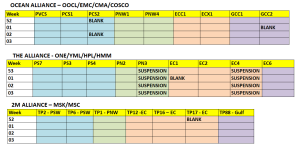
Ocean carriers in THE Alliance will continue to suspend a trans-Pacific West Coast and an Asia-Europe container service as part of its 2024 network plan but will restore two other services to the Pacific Northwest and the US East Coast.

In addition, THE Alliance will expand port coverage to make up for the suspensions and plans to continue using Panama Canal routings for some US services.

Hapag-Lloyd said Wednesday the Pacific South Loop 5 (PS5) from Asia to the US West Coast and the Far East Loop 5 (FE5) will remain out of service into 2024 “until further notice.”

The PS5, which offered 8,500 TEUs in weekly capacity, was cut in mid-2023 as part of a broad slate of changes that ocean carriers made to reckon with lower import demand into North America. The FE5, which used 14,000-TEU ships, was cut in October due to “the present market situation,” Hapag-Lloyd said at the time.

However, THE Alliance will still cover Asian ports served by those suspended services with continuing calls by other services. Those include a Tokyo port call on the PS3 service from the Indian subcontinent and Asia to the US West Coast in lieu of the PS5 service and a Colombo port call on the FE4 service due to the FE5 suspension.

Other Asian port calls added in 2023 will also be kept in place on its trans-Pacific services in 2024, THE Alliance said. Those include South Korea’s Busan on its PS7 service to Southern California.

The Pacific North Loop 3 (PN3), which was suspended in September due to the import demand downturn, will resume next year with an additional call at Vietnam’s Port of Haiphong along with service from China and South Korea. Another Pacific Northwest service, PN2, is dropping port calls to Busan and Taiwan as part of next year’s rotation, according to the schedule update.

The East Coast 4 (EC4) service to the US East Coast via the Suez Canal will also be restored, with the first sailing expected in the second quarter of 2024.

Longer Suez transits

THE Alliance also noted that its two US East Coast services and one Gulf Coast plan to use Panama Canal routings in 2024, unless transit or draft restrictions worsen. The three services have been temporarily rerouted away from the Panama Canal due to its draft and transit restrictions, requiring a five- day longer transit and an additional one or two ships to meet scheduled arrivals.

THE Alliance said it will offer additional calls on Pacific Coast ports with those three services. That includes a call to Mexico’s Port of Manzanillo for the EC2 service to the US Southeast and a call at Panama’s Port of Rodman for the Gulf Coast EC6 service.

THE Alliance will also continue a weekly service from Europe that started in mid-2023 to Canada’s Port of Saint John.

Source:

Angell, M. (2023b, December 13). The Alliance’s 2024 Network adds port calls as services remain suspended. Journal of Commerce. https://www.joc.com/article/alliances-2024-network-adds-port-calls-services-remain-suspended_20231213.html