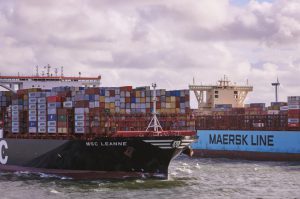
Carriers are facing the ‘quiet before the storm’ for contract rates

A year ago, shippers were desperate to agree annual contract deals with ocean carriers  to secure their supply chains, and were prepared to do, and pay, ‘whatever it took’.

And carriers were holding ‘beauty contests’ to determine the most attractive large-volume BCOs to be included in their exclusive customer portfolios.

But 12 months on, the container liner shipping market has seen an 180-degree turn – world economies are being racked by huge hikes in energy costs, high inflation and spiralling interest rates, causing a pause in discretionary spending by consumers and a sharp downturn in demand.

Since the ‘non-event’ peak season in July and August this year – traditionally when carriers garner the most revenue from pre-holiday season orders – container spot rates from Asia have collapsed, along with demand, as carriers have been obliged to heavily discount their short-term rates.

Moreover, the margin between the weekly decreasing spot rates and the elevated annual contract rates became so great that one by one carriers buckled and granted their core contract customers dispensation to book cargo via their spot platforms.

Meanwhile, despite an aggressive blanking strategy by the shipping lines, including ‘slidings’ and sending vessels on the backhaul from North Europe back to Asia via the longer Cape of Good Hope route, carriers were unable to turn the fall in spot rates back to pre-pandemic levels, or below on some tradelanes.

Nevertheless, there is evidence over the past couple of weeks that the spot rate bottom may have been reached on the key Asia-North Europe and Asia to US west coast routes.

For instance, this week’s Asia-North Europe component of Drewry’s WCI index actually recorded a slight uptick, to $1,706 per 40ft.

And there was another sign this week that the rot had stopped on the route, with The Loadstar’s inbox receiving very few ‘spam’ e-mail quotes from China-based forwarding agents offering “prompt space with all carriers at $1,000 a box”.

And on the transpacific Asia to US west coast route, spot rates also seem to have plateaued, with the week’s Xeneta XSI reading ticking up 1.3%, to $1,529 per 40ft.

By Christmas on the Asia to Europe tradelane, the contract season is normally well under way, but judging by the feedback from some of The Loadstar’s forwarding and NVOCC contacts, there is an understandable reluctance by both shippers and carriers to start negotiations until they see how the market plays out after the Chinese New Year, which commences on 22 January.

Xeneta’s long-term contract market report for December saw its index of crowd-sourced contract rates flat on the month, albeit that few deals were completed.

But Xeneta’s CEO Patrik Berglund believes we are really just seeing “the quiet before the storm”, in terms of contract rate reductions. He said: “The narrative for the beginning of 2023 looks to be very different.

“All indicators point towards considerable rate drops from today’s levels, with several of the major Far East trades pointing towards new long-term contracts that are much closer to the current far lower spot rate benchmarks.”

Source:

Wackett, M. (2022, December 23). Carriers are facing the ‘quiet before the storm’ for contract rates. The Loadstar. Retrieved December 28, 2022, from https://theloadstar.com/carriers-are-facing-the-quiet-before-the-storm-for-contract-rates/
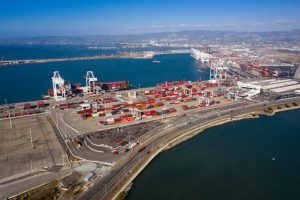

Ocean Network Express acquires terminals in US West Coast

OCEAN NETWORK Express has agreed to acquire a 51% stake in two terminal companies held by its Japanese parents.

Both TraPac LLC and Yusen Terminals LLC—owned by Mitsui OSK Lines and Nippon Yusen Kabushiki Kaisha, respectively—provide container terminal services in Los Angeles, with the YTL also operating in Oakland in the US west coast.

A definite agreement has been signed between the parties, while the deal remains pending regulator’s approval.

The acquisitions are part of the continued efforts by MOL and NYK to integrate their container shipping businesses into ONE.

“The recent disruptions to the supply chain due to the [coronavirus pandemic] have highlighted the importance container terminals play in keeping global trade flowing,” ONE said in a statement.

“The newly acquired container terminals will safeguard ONE’s access to terminal capacity in key and strategic gateways, support its growth ambitions and enhance its service offerings to customers.”

Source: The Lloyds’ List

Air Canada prepares Vancouver hub for 2024 arrival of 777 freighters

MIAMI — Air Canada’s first freighter aircraft are the most visible manifestation of an aggressive push to grow cargo business, but the airline is also building up airport infrastructure to support higher volumes and more profitable specialty products.

Without efficient ground handling capabilities the extra cargo jets won’t deliver the expected service and revenue.

Air Canada is preparing to expand its Vancouver, British Columbia, cargo terminal in preparation for receiving two 777 factory-built freighters from Boeing that will operate on trans-Pacific routes, said Jason Berry, vice president of cargo, during an interview at The International Air Cargo Association’s trade show here last month.

The upgrade is part of a large program to improve cargo hubs across its network.

Air Canada (OTCUS: ACDVF) currently occupies a stand-alone facility that processes shipments moving on passenger aircraft at Vancouver International Airport. A tenant in an adjacent hangar is moving out and Air Canada will begin work in January on connecting and refurbishing the two buildings.

“We’re in the early stages of just determining flow and process and how do you want it to look. It’s a big commitment for us,” Berry said.

In March, Air Canada completed a CA$16 million ($12.5 million) enhancement of its temperature-controlled facility at the main Toronto hub, which now offers 30,000 square feet of cooler space for pharmaceuticals, fresh food, flowers and other perishable items. The project is the first phase of a $75 million, multiyear investment in the Toronto facility, including new technologies designed to improve processing efficiency.

Air Canada also increased handling capacity by 35% at its Frankfurt, Germany, hub last January ahead of inaugural service by its first Boeing 767-300 converted freighter.

Berry said planning for a “massive” remodel of Air Canada’s London Heathrow cargo terminal is underway.

3rd freighter joins fleet

The airline is celebrating the freighter unit’s one year anniversary.

Last week, the airline’s third 767-300 freighter entered service after Israel Aircraft Industries converted the used passenger jet to carry main-deck containers. The inaugural flight arrived in Atlanta and Bogota, Colombia, according to posts by the company and an airport services partner on LinkedIn. The newest cargo jet also enabled Air Canada to launch dedicated service from Toronto to Dallas.

The carrier is scheduled to take delivery of five more converted freighters plus two production freighters from Boeing next year and receive the 777s in 2024, bringing the freighter fleet to a dozen aircraft.

Air Canada was a major cargo airline decades ago but gradually got rid of its freighters to focus on passenger business.

Management made a strategic decision to restart a freighter airline after generating large returns during the COVID crisis with cargo-only flights that replaced passenger service when travel dried up. The company realized that a dedicated freighter division would enhance the network effect of shipments moving around the world on passenger aircraft, and enable the company to capture more business from growth in Canada’s air cargo market and demand for cross-border e-commerce.

Air Canada’s freighters also serve Miami; Quito, Ecuador; and Lima, Peru, three times per week and Halifax, Nova Scotia, six times per week. From Toronto and Halifax, Air Canada flies three times per week to Madrid, twice a week to Frankfurt, and once a week each to Cologne, Germany, and Istanbul.

Berry called the freighters “seasonality busters” that make importers and exports more willing to ship year-round because transportation is more consistent and reliable.

“These global freight forwarding companies and local customers need a rich network. They don’t want you just for one lane. They want to work with airlines that have a network because that’s actually going to get the scale and we can partner the most together,” he said at Air Canada’s exhibit booth.

The freighters maintain capacity that normally fluctuates on key cargo routes as the airline adjusts the number of passenger flights between the busy summer and slower winter seasons.

“As the only combination carrier in North America we will be less subject to seasonality than any of the major carriers in the United States,” the cargo chief said.

Air Canada’s third quarter cargo revenue was 23% lower compared to last year. Berry stressed that most of the decline occurred because most passenger aircraft repurposed for dedicated cargo operations during the pandemic, including seven large aircraft with their seats temporarily removed, returned to full-time passenger duty as travel demand rebounded.

“We were flying 45 passenger freighters a day before the peak and they’re gone. It’s a good story,” Berry said, adding that cargo revenue is expected to increase next year with more cargo jets in the fleet and the passenger network recovering to near pre-pandemic levels next summer.

“We’re actually growing market share massively in Latin America and Europe. You just can’t offset all the Asia capacity that has left us because we were basically flying double daily into Shanghai with a passenger freighter, flying 10 times a week into Hong Kong. Those are all gone because now they’re back flying passengers,” Berry said.

“We can’t wait until Asia turns back on [for travel following COVID restrictions]. That’s a force multiplier for us because we’ll have cargo coming in across both oceans into our hubs to go then to distribute. And then when our 777s come in 14 months, that allows us some of our own capacity into Asia where maybe our passenger size might not be ready to fly” at 2019 levels.

Berry dismissed the possibility that there may not be enough business to go around in Canada for a larger Air Canada Cargo, as well as expansion-minded all-cargo operator Cargojet and fellow passenger carrier WestJet, which plans to begin flying narrow-body freighters in March.

Overlap is minimal because Cargojet mostly flies point to point for other carriers whereas Air Canada operates a global passenger network on six continents in which 30% of freighter traffic connects to passenger flights to reach many different cities, Berry said.

“There’s plenty of room for both because we do very different things. There’s no selling arm on that side. They don’t sell cargo. It’s just the airplane,” he said.

Source: Freightwaves

Ocean carriers plan to blank half their sailings from Asia, post-CNY

Against a background of extremely weak demand forecasts, ocean carriers are preparing to blank around half their advertised sailings from Asia to North Europe and the US after Chinese New Year on 22 January.

High inventory levels in Europe and the US, coupled with uncertainty surrounding future consumer demand, has seen orders cancelled or postponed, resulting in Chinese factories preparing to shut down well ahead of the CNY holiday.

For example, apparel marker Inditex said in its earnings call this week its inventory levels on 31 October were 27% higher year on year, and 15% higher on 8 December. It would not be drawn on its orderbook for next year.

In its latest North America market update, Maersk said this year “more shippers are opting to wait until the holiday period concludes, as stocks shipped earlier in 2022 are already in position to fulfil demand”.

Meanwhile, after several consecutive weeks of double-digit falls, container spot market indices plateaued this week, suggesting the bottom may have been reached.

For example, on the transpacific, the Asia-US west coast component were all virtually unchanged on the week, with Xeneta’s XSI recording an average rate of $1,496 per 40ft. While, for the east coast, Drewry’s WCI edged down just 1%, to $3,952 per 40ft.

Indeed, joining the port of Los Angeles monthly media briefing this week, ONE CEO Jeremy Nixon said he expected short-term rates would remain flat into 2023, and added: “I think we are effectively on the bottom of those spot market rates.”

But he warned of a “big drop” in exports from Asia after the CNY holiday, and a “very soft” February and March.

“Let’s see whether demand starts to push back up around April/May time,” he said.

Elsewhere, on the Asia to North Europe tradelane, the average spot rates recorded by the publishing indices this week ranged from a reading of $2,167 per 40ft by the Freightos Baltic Exchange, down to $1,674 per 40ft by the WCI.

However, reports to The Loadstar indicate that space is becoming tight for sailings to North Europe prior to CNY.

And many annual contract negotiations for the route – traditionally finalised in December or January – appear to have stalled, as neither shippers nor carriers want to commit in the uncertain market conditions.

Spot rates from Asia to Mediterranean ports were also stable this week, with, for instance, the WCI reading unchanged at $2,909 per 40ft.

The transatlantic tradelane remains the outlier, with headhaul North Europe to US east coast short-term rates still at least three times higher than before the pandemic. In fact, this week’s XSI reading for North Europe to the east coast rates even ticked up slightly, to $7,189 per 40ft.

The strength of the US dollar against the euro and sterling, along with the increased focus on sourcing product from Europe instead of China, has enabled the trade to stay robust despite the downturns elsewhere.

Nevertheless, according to Sea-Intelligence, freight rates are about to nosedive on the tradelane, due to a huge 43% year-on year injection of capacity on the route.

“Spot rates on the transatlantic are primed to collapse in the coming months,” said the consultant.

Source: Theloadstar

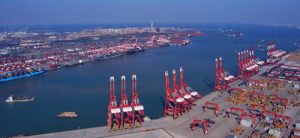
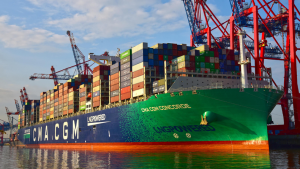
CMA CGM expands onshore power use in Shanghai

CMA CGM has signed a long-term agreement with Shanghai International Port Group to expand the use of onshore power supply to cut emissions.

The approach, dubbed as “cold ironing”, allows ships to shut down auxiliary engines while at berth, hence eliminating emissions — including carbon dioxide, sulphur oxide, particulate matter and nitrogen oxide — and reducing noise pollution.

“From today, all fully-fitted CMA CGM containerships calling at the port of Shanghai will systematically use the onshore power connection,” said the French carrier in a statement on Thursday.

Earlier, the two companies completed a technical trial of the facilities at the Yangshan Deepwater port in Shanghai in late November, which involved a large containership, the 13,982 teu APL Fullerton (IMO: 9632026), among several other vessels.

CMA CGM said its newbuildings and the most recent vessels to enter its fleet were equipped with the technology to use cold ironing. Meanwhile, “an extensive retrofitting programme” is being conducted to extend the facilities to other ships.

The company expects 13 of its vessels to connect to onshore power when calling at the port of Shanghai by the end of this year and a further 50 by mid-2023.

“CMA CGM is steadfastly committed to installing more environmentally responsible solutions on board our vessels, the group supports cold ironing and we will continue to equip our fleet accordingly,” said CMA CGM’s China chief executive Ludovic Renou.

CMA CGM and SIPG have also collaborated on liquefied natural gas bunkering at the port.

In March this year, Hai Gang Wei Lai (IMO: 9886756), a 20,000 cu m LNG bunker barge deployed by the Chinese port operator, fuelled 15,000 teu CMA CGM Symi (IMO: 9867839) via a ship-to-ship transfer.

“We firmly believe that enhanced co-operation between ports and shipping companies will accelerate the journey of decarbonisation,” said SIPG general manager of engineering Wenbin Luo.

Source: The Lloyd’s List

China eases Covid rules at ports

CHINA has relaxed its coronavirus restrictions at ports, including new rules that benefit crew changes, as part of a broader policy U-turn that will see the country co-exist with the virus.

In a newly published guideline for domestic port operations, the transport ministry has removed the mandatory requirement of nucleic acid tests for port workers, except for those on posts exposed to high risk of infection.

The positions include pilots, inspectors or stevedores that need to perform their duties by boarding international trading vessels.

Vessels calling at Chinese ports are no longer required to provide the digital health code and 48-hour virus test results of the crew on board before arrivals.

The new rule is expected to make vessel docking and crew rotation easier in China, according to shipmanagement sources.

China has also opened visa application for seafarers from eastern European countries, allowing them to enter the country and take over newbuildings via a process that involves seven days of quarantine, they said.

“This was not possible a few months ago,” said a Hong Kong-based shipmanager.

However, not all ports have followed Beijing’s order.

One executive from a Hong Kong-based tanker company said crew are still required to test negative before being allowed to enter ports in China.

“Beijing is moving fast,” said the person. “I think it will take some time for all ports to follow suit.”

And the changeover of foreign crew at Chinese ports continues to be a tall order.

Seafarers from some big crew nations, such as the Philippines, are unable to obtain Chinese visa, while the ban on repatriation of foreign crew remains largely in place, said sources.

China is one of the few countries in the world that still impose strict cross-border travel restrictions, including compulsory quarantine in designated hotels, for overseas arrivals.

That said, there are unconfirmed media reports which suggested Beijing was considering a reopening of its border early next year.

The transport ministry has also requested ports and pilot stations to establish contingency plans and reserve duty that can keep port operations normal in the event of an infection flare-up.

Source: The Llyod’s List

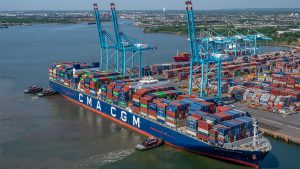
CMA CGM to acquire two terminals in the growing port of New York and New Jersey

CMA CGM has agreed to buy two “flagship” terminals at the port of New York and New Jersey from Global Container Terminals.

The French liner giant will take control of GCT Bayonne and GCT New York, which have a combined capacity of 2m teu per year.

“While Bayonne terminal has the highest level of automation, the fastest truck turn time in the harbor, the closest ocean access, and an ability to service vessels of up to 18,000 teu, New York Terminal benefits from a highly productive labor force in the Port of New York and New Jersey and connects the dense New York hinterland with direct trucking and intermodal access,” the company said.

The group said it had significant development plans for the terminals, including expanding its combined capacity by up to 80%. The increase will serve the company as it seeks to further grow its shipping line calls in the New York area.

The move is part of CMA CGM’s strategy to develop its terminal business and increase its presence in the US, having also bought back Fenix Marine Services’ terminal in the port of Los Angeles in January.

Overall, the group has investments in 52 port terminals in 28 countries through CMA Terminals and its Terminal Link joint venture, including five terminals in the US.

“The acquisition of GCT Bayonne and GCT New York terminals is a strategic investment for the CMA CGM Group. It reinforces the services we provide to U.S. customers and their supply chain efficiency. It further consolidates our positions in the United States, a major market among the fastest-growing worldwide, and will help us continue our development,” said chairman and chief executive Rodolphe Saadé.

The announcement comes as the port of New York and New Jersey is on track for its strongest year on record, having grown 18.5% in 2021 from the previous year, and 9.4% in the year to date. It has taken the lead as the busiest port in the US in the past three months, overcoming both of its west coast competitors at Los Angeles and Long Beach.

A significant chunk of the port’s growth this year is due to cargo diversions from the west coast, where port congestion and a protracted labour dispute have led disruption-wary shippers to send their freight eastwards. It remains to be seen how much of the diverted cargo will remain in the port of New York and New Jersey and other east and gulf coast ports after the labour situation on the west coast is resolved.

After handling record levels of cargo for 26 straight months, the port of New York and New Jersey showed the first signs of slowing down in October amid a broader trend of declining imports to the US. Throughput declined by 0.5% year-on-year, while imports were down 4%, and the vessel backlog at its anchor has shrunk to average between two and three ships. Still, October’s throughput was 18.9% higher than in 2019, and while spot rates on the Shanghai-New York route were down 65% this year, they were up 12% on the New York-Rotterdam route and 17% on the Rotterdam-New York route, according to Drewry.

The acquisitions, announced late Tuesday, are subject to regulatory approvals.

Source: The Lloyd’s List

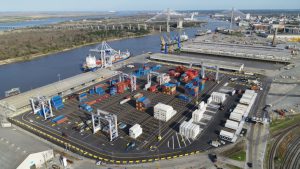
Port of Savannah to increase containership handling capacity

THE board of Georgia Ports Authority has approved a plan to renovate and realign the docks in the port of Savannah’s ocean terminal to better accommodate the port’s growing box volumes.

The terminal handles breakbulk and containers, and the transformation is part of a broader effort to turn it into a container-only operation.

The depot will continue containership and breakbulk operations during construction, said GPA chief operating officer Ed McCarthy.

The docks will be rebuilt to provide an additional 2,800 linear feet of berth space that could handle two 16,000 teu containerships simultaneously, which will be served by new ship-to-shore cranes.

The GPA plans to shift most breakbulk operations to the port of Brunswick, where construction has started on 360,00 sq ft of dockside warehousing, according to executive director Griff Lynch.

“Completion of this project will improve our flexibility and allow Georgia Ports to optimise cargo movement, supporting our customers in delivering goods to market efficiently,” he added.

Overall, the project “will bring expanded gate facilities and paving to allow for 1.5m twenty-foot equivalent units of annual capacity,” according to the statement.

The port of Savannah has grown tremendously over the past two years during the pandemic-induced import boom. It handled almost 20% more cargo in 2021 than in 2020, and has grown an additional 7.2% so far this year compared with the year earlier period. Volumes were further buoyed this year by the labour dispute on the west coast that led many disruption-wary shippers to divert their cargo eastwards.

The port logged its busiest month on record in August, handling 575,513 teu, while October (552,800 teu) and July (530,800 teu) were its second and third busiest months, respectively.

The increase in volumes has created a vessel backlog that hovered over 35 boxships during summer, and while it has come down significantly from those highs, Lloyd’s List Intelligence data shows that there were still 23 ships at anchor as of Monday afternoon, the most of any US port.

Port officials expect that volumes will ease as the year ends, and Mr Lynch said that the opening of a new container berth at the port’s Garden City terminal next summer coupled with the declining volumes will help expedite vessel service.

“While we are beginning to see an anticipated market correction, it is important that GPA move forward with projects like the ocean terminal enhancements to accommodate business growth,” said GPA board chairman Joel Wooten. “Through continued infrastructure improvement, we will ensure the free flow of commerce, and our ability to meet expanding customer demand.”

The GPA board has approved $1.17bn in infrastructure investments over the past year, according to the statement.

Source: The Lloyd’s List

2M split may be on the horizon as tonnage-rich MSC prepares to go it alone

Since August 2020, MSC’s brokers have completed the acquisition of nearly 250 second-hand containerships to usurp 2M partner Maersk as the biggest ocean carrier in capacity terms, suggesting the alliance deal may not be renewed when it expires in April 2024.

According to Alphaliner data, the Geneva-headquartered carrier currently operates 709 vessels, for a capacity of 4.6m teu, compared with Maersk’s 711 ships and 4.3m teu.

However, MSC has a massive orderbook, of 1.75m teu (equivalent to the fleet of fifth-ranked carrier Hapag-Lloyd), while Maersk has just 374,000 teu of capacity on order.

S&P brokers told The Loadstar MSC was by far the “most aggressive” carrier during the peak of the second-hand tonnage boom, with only CMA CGM’s 85 or so acquisitions threatening its monopoly of the buyer’s market.

MSC said its aim was to be less dependent on the charter market for its growth aspirations and, following the vessel acquisitions, its owned tonnage was up to 45% of its fleet – albeit not as high as Maersk’s 60%, or Hapag-Lloyd’s 62%.

Moreover, the range of purchases by the carrier – from ULCVs down to feeder vessels of 2,500 teu and below – supports its strategy of taking control of more of its vessel operations rather than using slot-charter swaps or using commercial feeder operators for hub-and-spoke relays.

Many of MSC’s vessel purchases were made when daily charter hire rates were skyrocketing and owners were trying to lock-in deals at highly elevated rates for minimum two-year periods.

Consequently, the asset values of the ships soared and, although MSC secured second-hand tonnage at the start of its buying spree at bargain rates (before their values caught up with their earnings potential on the charter market), during the peak of the market they were obliged to pay top dollar to secure purchases.

For example, in September last year, MSC paid $68m for the 2005-built 5,042 teu CSL Santa Maria which, according to Vesselsvalue, is now worth just $30m.

And in November 2021, the carrier acquired one of Sea Consortium’s largest ships, the 2014-built 4,896 teu X-Press Jersey for an eyewatering $105m. The feeder specialist had acquired it two years earlier for $27m – and, according to Vesselsvalue, it is now worth $48m.

Nevertheless, the declines all represent paper losses, as MSC is unlikely to sell the ships it acquired during the S&P raids and, furthermore, does not have to answer to public shareholders. But the vast tonnage it acquired during the demand peak will now challenge its vessel management staff as they seek to redeploy surplus tonnage.

Furthermore, the delivery of the vast 1.75m teu of newbuild tonnage over the next few years will surely mean MSC will need to operate on a standalone basis after its 2M agreement with Maersk ends.

Indeed, a carrier contact from another alliance The Loadstar spoke to recently was convinced there would be, as he put it, “another game of musical chairs” among the lines, as the industry returns to a pre-pandemic, unit cost-driven ‘new normal’.

“You are only as good as your last month’s voyage results,” he said, “and VSA partners will all be looking to work with the lines that have less exposure to the downturn,” he added.

Source: Theloadstar

President Biden calls on Congress to intervene as rail dispute threatens US industry

With a rail strike that could cripple industry just 10 days away, US president Joe Biden has called on Congress to legislate to force all the unions involved to agree a deal struck in September.

Agreement had been reached with eight unions on a pay deal brokered by the Presidential Emergency Board, but four other unions held out over claims for 15 days sick pay a year.

Yesterday, President Biden described the September agreement as: “A historic 24% pay raise for rail workers. It provides improved health care benefits, and it provides the ability of operating craft workers to take unscheduled leave for medical needs.”

The president added there was now “no path to resolve this dispute”, and called on Congress to act to avert major supply chain disruption.

The president said the disruption from a rail strike could see 750,000 people out of work within two weeks and many industries, starved of vital supplies, forced to shut down. Farmers would not be able to feed their animals and key chemicals for purifying water would be caught up.

In asking Congress to prevent the dispute from escalating, Mr Biden said he was acting to protect industry and the jobs of millions of other trade union members across America.

However, the president added that he shared the concerns over sick pay raised by the unions.

“No one should have to choose between their job and their health – or the health of their children. I have pressed for legislation and proposals to advance the cause of paid leave in my two years in office, and will continue to do so. Every other developed country in the world has such protection for its workers.”

But Mr Biden also pointed to a “critical moment for our economy” and the upcoming holiday season, and argued that “we cannot let our strongly held conviction for better outcomes for workers deny them the benefits of the bargain they reached”.

Source: Theloadstar